JLPT vs JFT for Visa Applications: Which Test Is Better for You?
Choosing between the Japanese-Language Proficiency Test (JLPT) and the Japan Foundation Test for Basic Japanese (JFT-Basic) is one of the most critical early steps when planning your move to Japan. Both exams assess your ability to communicate in Japanese, but they serve vastly different immigration, academic, and professional purposes.
Selecting the wrong test can cost you months in visa processing delays or restrict your eligibility for long-term residency. Understanding how these tests align with your immediate timeline and overall goals in Japan is essential.
Understanding the Two Examinations
What Is the JLPT?
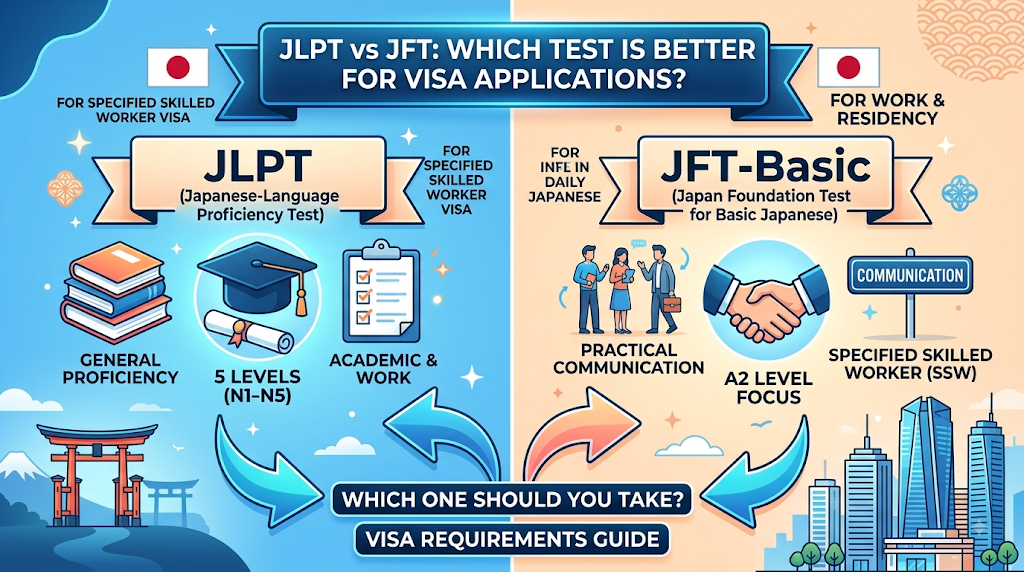
The JLPT is the traditional gold standard for evaluating Japanese language proficiency globally. Administered jointly by the Japan Foundation and Japan Educational Exchanges and Services (JEES), the exam is divided into five tiered levels: N5 (beginner) to N1 (advanced).
- Test Format: Paper-based multiple-choice exam (pencil and bubble sheet).
- Schedule: Conducted only twice a year—on the first Sunday of July and December.
- Result Turnaround: Approximately 2 months post-exam.
- Official Site: You can verify testing schedules and test site locations on the Official JLPT Website.
What Is the JFT-Basic?
The JFT-Basic was created specifically to support the Specified Skilled Worker (SSW / Tokutei Ginou) visa program introduced by the Japanese government. Rather than offering multiple levels, the JFT-Basic evaluates whether a candidate meets the CEFR A2 level (roughly equivalent to JLPT N4), which is required to navigate everyday life and work in Japan without severe language barriers.
- Test Format: Computer-Based Testing (CBT) at authorized Prometric test centers.
- Schedule: Held multiple times per month in Japan and participating countries.
- Result Turnaround: Immediate unofficial score report on screen; official certificate available within a few days.
- Official Site: Learn more about test structure and Prometric registration on the Japan Foundation’s Official JFT-Basic Portal.
JLPT vs JFT: Side-by-Side Comparison
| Feature | JLPT (Japanese-Language Proficiency Test) | JFT-Basic (Japan Foundation Test) |
| Primary Target Audience | Students, corporate workers, academics, general learners | Skilled workers applying for SSW visas |
| Proficiency Levels | 5 Levels (N5, N4, N3, N2, N1) | Single Level (CEFR A2 / N4 level equivalent) |
| Testing Format | Paper & Pencil (Bubble Sheet) | Computer-Based Testing (CBT) with headphones |
| Testing Frequency | 2 times per year (July & December) | Multiple times per month (Year-round) |
| Results Availability | ~2 months after testing | On-screen immediately; official in 2–5 days |
| Visa Applicability | SSW, Work Visas, HSP Visa Points, PR applications | Specified Skilled Worker (SSW 1) only |
| Global Availability | Over 90 countries worldwide | Japan & selected Asian/SSW-sending nations |
Visa Breakdown: Which Test Qualifies for Which Visa?
The decision between JLPT vs JFT for visa eligibility comes down to the specific Status of Residence you are pursuing. The regulations set by the Japan Immigration Services Agency dictate which language qualifications are accepted.
Visa Goal Matrix
│
├── Specified Skilled Worker (SSW 1) ──► Fast Option: JFT-Basic  OR  Traditional: JLPT N4
├── Specialist in Humanities / Work Visa ──► JLPT N2 / N1 (JFT-Basic NOT accepted)
├── Highly Skilled Professional (HSP) ────► JLPT N2 (10 pts) / N1 (15 pts)
└── Permanent Residence (Fast-Track) ─────► JLPT N2 / N1
1. Specified Skilled Worker (SSW / Tokutei Ginou)
If you are applying for an SSW 1 visa in sectors like nursing care, food service, agriculture, construction, or manufacturing, both JLPT N4 (or higher) and JFT-Basic are equally accepted.
- The Advantage of JFT-Basic here: Because the JFT-Basic is offered frequently via computer testing, you do not have to wait 6 months for the next JLPT testing window. If you pass, your documentation can be submitted to immigration almost immediately.
2. Standard Work Visas (Engineer, Specialist in Humanities, International Services)
For standard corporate employment in Japan, companies sponsor work visas under professional categories. Read our breakdown on Japanese Visa Language Requirements: Do You Really Need JLPT? to see how immigration policy interacts with employer demands.
- JFT-Basic: Not accepted. The JFT-Basic does not prove advanced professional language capability.
- JLPT: Industry standard. While Japanese law does not strictly mandate a JLPT certificate for every work visa application, employers rarely issue job offers or visa sponsorship without an N2 or N1 certificate. See details on how JLPT Required for Japanese Work Visa (Explained Clearly) impacts corporate sponsorship.
3. Highly Skilled Professional (HSP) Visa
Japan’s HSP point-based visa system grants accelerated residency perks, priority processing, and permanent residency eligibility in as little as 1 to 3 years.
- JFT-Basic: Yields 0 immigration points.
- JLPT: Yields substantial immigration points (JLPT N1 awards 15 points; JLPT N2 awards 10 points). Learn how to maximize your application with our guide on How JLPT Points Work for Japanese Immigration.
4. Permanent Residence (PR) Applications
Applying for permanent residence through the standard 10-year residency track or expedited 1-to-3-year tracks heavily favors proven language fluency. Check out our comprehensive guide on JLPT for Permanent Residence in Japan: Full Guide to understand how N2 and N1 certificates strengthen your dossier during legal review.
Choosing the Right Test for Your Situation
                         Are you applying for the
                       Specified Skilled Worker (SSW)
                                  Visa?
                                /       \
                               /         \
                             YES          NO
                             /             \
                            /               \
         Do you need test results            Choose the
          in less than 60 days?               JLPT
                /         \                 (N3 to N1)
               /           \
             YES            NO
             /               \
     Take JFT-Basic      Either JFT-Basic
     (Fastest Route)       or JLPT N4
Choose JFT-Basic If:
- You need a visa immediately for SSW 1: You have a job offer lined up in an SSW industry and cannot wait until July or December for the next JLPT exam.
- You prefer Computer-Based Testing: CBT allows you to hear audio clearly through personal headphones and interact with dynamic test elements on a computer monitor.
- You struggle with complex Kanji writing: JFT-Basic focuses primarily on communicative competence and practical reading rather than high-level academic Kanji character recognition.
Choose JLPT If:
- You aim for long-term career growth in Japan: Corporate jobs, white-collar management, engineering positions, and translation roles strictly require JLPT N2 or N1.
- You want to earn Point-Based Visa Bonuses: You plan to utilize the Highly Skilled Professional visa track or fast-track Permanent Residence.
- You live outside Asia: JFT-Basic test centers are currently concentrated in Japan and select Southeast/South Asian countries, whereas JLPT test sites operate globally.
Strategic Preparation Tips
Preparing for JFT-Basic (CBT Format)
- Master CEFR A2 Can-Do Statements: Practice real-life scenarios—reading train schedules, understanding workplace safety signs, and ordering food.
- Get Comfortable with Screen Reading: Practice reading Japanese text on a computer monitor without relying on physical highlighters or paper notes.
- Use Official Sample Questions: Utilize the interactive online sample questions provided by the Japan Foundation to get accustomed to the Prometric testing interface.
Preparing for JLPT (Paper Format)
- Build Bubble-Sheet Speed: Practice filling out bubble sheets accurately while keeping pace with strict section timers.
- Focus on Cumulative Kanji Knowledge: JLPT places heavy weight on formal grammar patterns, reading comprehension of dense paragraphs, and precise vocabulary.
- Pacing in Listening: On the paper JLPT listening section, audio plays once without pauses for deliberation. Train yourself to mark answers instantly on the sheet while listening.
Frequently Asked Questions
Do JLPT or JFT-Basic Certificates Expire?
Neither the JLPT nor the JFT-Basic certificate officially expires. However, individual immigration offices or employers may request a certificate issued within the last 2 to 5 years to verify that your current language capability matches your test record.
Can I converted my JFT-Basic score into a JLPT N4 certificate?
No. Although both tests assess a similar level of practical language capability (CEFR A2), they are distinct examinations managed under different administrative frameworks. You cannot convert or exchange scores between them.
Can I take both tests?
Yes. Many candidates take the JFT-Basic to obtain their initial SSW visa quickly, and then take the JLPT N3, N2, or N1 while living in Japan to transition into standard corporate visas or advance their careers.
Selecting between the JLPT vs JFT for visa applications comes down to speed versus scope. If your goal is entering Japan rapidly under the Specified Skilled Worker framework, the JFT-Basic provides the fastest, most flexible pathway. If your target is corporate employment, higher earnings, or long-term immigration privileges, investing your time into passing the JLPT (N2 or N1) remains the undisputed strategy.