The Japanese Government (MEXT) Scholarship is among the most prestigious fully funded awards in international higher education. Every year, thousands of students worldwide compete for full tuition coverage, return airfare, and a generous monthly living stipend.
As a Japanese language educator and academic advisor who has guided dozens of scholars through the MEXT pipeline, the single most common question I encounter is: “Is the JLPT mandatory for the MEXT Scholarship?”
The short answer is no—but the complete, strategic answer is nuanced. While MEXT guidelines rarely list a formal Japanese Language Proficiency Test (JLPT) certificate as an absolute prerequisite for every category, having one fundamentally shifts your competitiveness during the screening process.
Is JLPT Mandatory for the MEXT Scholarship?
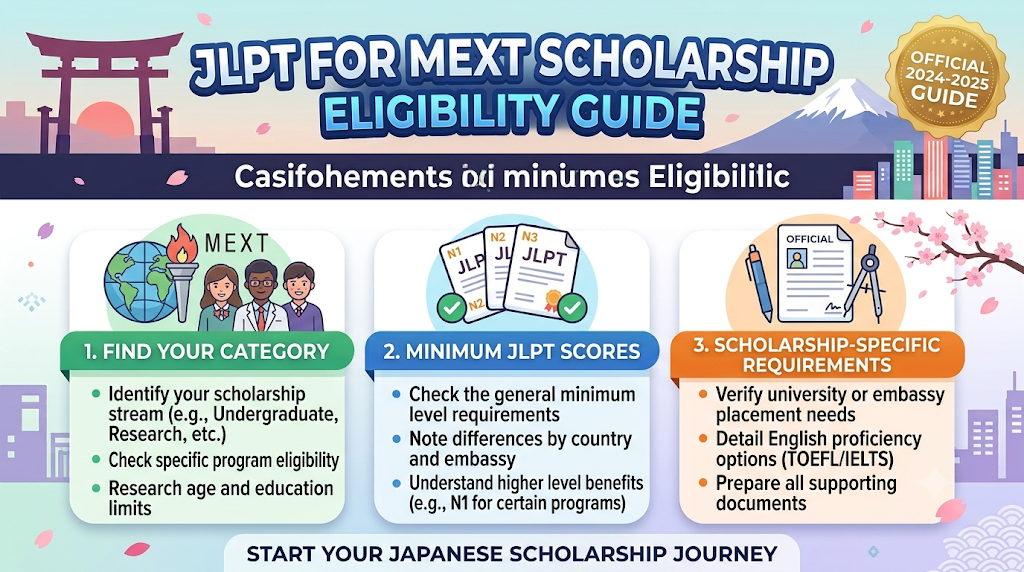
Official MEXT guidelines state that applicants must be willing to learn Japanese and adapt to life in Japan. However, whether a JLPT certificate is required depends entirely on your scholarship category, your chosen medium of instruction (English vs. Japanese), and your application track (Embassy vs. University Recommendation).
                      ┌──────────────────────────────────────┐
                      │    MEXT SCHOLARSHIP APPLICATION     │
                      └──────────────────┬───────────────────┘
                                         │
                 ┌───────────────────────┴───────────────────────┐
                 ▼                                               ▼
   ┌───────────────────────────┐                   ┌───────────────────────────┐
   │  EMBASSY RECOMMENDATION   │                   │ UNIVERSITY RECOMMENDATION │
   └─────────────┬─────────────┘                   └─────────────┬─────────────┘
                 │                                               │
        ┌────────┴────────┐                             ┌────────┴────────┐
        ▼                 ▼                             ▼                 ▼
   Japanese Track    English Track               Japanese Track    English Track
  (JLPT Critical)   (JLPT Optional               (JLPT N2/N1       (JLPT Optional
                     but Advantage)                Mandatory)       but Advantage)
1. Embassy Recommendation Route
Through the Embassy track, you apply via the Japanese Embassy or Consulate General in your home country.
- Official Prerequisite: JLPT is generally not mandatory to apply.
- The Reality: Every applicant in the Embassy route must sit for a standardized Japanese written examination during the first screening—regardless of their field of study or intended language of instruction. While you don’t need a physical JLPT certificate to apply, your performance on this test directly impacts your ranking.
2. University Recommendation Route
Through this track, a Japanese university directly recommends prospective international graduate students to MEXT.
- Official Prerequisite: Language criteria are set directly by the host university.
- The Reality: If you apply for a degree program taught in Japanese, universities almost always mandate a formal JLPT N2 or N1 certificate at the time of application. For English-medium degree programs, the JLPT is usually optional, though submitting an N3 or higher can break ties between candidates.
MEXT Scholarship Categories & JLPT Expectations
MEXT offers several distinct scholarship programs. Language expectations vary drastically depending on the program level and structure:
| MEXT Category | Targeted Degree | Official JLPT Mandatory? | Practical Level for Selection | Preparatory Language Year Included? |
| Undergraduate (Gakubu) | Bachelor’s Degree | No (Embassy exam required) | N3–N2 | Yes (1 Year) |
| Research / Graduate | Master’s / PhD | No (for English tracks); Yes for Japanese tracks | N2–N1 (Humanities) N5–N3 (STEM) | Yes (6 Months, if needed) |
| College of Technology (Kosen) | Associate / Engineering | No (Embassy exam required) | N4–N3 | Yes (1 Year) |
| Specialized Training (Senshu) | Vocational Certificate | No (Embassy exam required) | N3–N2 | Yes (1 Year) |
| Japanese Studies Students | Non-degree Exchange | Yes (Usually N2 or higher) | N2–N1 | No (Direct Study) |
If you want to understand where your current skills fit within the broader study-in-Japan landscape, review our detailed guide on the JLPT Level Needed to Study in Japan (N5–N1 Explained) to gauge how specific scores map to academic readiness.
Decoding MEXT Requirements Across Fields
1. Undergraduate Students (Gakubu)
Undergraduate grantees undergo one full year of intensive Japanese language and academic preparation at designated institutions like the Tokyo University of Foreign Studies (TUFS) or Osaka University before matriculating into their 4-year degree programs.
Because MEXT builds a 1-year language buffer into this track, beginners are technically eligible. However, because thousands of students compete for a handful of spots per country, applicants who demonstrate prior Japanese study (N4–N3 or higher) score significantly better on the written exam, making them far more likely to survive the first embassy screening.
2. Research & Graduate Students (Master’s / PhD)
Graduate candidates fall into two primary academic camps:
- Humanities, Law, Social Sciences, & Business: A strong Japanese foundation (JLPT N2 or N1) is virtually essential. University professors in these disciplines expect scholars to read Japanese academic literature and primary source materials.
- STEM (Science, Technology, Engineering, & Mathematics): Many STEM laboratories operate in English. Professors prioritize your research proposal, methodology, and technical publications over language fluency. However, having an N4 or N3 certification reassures host professors that you can navigate daily life independently in Japan.
For additional university-level criteria and admissions benchmarks, consult our overview on JLPT Required for Japanese University Admission.
How MEXT Evaluates Japanese Language Ability
A common source of confusion for MEXT candidates is the distinction between official JLPT certification and MEXT’s internal evaluation methods.
                           ┌───────────────────────────┐
                           │ MEXT LANGUAGE EVALUATION  │
                           └─────────────┬─────────────┘
                                         │
                ┌────────────────────────┴────────────────────────┐
                ▼                                                 ▼
  ┌───────────────────────────┐                     ┌───────────────────────────┐
  │   EMBASSY WRITTEN EXAM    │                     │   OFFICIAL JLPT PROFILE   │
  └─────────────┬─────────────┘                     └─────────────┬─────────────┘
                │                                                 │
  • Mandatory for ALL Embassy applicants            • Administered by Japan Foundation/JEES
  • Paper exam (3 levels: A, B, C)                  • Certificates never expire
  • Tests grammar, reading & vocabulary             • Evaluates reading & listening skills
  • Used for national embassy ranking               • Universally recognized by universities
The Embassy Written Japanese Exam
During the Embassy first screening, all candidates sit for a paper-based Japanese exam divided into three difficulty sections:
- Elementary (A): Equivalent to JLPT N5–N4 level grammar, basic vocabulary, and simple reading passages.
- Intermediate (B): Equivalent to JLPT N3–N2 level structures, kanji compound knowledge, and contextual reading.
- Advanced (C): Equivalent to JLPT N1 level nuances, complex syntax, and formal written discourse.
You receive a composite score across all three sections. Even if you apply for a purely English-taught Master’s program in engineering, scoring well on the Japanese exam demonstrates high adaptability, boosting your composite selection rank.
For comprehensive guidelines on official test structures, schedules, and test centers, you can consult the Official JLPT Website.
Strategic Advantages of Holding a JLPT Certificate Before Applying
Even when not legally required, submitting a official JLPT score report provides significant strategic advantages during the evaluation process:
                          ┌──────────────────────────────┐
                          │   JLPT CERTIFICATE IN HAND   │
                          └──────────────┬───────────────┘
                                         │
        ┌────────────────────────────────┼────────────────────────────────┐
        ▼                                ▼                                ▼
┌──────────────┐                 ┌──────────────┐                 ┌──────────────┐
│  Professors  │                 │    Screening │                 │    Direct    │
│  Confidence  │                 │   Advantage  │                 │  Placement   │
└───────┬──────┘                 └───────┬──────┘                 └───────┬──────┘
        │                                │                                │
  Demonstrates research            Breaks ties against             Bypasses mandatory
  independence in labs             equally-qualified applicants    preparatory language year
1. Securing the Letter of Provisional Acceptance
If you pass the Embassy first screening as a graduate applicant, you must independently contact Japanese universities to request a Letter of Provisional Acceptance.
Prominent professors at top institutions (like Tokyo University, Kyoto University, or Waseda) receive dozens of inquiry emails every week. Attaching an official JLPT N2 or N1 certificate to your preliminary email immediately signals that you are an independent researcher who will not require continuous translation assistance in the lab or seminar group.
2. Qualify for “Direct Placement”
High-achieving undergraduate applicants holding a JLPT N2 or N1 certificate may qualify for Direct Placement. This allows you to skip the initial 1-year preparatory Japanese language program and enter your undergraduate university course immediately upon arriving in Japan, saving a full academic year.
3. Comprehensive Visa & Financial Peace of Mind
Demonstrating recognized language proficiency simplifies your administrative processing with immigration authorities upon arrival. Learn more about immigration baselines in our guide on Student Visa Language Requirements for Japan.
What If You Have No JLPT Certificate? (Alternative Action Plan)
If MEXT scholarship deadlines are approaching and you do not hold an official JLPT score, do not panic. You can build a competitive application profile without one:
- Self-Study Portfolio: Explicitly document your language learning journey in your application essay. Mention current study hours, textbooks used (e.g., Genki, Minna no Nihongo, Shin Kanzen Master), and planned test dates.
- Institutional Proof of Language Study: Request an official transcript or letter from your university’s modern languages department or a certified local language institute stating the total hours of Japanese instruction completed.
- Maximize Your English Track Metrics: If applying to an English-degree track, focus on achieving top-tier scores in standardized tests (TOEFL iBT/IELTS, GRE, or GMAT). High academic metrics balance out an unverified Japanese profile.
- Target Secondary Funding Options: Explore alternative government and private grants by reviewing our list of Scholarships in Japan That Accept JLPT Scores.
For an exhaustive breakdown of official government eligibility updates and embassy application windows, check the Study in Japan MEXT Scholarship Portal.
Expert Recommendations for Preparing the JLPT Alongside MEXT
Balancing JLPT preparation with MEXT application requirements (research plans, transcripts, recommendation letters) requires a clear schedule:
- 12 Months Before Application: Determine your primary track (Embassy vs. University). Take an official diagnostic test or past paper to benchmark your JLPT level.
- 8 Months Before Application: Register for the July or December JLPT test session. Focus on core grammar patterns and high-frequency kanji compounds.
- 4 Months Before Application: Practice timed reading comprehension passages and past MEXT Embassy exam papers. Work closely with academic referees for strong recommendation letters.
- Application Month: Submit your complete application package. Highlight your active language targets prominently in your MEXT Study Plan / Field of Study document.