
Japanese Student Visa Language Level: What Immigration & Schools Really Expect
If you are planning to study in Japan, figuring out visa requirements can quickly feel overwhelming. Between conflicting forum posts, outdated advice, and shifting immigration policies, one question always comes up first: What Japanese language level do I actually need to get my student visa approved?
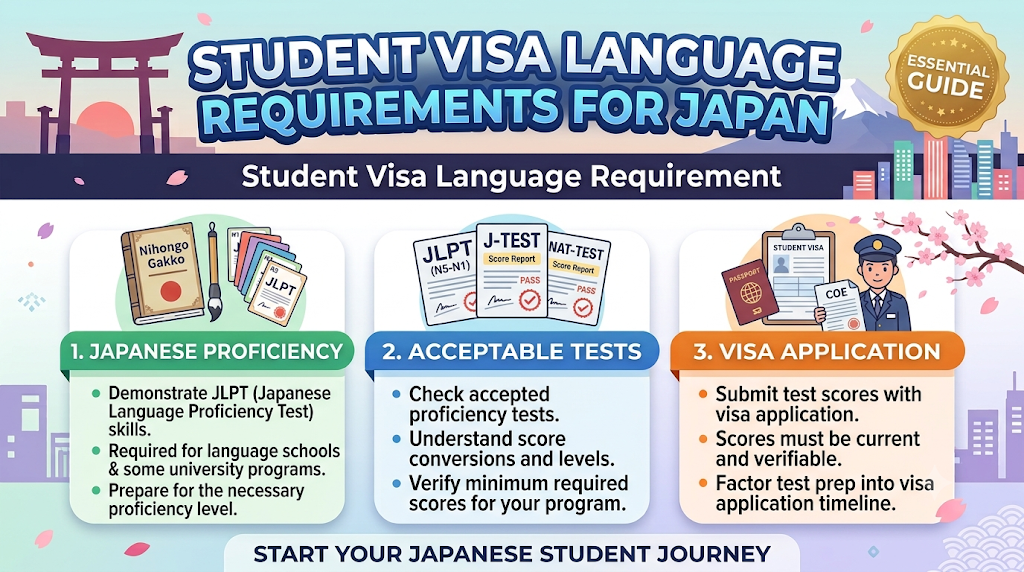
As a Japanese language instructor and JLPT specialist who has guided hundreds of international students through the visa pipeline, I hear this constantly. Many applicants assume they can fly into Tokyo as complete beginners without knowing a word of Japanese. Others panic, believing they must pass advanced exams before setting foot on a plane.
The truth sits right in the middle—and immigration screening standards have evolved significantly.
Whether you plan to attend a Japanese language school, enroll directly in an undergraduate program, or pursue technical training, understanding the required Japanese student visa language level is critical to securing your Certificate of Eligibility (CoE) without unnecessary delays or rejections.
The Reality of Japanese Student Visa Language Level Requirements
When applying for a Japanese student visa, you are dealing with two separate gatekeepers:
- The School’s Admission Office: Determines whether you meet their academic and linguistic entry standards.
- The Immigration Services Agency of Japan (ISA): Evaluates your visa application (CoE) to confirm you are a legitimate student with realistic preparation.
Even if a language school accepts a beginner, the Immigration Services Agency of Japan requires concrete evidence that you possess a baseline commitment to learning the language.
The exact Japanese student visa language level depends directly on your intended path in Japan.
| Destination / Goal | Minimum Required Level | Preferred / Recommended Level | Common Proof Accepted |
| Japanese Language School | JLPT N5 / 150 Study Hours | JLPT N5 or N4 Certificate | JLPT, NAT-TEST, J-TEST, 150-hour Certificate + Interview |
| Vocational School (Senmon Gakko) | JLPT N2 or EJU Japanese (200+ pts) | JLPT N2 or higher | JLPT N2, EJU, or 6 months at a certified language school |
| University (Japanese-Taught) | JLPT N2 / EJU Japanese | JLPT N1 | JLPT N2/N1, EJU Japanese Test |
| University (English-Taught) | Beginner / No Formal Requirement | JLPT N5 or N4 | English Proficiency (TOEFL/IELTS) + basic prep |
| Graduate School | JLPT N2 (Humanities) / N3 (STEM) | JLPT N1 | JLPT N1/N2, Professor Interview, Research Proposal |
1. Japanese Language Schools: The N5 / 150-Hour Standard
If your goal is to study at a Japanese language institute, your entry bar is designed to be accessible, but it is not zero.
The Baseline Standard
Historically, immigration authorities required applicants to prove at least 150 hours of Japanese language study at an accredited institution or hold an official certificate equivalent to JLPT N5.
JLPT N5 represents basic Japanese competency. At this level, you should be able to:
- Read and write all Hiragana and Katakana characters.
- Recognize approximately 100 basic Kanji (e.g., 日, 本, 人, 学, 生).
- Understand essential everyday phrases, simple classroom instructions, and basic sentence structures in polite forms (desu / masu).
Recent Changes to the 150-Hour Rule
Historically, a stamped letter from a local tutor or an unverified online course confirming “150 hours of study” was sufficient for visa approval.
However, immigration screening policies have tightened. Authorities now scrutinize unverified study letters, particularly for applicants from countries with high visa rejection rates. Today, immigration officials increasingly expect:
- An official test certificate (such as JLPT N5, NAT-TEST 5-Q, or J-TEST F-level).
- A verified certificate from a recognized language school accompanied by a structured transcript and attendance logs.
- A recorded pre-screening interview conducted directly by the Japanese language school to confirm beginner conversational ability.
Expert Insight: If you rely solely on a 150-hour study certificate without taking an official exam like the JLPT or NAT-TEST, ensure your issuing school provides an itemized curriculum, attendance records, and verifiable contact credentials. Missing verification is one of the most common reasons for CoE processing queries.
To understand how individual proficiency tiers affect your academic strategy once you land in Tokyo, read our breakdown on the JLPT Level Needed to Study in Japan (N5–N1 Explained).
2. Direct University Admission: The N2 and N1 Benchmark
Skipping language school to enroll directly in an undergraduate or graduate degree taught in Japanese requires a significantly higher Japanese student visa language level.
In Japanese higher education, lectures, textbooks, group research, and examinations occur entirely in native-level Japanese. Consequently, universities require advanced comprehension before endorsing your visa application.
JLPT N5/N4 ──> Daily Survival Japanese (Language School Entry)
JLPT N3    ──> Intermediate Conversational / Bridge Level
JLPT N2    ──> University Lectures / Academic Seminars (Minimum Admission Standard)
JLPT N1    ──> Full Academic Fluency / Technical Research & Thesis Defense
Why N2 is the Standard Gold Threshold
JLPT N2 proves you can read articles, comprehend nuanced commentary, and follow spoken conversations at near-normal speed in structured environments. Most Japanese universities set JLPT N2 as their absolute baseline for international applicants.
To explore how higher education institutions evaluate these requirements alongside entrance exams, review our guide on JLPT Required for Japanese University Admission.
3. English-Taught Programs: Do You Still Need Japanese for a Visa?
Japan has expanded its English-medium degree programs across major institutions (such as Waseda, Sophia, Kyoto University, and the University of Tokyo).
Visa Rules for English Programs
If you are accepted into a degree program conducted entirely in English, immigration does not require formal Japanese test scores to grant a student visa. Your primary language proof will be an English proficiency test such as TOEFL or IELTS.
The Hidden Trap
While immigration might approve your visa without Japanese certification, navigating life in Japan without basic language skills presents major practical hurdles:
- Off-Campus Paperwork: Opening a Japanese bank account, registering at the local Ward Office (Kuyakusho), and signing a apartment lease require basic Japanese communication.
- Part-Time Work (Arubaito): A student visa permits you to work up to 28 hours per week, but finding employment without at least N4-level Japanese is challenging outside of basic dishwashing or factory sorting.
- Scholarship Opportunities: Many merit-based financial aid programs favor candidates with documented Japanese ability. Check out our comprehensive guide on Scholarships in Japan That Accept JLPT Scores to see how language proficiency impacts financial aid options.
Recognizing Alternative Japanese Proficiency Exams for Visas
While the Japanese-Language Proficiency Test (JLPT) is the global gold standard, it presents a practical problem: it is administered only twice a year (July and December) in most countries.
If your visa application deadline does not align with the JLPT schedule, Japanese immigration authorities accept several official alternative examinations to verify your Japanese student visa language level:
- NAT-TEST: Mirrored directly after the JLPT format (Levels 5 through 1). It is held up to six times a year, making it an excellent option for urgent visa deadlines.
- J-TEST (Test of Practical Japanese): Focuses heavily on practical business and daily communication skills. Scoring Level F or higher satisfies beginner visa criteria.
- BJT (Business Japanese Proficiency Test): Commonly used for adult learners, vocational applicants, or those transitioning into employment.
For full exam details, test schedules, and registration deadlines, visit the Official JLPT Website.
How to Prove Your Language Level to Immigration (Step-by-Step)
When your Japanese school or university submits your Certificate of Eligibility (CoE) packet to the Immigration Services Agency, you must include verifiable proof of language proficiency.
Document Checklist for Language Proof
[ ] Original Test Certificate (JLPT, NAT-TEST, or J-TEST)
    OR
[ ] Official 150-Hour Certificate of Completion (with detailed course syllabus)
[ ] Official Academic Transcript showing hours attended and grades earned
[ ] Letter of Recommendation from your Japanese Language Instructor
[ ] Summary Statement of Purpose explaining your study goals in Japan
For students targeting government-funded routes where language benchmarks are evaluated strictly during pre-screening, refer to our detailed resource on JLPT for MEXT Scholarship: Eligibility Guide.
Practical Tips to Guarantee Visa Approval
As an instructor who has assisted numerous students through CoE screening, here is my top practical advice for meeting the required Japanese student visa language level smoothly:
- Do Not Rely Solely on Self-Study Apps: Duolingo or casual flashcard apps do not generate verifiable documentation for immigration authorities. Combine self-study with structured courses that issue official completion certificates.
- Aim for Official Certification: Passing an official exam like JLPT N5 or NAT-TEST Level 5 provides unambiguous proof of your abilities, significantly reducing the likelihood of immigration requesting extra documentation.
- Align Your Statement of Purpose: Your visa essay (Riyuusho) should explain why you want to study in Japan and how your current language preparation aligns with your future academic or career aspirations.
- Prepare for the School Interview: Many institutions now conduct brief video interviews to verify that your real-world listening and speaking skills match the documents submitted in your application.
To understand how language preparation integrates into broader academic planning, university selection, and admission schedules, consult our master guide: Study in Japan with JLPT: Universities, Admission & Requirements.
Frequently Asked Questions
Can I get a Japan student visa with zero Japanese knowledge?
While some language schools accept absolute beginners, immigration guidelines strongly prefer proof of at least 150 hours of study or a beginner certification like JLPT N5. Arriving with no Japanese knowledge increases your risk of visa processing delays.
Is JLPT N5 enough for a student visa?
Yes. JLPT N5 meets the baseline requirement for entering a Japanese language school on a student visa. However, enrolling directly in a Japanese university requires JLPT N2 or N1.
What if I fail the JLPT right before my visa application deadline?
If you miss the JLPT or do not pass, register for the NAT-TEST or J-TEST. These alternative exams are held more frequently throughout the year and are fully recognized by Japanese immigration authorities