AI Tools to Learn Japanese Faster in 2026: The Ultimate Master Guide
Learning Japanese has long been considered one of the most challenging undertakings for native English speakers. With three distinct writing systems ($hiragana$, $katakana$, and $kanji$), nuanced levels of politeness ($keigo$), and a sentence structure that completely flips western grammar on its head, the journey requires hundreds of hours of deliberate practice.
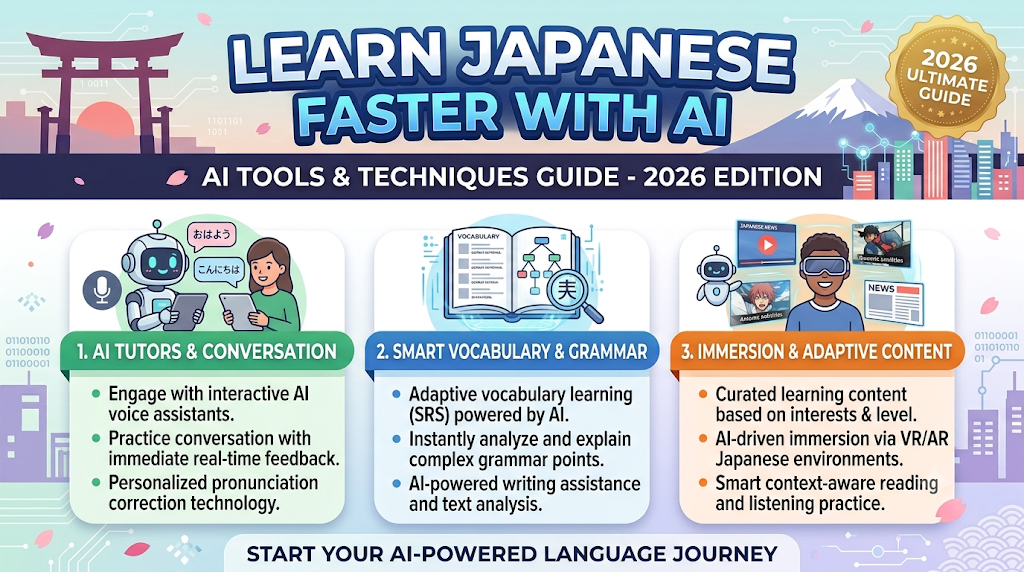
However, the technology landscape has shifted dramatically. Generative AI, natural language processing, and advanced audio-synthesis models have made high-speed Japanese learning more accessible than ever. Integrating smart tools directly into your daily immersion workflow allows you to analyze complex native content, generate instant reading guides, and practice natural conversation whenever you choose.
Whether you are studying for your first exam or pushing past intermediate plateaus toward fluency, this guide details how to leverage modern AI tools to master Japanese efficiently in 2026.
The 2026 Shift: How AI Transforms Japanese Language Learning
Traditional language learning relied heavily on static textbooks, pre-recorded audio files, and rigid flashcard decks. While foundational resources remain invaluable, AI brings three distinct advantages to the table:
- Contextual Flexibility: Instead of relying solely on generic sample sentences, AI tools dynamically generate contextual examples tailored to your specific interests (such as gaming, cooking, or business).
- Instant Grammar Dissection: Complex Japanese sentences often contain multiple layered grammar points stacked at the end of a clause. AI can break down a 30-character clause into its component particles, auxiliary verbs, and nuance levels in milliseconds.
- Zero-Anxiety Speaking Output: Practicing spoken Japanese with native speakers can feel intimidating for beginners. AI conversational agents offer a safe environment to practice output, experiment with complex structures, and receive immediate corrections without pressure.
Essential AI Tool Categories & Top Recommendations
To build an efficient learning ecosystem, you do not need dozens of apps. A streamlined stack of high-efficacy tools targeting specific skills yields the best results.
1. Large Language Models (LLMs) for Deep Analysis
Generative AI models serve as 24/7 personal tutors. They excel at explaining nuanced grammar distinctions, such as the functional difference between particles は (wa) and が (ga), or when to use 〜てしまう (-teshimau) versus 〜ておく (-teoku).
- Primary Application: Grammar explanations, custom sentence generation, reading material simplification, and prompt-driven conversation practice.
- Expert Tip: Always instruct the AI model to include $furigana$ (phonetic readings) above $kanji$ or specify your current proficiency level (e.g., JLPT N4 or N3) to keep outputs accessible.
For practical setups and custom prompt workflows, read our detailed guide on Using ChatGPT to Learn Japanese (Best Prompts).
2. Intelligent Flashcards & Spaced Repetition (SRS)
Memorizing $kanji$ and compound vocabulary requires consistent review. AI-enhanced Spaced Repetition Systems analyze your retention speed and automatically adjust review intervals so you spend time only on terms you are likely to forget.
- Primary Application: $Kanji$ retention, vocabulary building, and sentence-mining from native content.
- Recommended Tooling: Platforms like AnkiWeb utilize customized plugins that leverage AI search APIs to automatically pull readings, pitch accents, and definitions directly into your cards.
3. Smart Translation & Context Engines
Traditional mechanical dictionary tools often fail to capture the subtle nuances of polite speech ($teineigo$) versus humble speech ($kenjougo$). Modern neural translators handle Japanese contextual cues with significantly higher accuracy.
- Primary Application: Translating full passages, parsing colloquial expressions, and comparing formal versus informal variants.
- Recommended Tooling: Tools such as DeepL provide deep contextual translation accuracy, helping learners identify how conversational Japanese shifts based on social relationships and settings.
4. Interactive Grammar & Writing Assistant Tools
Writing natural Japanese requires correct particle placement and appropriate verb conjugations. Specialized AI feedback tools point out subtle awkwardness that basic spell-checkers miss.
To explore dedicated writing assistants and evaluate their precision, read our review on the Best AI Grammar Checker for Japanese Learners.
Tool Comparison Matrix for Japanese Learners
| Tool Type | Primary Skill Targeted | Ideal JLPT Level | Best For |
| Generative AI (LLMs) | Grammar, Reading, Writing | N5 to N1 | On-demand tutoring, custom prompts |
| Neural Translators | Reading Comprehension | N3 to N1 | Translating dense, real-world text |
| AI-Enhanced SRS | Vocabulary & Kanji Retention | N5 to N1 | Long-term memory acquisition |
| Conversational Bots | Spoken Output & Listening | N4 to N2 | Low-pressure practice sessions |
| Grammar Assistants | Sentence Construction | N4 to N1 | Proofreading and error analysis |
If you are evaluating mobile solutions to keep your daily study streak active, check out our curated breakdown of the Best AI Apps to Learn Japanese (2025 Review).
Practical Workflows: Integrating AI into Daily Study
To get the most out of AI tools, move beyond simple queries like “How do you say hello in Japanese?” Use structured workflows designed for deliberate practice:
[Native Japanese Text / Media]
            │
            ▼
┌─────────────────────────┐
│ AI Parsing & Breakdown  │ ──► Explains particle usage & grammar
└─────────────────────────┘
            │
            ▼
┌─────────────────────────┐
│ Custom Deck Creation    │ ──► Imports target vocabulary into SRS
└─────────────────────────┘
            │
            ▼
┌─────────────────────────┐
│ Interactive AI Output   │ ──► Practice writing/speaking using target terms
└─────────────────────────┘
Workflow 1: Sentence Mining Native Material
- Extract: Copy a sentence from a news article, light novel, or anime transcript.
- Analyze: Input the sentence into your preferred AI engine with the prompt: “Break down this Japanese sentence grammatically. List every particle, verb form, and vocabulary word with its dictionary entry.”
- Automate: Generate an SRS flashcard containing the full sentence, native audio, and pitch accent markup.
Workflow 2: Targeted Speaking Practice
- Set the AI personality to act as a native clerk, friend, or coworker.
- Specify the scenario (e.g., ordering food at an izakaya or asking for directions at Shinjuku Station).
- Request that the AI correct any grammatical mistakes or unnatural phrasing at the end of each turn while keeping the conversation flowing in simple Japanese.
Can AI Help You Pass the JLPT?
A common question among learners preparing for the official test is whether AI tools can replace traditional study methods.
       JLPT Preparation Balance
┌──────────────────┬──────────────────┐
│   Traditional    │   AI-Assisted    │
│  Mock Testing    │  Custom Context  │
│    (50% Weight)   │   (50% Weight)   │
└──────────────────┴──────────────────┘
While AI excels at explaining grammar rules and providing endless practice reading passages, official JLPT tests assess rigid standardized formats, timed listening sections, and specific testing logic. For a balanced evaluation of test prep strategies, read our analysis on Can AI Help You Pass JLPT? Reality vs Hype.
For structured practice lists, standardized mock tests, and comprehensive grammar indices, cross-referencing your AI findings with established databases like JLPT Sensei ensures full alignment with the official curriculum.
Avoiding Common Pitfalls
While AI tools dramatically speed up acquisition, relying on them uncritically can lead to habits that hinder long-term fluency:
- Over-reliance on Romaji: Avoid letting AI generate romaji (English alphabet representations of Japanese). Shift immediately to hiragana and katakana, gradually introducing $kanji$ with $furigana$.
- Hallucinated Nuance: Large language models occasionally mistake rare idiomatic usages for standard daily speech. Always verify unfamiliar idioms against reliable dictionaries.
- Neglecting Passive Immersion: AI works best as an analytical tool, but it cannot replace active listening to native audio, podcasts, and real-world conversations.
Summary of Actionable Steps
- Establish Your Core Tools: Combine a generative LLM for grammar explanations, an AI-supported SRS flashcard system for retention, and an authentic study index.
- Standardize Your Prompts: Keep a document of tested prompt templates for instant sentence breakdowns and output exercises.
- Balance Practice: Divide study time equally between AI-assisted analysis and immersion in unedited native content.