The Mindset Shift: Why JLPT Anxiety Happens (and Why It’s Normal)
You have put in months of work. You have memorized hundreds of Kanji, drilled grammar points until your eyes hurt, and listened to audio dialogues at 1.25x speed. Yet, the moment you take your seat in the examination room and hear the proctor announce the rules in rigid, formal Japanese, your heart begins to race. Your hands feel cold, your mind goes completely blank, and suddenly standard N3 vocabulary looks like ancient hieroglyphs.
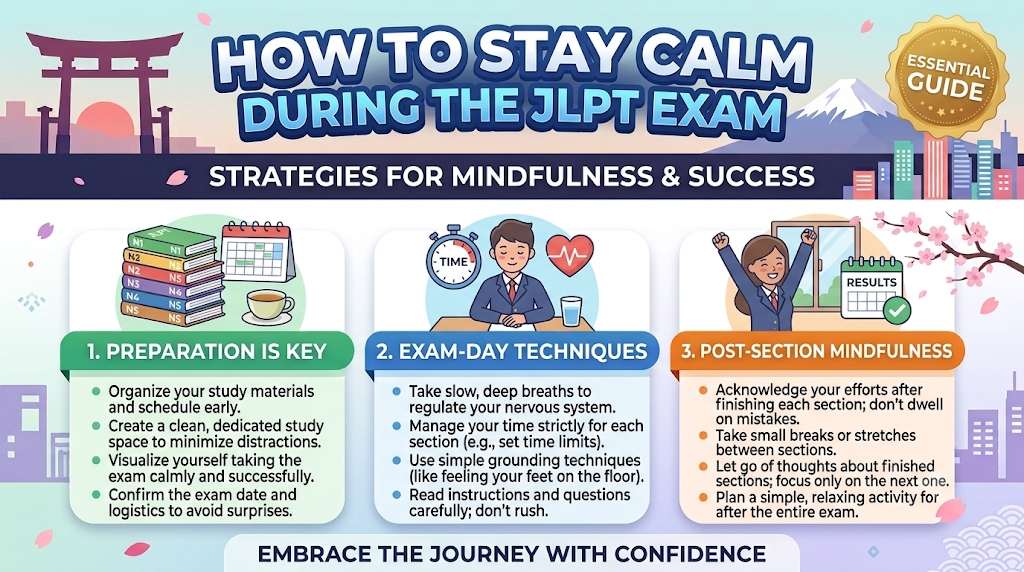
If this sounds familiar, you are not experiencing a lack of preparation—you are experiencing a natural physiological stress response. The Japanese Language Proficiency Test (JLPT) is uniquely designed in a way that triggers mental fatigue:
- No Partial Credit: Questions are binary; you either get it or you don’t.
- Strict Time Limits: Sections like Reading (読解 – Dokkai) heavily penalize slow readers.
- The Listening Trap: The Audio Section (聴解 – Chōkai) plays only once. Missing a single word can cause a cascading wave of panic.
Staying calm on exam day isn’t about suppressing your nerves; it’s about learning how to channel that adrenaline into focus. To understand how test anxiety fits into your long-term language learning trajectory, consult our comprehensive JLPT Exam Mindset: Anxiety, Failure & Motivation Guide.
Pre-Exam Preparation: Securing Your Mental Baseline
Your mental state on exam day is forged 48 hours before you step into the test center. Trying to cram complex N2 or N1 grammar structures the night before only triggers the “spacing effect” in reverse, overloading your short-term working memory and inflating anxiety.
       [ 48 Hours Before ]
      Cramming stops; light review only
                 │
                 ▼
       [ Night Before ]
    Prep gear, logistics, 7-8 hrs sleep
                 │
                 ▼
       [ Exam Morning ]
   Low-glycemic meal + arrive 45 min early
                 │
                 ▼
       [ Test Room ]
   Box breathing + focus on process, not score
1. The 48-Hour Protocol
- Stop Aggressive Cramming: Two days before the test, lock your Anki decks and put away heavy practice workbooks. Your brain needs rest to consolidate long-term memory.
- Review high-yield basics: Glance over comfortable material to build confidence rather than attempting to learn new Kanji. For official guidelines, structure, and registration info, visit the official JLPT Official Website.
- Prepare Your Test Kit: Place your voucher, lead pencils (HB or #2), eraser, analog watch, and ID in your bag the night before. Fumbling for items on test morning spikes cortisol early.
2. Physical & Biological Grounding
- Hydration Balance: Drink water in moderation. The JLPT does not offer bathroom breaks mid-section without losing valuable testing time.
- Fuel Your Brain Correctly: Avoid heavy, carb-laden meals before the test to prevent postprandial somnolence (the dreaded afternoon food coma). Opt for complex carbohydrates and healthy fats.
- Arrive Early: Reach the venue at least 45 minutes before doors close. Navigating crowded halls while rushing creates unnecessary stress.
In-the-Moment Tactics for Language Vocabulary & Reading (文字・語彙・文法・読解)
The language knowledge and reading section is a test of stamina and time management. Anxiety here usually stems from getting stuck on a single difficult question and watching the clock run down.
| Section Challenge | Cause of Anxiety | Calming Tactic / Fix |
| Stuck on Kanji/Vocab | Memory block / Overthinking | Use the 30-Second Rule, mark, and skip immediately. |
| Long Reading Passages | Cognitive overload / Running out of time | Read questions first; scan for topic markers (は, が, しかし). |
| Grammar Nuances | Second-guessing choices | Trust your initial native-speed intuition; don’t over-analyze. |
The 30-Second Skip Rule
If you look at a Vocabulary or Kanji question and do not know the answer within 30 seconds, guess, mark your best candidate, and move on.
Vocabulary questions yield the exact same point weight relative to effort as long-winded questions, but take a fraction of the time. Every minute spent obsessing over a forgotten N3 vocabulary word is a minute stolen from your reading comprehension section.
Navigating Reading Panic
When reading long passages, panic often makes you read the same sentence four times without digesting a single word.
- Anchor with the Questions First: Before reading the passage, read the question stems (not necessarily all choices) to give your brain a clear filter.
- Look for Transition Signals: Pay close attention to words like しかし (however), つまり (in short), or したがって (therefore). Authors hide core arguments right after these markers.
Handling the Listening Section Panic (聴解)
The JLPT Listening section is notorious for inducing test panic because audio track tracks play once and do not stop. If your focus breaks for three seconds, you might miss the crucial twist word like じゃない (wasn’t) or むしろ (rather).
   [ Audio Starts ] ──► [ Miss a Word/Phrase ]
                               │
                               ▼
                   [ DO NOT STOP TO PONDER ]
                               │
            ┌──────────────────┴──────────────────┐
            ▼                                     ▼
 [ Pick Best Guess Immediately ]       [ Refocus on Next Track ]
            │                                     │
            └──────────────────┬──────────────────┘
                               ▼
                   [ Maintain Audio Pace ]
What to Do When You Lose Track
- Cut Your Losses Immediately: If you miss a key sentence, pick a random answer instantly and reset your focus for the next prompt. Trying to figure out Question 3 while Question 4 is playing guarantees you will lose points on both.
- Use the Note Sheet Wisely: Don’t try to transcribe full Japanese sentences. Use quick symbols (e.g., arrows for directions, +/- for positive/negative reactions, initial letters for names).
- Watch Out for “Trap” endings: Japanese places negation and modification at the very end of the sentence. Listen all the way to the final verb conjugation before drawing a conclusion.
If you want to dive deeper into structural test resources, test location updates, and practice workbooks, check out the Japan Foundation JLPT Resource Page.
Somatic Techniques to Reset Your Body in 60 Seconds
If you feel full-blown panic setting in—racing heart, sweating palms, hyperventilation—you must use somatic (body-based) signals to manually flip your nervous system from fight-or-flight to rest-and-digest.
1. Box Breathing (4-4-4-4 Method)
Quietly perform this exercise while sitting at your desk:
- Inhale through your nose slowly for 4 seconds.
- Hold your breath for 4 seconds.
- Exhale smoothly through your mouth for 4 seconds.
- Hold your lungs empty for 4 seconds.
- Repeat 3 times. This immediately slows down elevated heart rates.
2. Physical Grounding (The Desk Press)
Press your feet flat onto the floor, place your palm firmly on the wooden surface of your desk, and focus on the physical sensation of solidity. Remind yourself: I am sitting in a chair, taking an optional exam. I am safe.
Post-Section Recovery: How to Reset During Breaks
The break between the Reading/Vocabulary section and the Listening section is a critical window. Many students spend this time discussing answers with peers or frantically checking dictionaries on their phones.
- Do Not Discuss Answers: Talking to other test-takers about questionable answers will only fuel anxiety about past mistakes that you can no longer change.
- Step Outside the Room: Physical movement clears metabolic waste from your brain. Walk down the hallway, stretch your shoulders, and get fresh air.
- Clear Your Mind: Treat the second half of the exam as a fresh start. Whatever happened during the reading portion stays in the reading portion.
Long-Term Perspective: The Big Picture of Language Acquisition
At the end of the day, the JLPT is a snapshot of your test-taking efficiency under specific conditions on a single afternoon—it is not a final verdict on your intelligence or your real-world Japanese capacity.
                  [ Take the JLPT ]
                         │
         ┌───────────────┴───────────────┐
         ▼                               ▼
    [ Passed ]                      [ Failed ]
         │                               │
  Build Next Level           Analyze Weak Points
         │                               │
         └───────────────┬───────────────┘
                         ▼
             [ Continuous Growth ]
Even if things don’t go according to plan on test day, remember that failure is simply data telling you where to adjust your study routine. If you find yourself facing an unexpected result down the road, read our detailed guides on Failed JLPT? What to Do Next (Step‑by‑Step) and learn How to Bounce Back After Failing JLPT to construct a resilient study plan.
Furthermore, language acquisition is a marathon, not a sprint. Consistently pushing yourself too hard without proper rest can lead to burnout. If you feel like your momentum is flagging over long months of study, check out our insights on JLPT Burnout: How to Stay Motivated Long‑Term.
Stay calm, trust the preparation you have put in, execute your time management strategy, and treat every question as an opportunity to demonstrate what you know.