
Learning Japanese grammar often feels like solving a puzzle where the pieces shift depending on who is speaking. Standard textbooks will tell you that appending たばかり (tabakari) to the past tense form of a verb means “just did something.” While that translation is functionally accurate, relying on it entirely will leave a massive gap in your comprehension of natural Japanese.
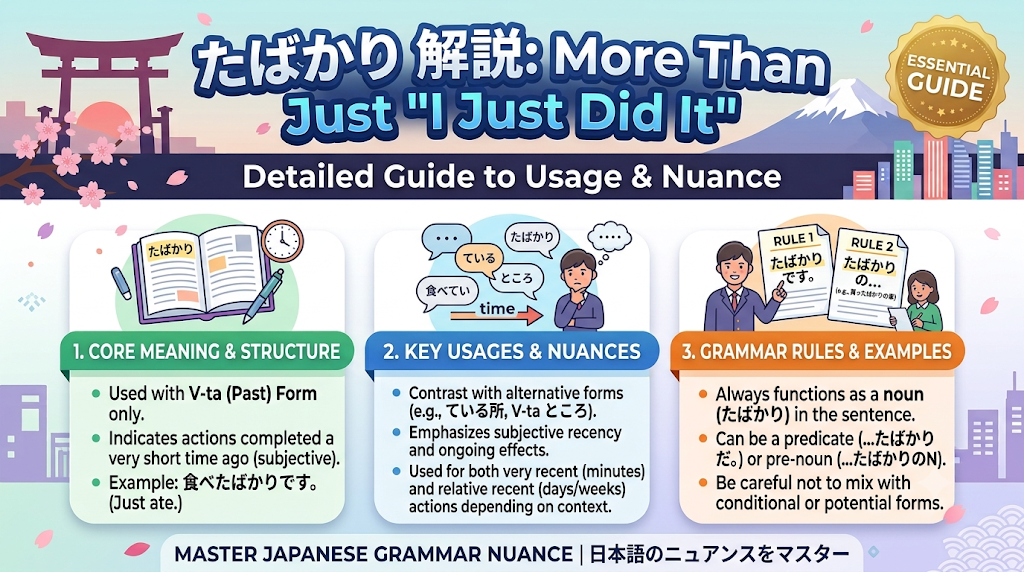
If you view time purely as a clock or a calendar, たばかり will break those rules. A native speaker might use it to talk about an action that happened five seconds ago, or an event that occurred three years ago.
Understanding this flexibility requires looking beyond basic translations. In spoken and written Japanese, time is frequently subjective, governed by perception rather than the ticking of a clock.
The Fundamental Structure of たばかり
At its core, たばかり attaches directly to the た-form (past tense/informal past) of a verb.
| Structure | Example Verb | Conjugated Form | English Meaning |
| Verb (た-form) + ばかり | 食べる (to eat) | 食べたばかり | Just ate |
| Verb (た-form) + ばかり | 起きる (to wake up) | 起きたばかり | Just woke up |
| Verb (た-form) + ばかり | 買う (to buy) | 買ったばかり | Just bought |
Sentence Patterns & Grammatical Roles
Depending on where the phrase sits in a sentence, its ending changes to match its function:
- As a sentence ending:
- 日本に来たばかりです。(I have just arrived in Japan.)
- Modifying a noun (using の):
- 買ったばかりの車 (A car that was just bought / A brand-new car)
- Modifying an action or verb (using に):
- 起きたばかりなのに、また寝た。(Even though they just woke up, they went back to sleep.)
Objective Time vs. Subjective Psychological Time
The defining feature of たばかり is that it reflects psychological distance, not objective chronometry.
When a speaker uses this structure, they are expressing that, in their mind, the event feels completely fresh, recent, or psychologically close to the present moment. Because human perception is fluid, the physical amount of time that has elapsed is secondary to how the speaker feels about it.
[ Objective Timeline ] -------------------------------------->
Event Happens                                      Present Moment
      |                                                  |
      +----------------- Elapsed Time -------------------+
                         (Minutes, Months, or Years)
                                  │
                                  ▼
                     Speaker perceives this window
                     as "fresh" or "recent"
                                  │
                                  ▼
                            [ たばかり ]
Scenario A: Seconds or Minutes Ago
- ラーメンを食べたばかりだから、お腹がいっぱいです。(I just ate ramen, so I’m full.)
- Context: Physical reality aligns with psychological perception. The eating happened 10 minutes ago, and the speaker is physically full.
Scenario B: Months or Years Ago
- この会社に入ったばかりだから、まだ分からないことが多いです。(I just joined this company, so there’s still a lot I don’t know.)
- Context: The speaker might have been hired six months ago. However, relative to a 30-year career or the complex nature of the job, six months feels short and “fresh.”
Because of this subjective boundary, you can pair たばかり with time expressions that normally signify the distant past, provided the feeling of recency remains intact.
- 3ヶ月前に結婚したばかりです。(We just got married three months ago.)
To dive deeper into why native speakers stretch this grammar across long timeframes, read Why Native Speakers Use たばかり for Events That Happened Long Ago.
たばかり vs. たところ: Nuance Breakdown
One of the most frequent points of confusion for JLPT learners is distinguishing between たばかり and たところ. Both are translated into English as “just did,” but they function under entirely different constraints.
   ┌─────────────────────────────────────────────────────────┐
   │                  TIMELINE OF AN ACTION                  │
   └─────────────────────────────────────────────────────────┘

   [ Action Completed ] ───► [ Immediate Aftermath ] ──────────► [ Later ]
             │                          │                          │
             ▼                          ▼                          ▼
      ★ たところ                  ★ たばかり                 ★ たばかり
   (Physical Point in Time)    (Psychological Recency)    (Psychological Recency)
   "Literally seconds ago"     "Feels recent to me"       "Feels recent to me"
- たところ (Objective Instant): Refers strictly to the absolute moment after an action finishes. The window of availability for たところ closes within seconds or minutes.
- たばかり (Subjective Perception): Refers to the speaker’s internal feeling that an action is recent. The physical time elapsed is irrelevant.
Direct Comparison Table
| Feature | たばかり (Tabakari) | たところ (Tokoro) |
| Focus | Speaker’s subjective feeling | Objective, pinpoint moment in time |
| Time Span | Seconds, days, months, or years | Seconds to minutes only |
| With Specific Time Words? | Works with 昨日の夜, 先月, 3年前 | Fails with explicit past time markers |
| Particle Combinations | 〜たばかりの / 〜たばかりだ | 〜たところだ / 〜ところを / 〜ところへ |
Comparative Example
- 今、家についたところです。(I have literally just stepped through the door of my house this second.)
- 先週、新しい家に引っ越したばかりです。(I just moved into a new house last week.) — Using ところ here would sound unnatural because “last week” is too far past the physical instant.
For an in-depth breakdown of these two patterns side-by-side, check out our guide on たばかり vs たところ: Which One Sounds More Natural?. If you want to master the temporal mechanics of たところ specifically, see たところ Grammar: Describing Your Exact Point in Time.
Practical Applications and Native Nuances
Understanding grammar formulas is only the first step. To use たばかり naturally, you need to understand the social and pragmatic reasons native speakers select it.
1. Managing Expectations & Making Excuses
When you join a new project, start a job, or adopt a new skill, using たばかり signals to others that you are still in the grace period of learning. It subtly asks for patience without sounding demanding.
- 日本語を習い始めたばかりなので、優しく話してください。(I only just started learning Japanese, so please speak gently.)
2. Justifying Current States or Decisions
たばかり works well to explain why a certain action cannot be taken or why a current state exists.
- さっき起きたばかりで、まだ頭が働かない。(I just woke up a moment ago, so my brain isn’t working yet.)
- 買ったばかりのスマホを落としてしまった。(I dropped the smartphone I had only just bought.)
- Note: Adding たばかり here heightens the emotional impact of the loss—it emphasizes the pain of breaking something brand new.
Related Time-Based Grammar Patterns
To speak fluidly, you must be able to navigate the entire spectrum of time-based grammar. Here is how たばかり fits alongside adjacent patterns:
[ BEFORE ACTION ] ───────► [ DURING ACTION ] ───────► [ IMMEDIATELY AFTER ] ───────► [ SUBJECTIVE RECENT ]
   〜ようとするとき               〜ているところ                  〜た直後 / 〜たところ               〜たばかり
- 〜た直後 (Ta Chokugo): Expresses that Action B happened immediately after Action A in a direct chain of events. Read our comparative analysis: 〜た直後 vs 〜たばかり: Is There Any Difference?.
- 〜たところで (Ta Tokorode): Means “even if / even when” an action is completed, a negative or unexpected result follows. Discover its unique usage in たところで Explained: Meaning, Exceptions, and Natural Examples.
For a complete overview of where these structures sit on the conversational timeline, check out:
- Talking About Progress in Japanese: Before, During, and After an Action
- The Complete Guide to Japanese Time-Based Grammar Patterns
- Japanese Expressions for Recent Actions: How to Say “Just Did” Something Naturally
Master Time Expressions with Authoritative Resources
Mastering Japanese grammar requires consistent immersion and structured learning. To cross-reference grammar points and practice with authentic materials, consult these trusted platforms:
- Review detailed JLPT grammar breakdowns, native audio examples, and sentence construction notes on Maggie Sensei.
- Practice real-world application, reading comprehension, and structured lessons at Tofugu.
- For official testing requirements, study guides, and test registration, visit the official JLPT (Japanese-Language Proficiency Test) website.
Common Errors to Avoid
Error 1: Using Non-Past Verbs
たばかり must attach to the informal past tense (た-form). Attaching it to the dictionary form or て-form is ungrammatical.
- ❌ 食べるばかり (Incorrect usage for recency)
- ⭕ 食べたばかり (Correct: Just ate)
Error 2: Confusing たばかり with Verb + ばかり (Always doing)
When combined with the て-form of a verb instead of the た-form, ばかり completely changes its meaning to “doing nothing but [action]” or “always doing [action].”
- 食べたばかり: Just ate.
- 食べてばかり: Doing nothing but eating.
Error 3: Forcing Physical Recency
Do not limit たばかり to things that happened moments ago. If you want to convey that a life event (graduating, moving, changing jobs) is still fresh in your mind, lean into たばかり even if months have passed.
Summary Checklist
To determine if たばかり is the right grammar choice for your sentence, ask yourself these three questions:
- Is the verb conjugated to the past informal (た) form?
- Does the event feel recent, fresh, or relevant to the speaker right now?
- Are you trying to express psychological recency rather than an exact, split-second timeframe?
If you answered yes to all three, たばかり is the exact structure you need to sound natural, nuanced, and authentic in everyday Japanese conversation.


