Have you ever tried to answer a message in Japanese, wanting to say “I literally just stepped out of the house” or “I just finished eating this exact second”, but felt like standard past tense didn’t quite capture the extreme freshness of the moment?
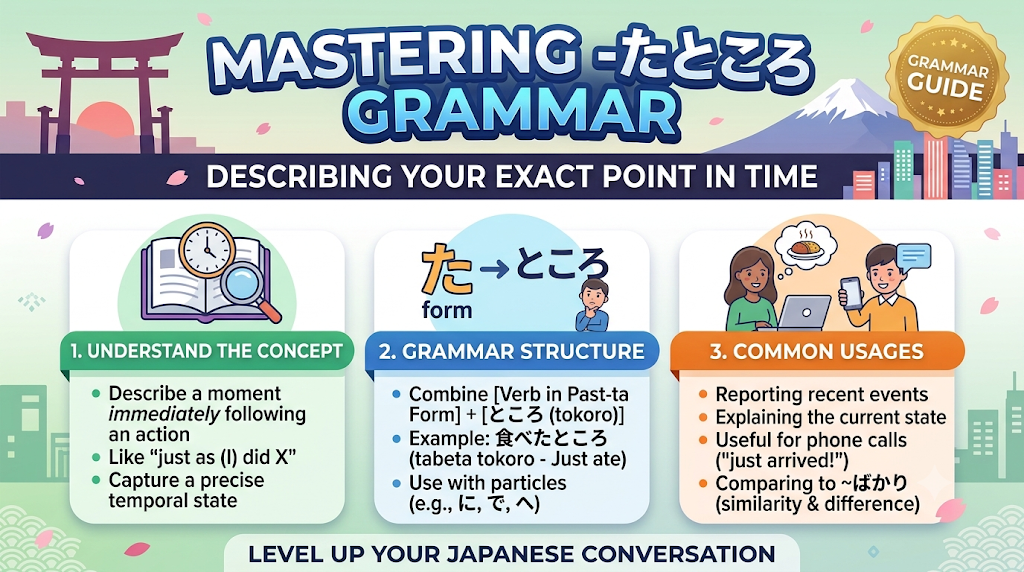
If you have been studying Japanese for a while, you know that timing is everything. Native speakers have a surprisingly precise set of tools to pin down moments in time, and 〜たところ (~ta tokoro) is one of the absolute sharpest tools in that kit.
In this guide, we are going to break down how to use 〜たところ naturally, examine why it works the way it does, look at real-life scenarios where it shines, and clear up the confusion that often trips up JLPT test-takers.
What Does たところ (Ta-tokoro) Actually Mean?
At its core, Verb (た-form) + ところ expresses an action that has just this second been completed.
The word 所 / 居 (ところ – tokoro) physically means “place” or “location.” However, in Japanese grammar, temporal concepts are frequently mapped onto spatial concepts. When used as a temporal marker, ところ acts like a pinpoint marker on a timeline. It captures the action right at the exact boundary line where the past meets the present.
When you attach ところ to the past tense (た-form) of a verb, you create a temporal snapshot. You are telling the listener: “The completion of this action and the present moment are overlapping.”
Key Features of 〜たところ:
- Literal Immediacy: It refers to something that happened moments ago—often seconds or a few minutes ago, rarely hours.
- Objective Observation: It states a factual temporal state rather than a subjective feeling of recency.
- No Lasting Gap: If time has passed and other actions have occurred in between, you generally cannot use 〜たところ.
How to Form 〜たところ
Forming this grammar pattern is straightforward. Take any verb, conjugate it into its informal past tense (た-form), and add ところ (or ところです for polite speech).
$$\text{Verb (Past/た-form)} + \text{ところ (です)}$$
Quick Conjugation Table
| Plain Verb | Past Tense (た-form) | 〜たところ Pattern | English Meaning |
| 食べる (taberu) | 食べた (tabeta) | 食べたところ | Just ate |
| 来る (kuru) | 来た (kita) | 来たところ | Just arrived |
| 帰る (kaeru) | 帰った (kaetta) | 帰ったところ | Just got home |
| 起きる (okiru) | 起きた (okita) | 起きたところ | Just woke up |
| 終わる (owaru) | 終わった (owatta) | 終わったところ | Just finished |
Real-Life Examples and Contexts
To truly understand how to use 〜たところ, let’s look at how it operates in real, day-to-day Japanese conversations.
1. Answering the Phone or Messages
Imagine your friend calls you while you are wiping the breakfast table.
- A: 今、何してる? (Ima, nani shiteru?)”What are you doing right now?”
- B: 朝ご飯を食べたところだよ。 (Asagohan o tabeta tokoro da yo.)”I literally just finished breakfast.”
Here, B uses たところ because the plate is likely still on the table. The action of eating ended mere seconds ago.
2. Spotting Someone Arrive
You see a coworker walking through the office door holding a damp umbrella.
- 今、会社に着いたところです。 (Ima, kaisha ni tsuita tokoro desu.)”I have just arrived at the office this instant.”
3. Reporting Immediate Updates at Work
In a professional setting, たところ is heavily used to report status updates to supervisors when a task was completed moments prior.
- 先ほど資料を送信したところです。ご確認ください。 (Sakihodo shiryou o soushin shita tokoro desu. Go-kakunin kudasa.)”I have just sent the documents a moment ago. Please check them.”
Practical Application: Particle Variations with たところ
Depending on how you end the sentence or connect it to another clause, たところ takes different particles. Understanding these nuances elevates your Japanese from basic to fluent.
1. 〜たところです (Ending a sentence)
Used to state your current status right now.
- 今、家に着いたところです。”I just got home right now.”
2. 〜たところだ (Casual sentence ending)
- たった今、バスが降りたところだ。”I literally just stepped off the bus.”
3. 〜たところ、[Clause B] (Setting the scene for a discovery)
When たところ is followed by a comma and another clause, it changes meaning slightly! It translates to “When I did [Action A], [Result B happened / I discovered B].”
- 窓を開けたところ、雪が降っていた。”When I opened the window, I discovered it was snowing.”
If you want to read more about how this connects to broader temporal structures, check out our guide on The Complete Guide to Japanese Time-Based Grammar Patterns.
Common Mistakes and Nuances
Even advanced learners run into traps when using たところ. Here are the most common pitfalls and how to avoid them.
Pitfall 1: Using たところ for Events That Happened Hours Ago
You cannot use たところ for an event that happened earlier this morning if it is now afternoon.
- Incorrect: けさ、5時に起きたところです。(Said at 2 PM)
- Correct: けさ、5時に起きたばかりです。 / 5時に起きました。
たところ demands strict physical recency. If significant time has elapsed or you have moved on to a secondary action, たところ sounds unnatural.
Pitfall 2: Confusing Dict-Form + ところ with た-Form + ところ
The meaning of ところ shifts dramatically depending on the verb tense attached to it:
- 辞書形 (Dictionary Form) + ところ: About to do something (Immediate future).
- 食べるところ (taberu tokoro) = “I’m just about to eat.”
- 〜ている (Te-iru Form) + ところ: In the middle of doing something (Present continuous).
- 食べているところ (tabete iru tokoro) = “I’m in the middle of eating right now.”
- 〜た (Ta Form) + ところ: Just completed doing something (Immediate past).
- 食べたところ (tabeta tokoro) = “I just finished eating.”
For a full breakdown of how these stages fit together seamlessly, explore Talking About Progress in Japanese: Before, During, and After an Action.
Deep-Dive Comparison: たところ vs. たばかり
This is the single biggest point of confusion for students preparing for the JLPT N3/N4 exams. Both 〜たところ and 〜たばかり translate to “just did something” in English, but they operate under completely different rules.
+-----------------------------------------------------------------------+
|                             TIMELINE                                  |
|                                                                       |
|  [Action Completed] --------------> [Minutes Pass] -------> [Months]  |
|          |                                                      |     |
|          v                                                      v     |
|     〜たところ                                            〜たばかり   |
|  (Strictly seconds/minutes)                        (Subjective feeling)|
+-----------------------------------------------------------------------+
The Difference in a Nutshell:
- 〜たところ (Objective Recency): Zero to very few minutes have passed. It is a literal pinpoint on a clock.
- 〜たばかり (Subjective Recency): The speaker feels like it happened recently, even if weeks, months, or years have passed!
Let’s look at an example:
- 先月、日本に来たばかりです。 (Natural)”I just came to Japan last month.” (Subjectively feels recent to the speaker).
- 先月、日本に来たところです。 (Unnatural / Incorrect)(Since a month has passed, you cannot use tokoro).
If you are looking for a deeper dive into these nuances, be sure to read our detailed comparison たばかり vs たところ: Which One Sounds More Natural? to make sure you never mix them up on an exam.
For more surrounding context on these past-action expressions, take a look at our core pillar post on Japanese Expressions for Recent Actions: How to Say “Just Did” Something Naturally.
Testing Your Knowledge: JLPT-Style Practice
Try these quick practice questions to test your understanding of 〜たところ!
Question 1
田中さんはいらっしゃいますか。
A: あ、田中さんなら、たった今____ところですよ。
- 帰る
- 帰った
- 帰っている
- 帰らせる
- Answer: 2. 帰った
- Explanation: The key clue here is たった今 (tatta ima – literally right now/just standard moment ago), which paired with tokoro demands the た-form to indicate immediate completion.
Question 2
Choose the sentence that sounds most natural:
- 3年前に結婚したところです。
- 3年前に結婚したばかりです。
- Answer: 2
- Explanation: Three years is far too long for たところ. However, three years can feel like “just recently” in the context of a lifelong marriage, making たばかり the correct choice. (To understand why speakers stretch time like this, read Why Native Speakers Use たばかり for Events That Happened Long Ago).
Related Grammar Structures You Should Know
To build a well-rounded grammar foundation, you should also familiarize yourself with other time-sensitive and action-oriented patterns:
- たばかり Explained: More Than Just “I Just Did It”: Master the subjective counterpart to ta-tokoro.
- 〜た直後 vs 〜たばかり: Is There Any Difference?: Learn how chokugo (immediately after) differs when linking two sequential actions.
- たところで Explained: Meaning, Exceptions, and Natural Examples: Don’t confuse ta-tokoro with ta-tokorode! Adding that single particle で changes the meaning entirely to “even if / even assuming that…”
For official test guidelines, vocabulary requirements, and reference material regarding the JLPT N3 and N4 levels, you can review the official resources on the JLPT Official Website or reference standard academic breakdowns like Tae Kim’s Guide to Learning Japanese.
Summary Checklist for たところ
Before you go off and practice speaking, keep this quick reference checklist in mind:
- ✅ Use Verb-た + ところ for actions finished seconds or minutes ago.
- ✅ Pair it with adverbs like たった今 (tatta ima) or ちょうど (choudo) for extra emphasis.
- ❌ Do not use it for events that happened hours, days, or years ago.
- ❌ Do not confuse it with Verb-辞書形 + ところ (about to do) or Verb-ている + ところ (currently doing).
Mastering 〜たところ is one of the easiest ways to make your Japanese sound punchy, precise, and expressive. Try using it today in your next language exchange or Japanese class!