If you have ever tried explaining why you can’t do something in Japanese, you probably learned the basic potential form (~られない) or ~ことができない early in your studies. However, as you advance toward the JLPT N2, you quickly discover that native Japanese speakers rarely rely on simple physical ability to decline requests or explain restrictions. Instead, social expectations, moral duties, and implicit unspoken rules dictate what can and cannot be done.
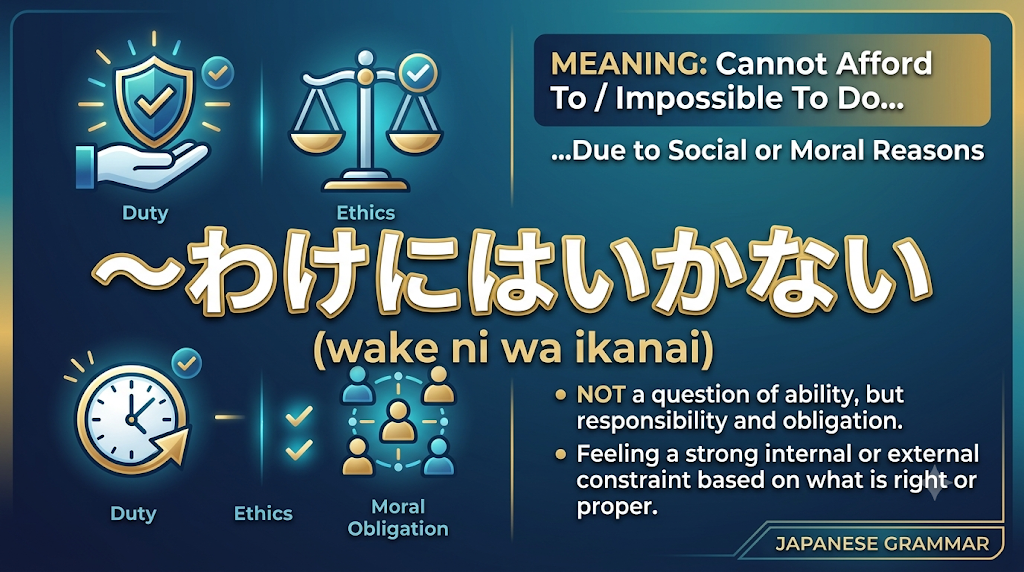
That is where 〜わけにはいかない (wake ni wa ikanai) enters your toolkit.
This grammar point is essential for sounding natural, polite, and culturally aware. In this guide, we will unpack how to use it, why it matters in Japanese society, how it differs from similar structures, and how to avoid common learner traps.
1. What Does 〜わけにはいかない Mean?
At its core, 〜わけにはいかない translates to:
- “Cannot afford to…”
- “Impossible to… (due to social, moral, or psychological reasons)”
- “Must not… (out of duty or common sense)”
Unlike physical impossibility (e.g., “I can’t fly” or “I can’t lift this box”), 〜わけにはいかない expresses a situation where you technically have the physical capacity to do an action, but social pressure, ethics, responsibility, or emotional burden prevent you from doing so.
Core Nuance
If you do the action, it would violate social etiquette, cause trouble for others, or go against your personal conscience.
- Physical constraint: “I cannot eat peanut butter because I am allergic.” ($\rightarrow$ ~ことができない)
- Moral/Social constraint: “I cannot eat this last slice of cake because it belongs to my host.” ($\rightarrow$ 〜わけにはいかない)
2. Structural Breakdown & How to Connect
Connecting words to 〜わけにはいかない is straightforward because it primarily attaches to the dictionary (plain) form of verbs.
| Verb Form | Pattern | Example | English Meaning |
| Affirmative (Dictionary) | Verb (Plain) + わけにはいかない | 休むわけにはいかない | Cannot afford to take a day off |
| Negative (Nai-form) | Verb (Negative) + わけにはいかない | 休まないわけにはいかない | Cannot afford not to take a day off (Must take off) |
Formal vs. Casual Variants
- Polite/Standard (spoken/written): 〜わけにはいかない / 〜わけにはいきません
- Emphatic spoken: 〜わけにもいかない / 〜わけにもいきません (Adds emphasis: “cannot do that either”)
3. Real-World Sentence Examples
To build intuition, examine how this grammar functions across workplace, personal, and social contexts.
Context 1: Workplace Responsibility & Obligations
In a Japanese office environment, individual actions directly impact the team. Admitting you cannot do something due to obligation is very common.
- 明日は大切なプレゼンがあるから、風邪を引いても休むわけにはいかない。
- Ashita wa taisetsu na purezen ga aru kara, kaze o hitemo yasumu wake ni wa ikanai.
- “Since there is an important presentation tomorrow, I can’t afford to take the day off even if I catch a cold.”
- 上司からの頼みだから、断るわけにはいかないよ。
- Joushi kara no tanomi dakara, kotowaru wake ni wa ikanai yo.
- “Because it’s a request from my boss, I can’t really refuse it.”
Context 2: Social Manners & Ethics
- 車を運転してきたので、お酒を飲むわけにはいきません。
- Kuruma o unten shite kita node, osake o nomu wake ni wa ikimasen.
- “Since I drove here, I cannot afford to drink alcohol.”
- 友達が困っているのに、見捨てるわけにはいかない。
- Tomodachi ga komatte iru noni, mishiteru wake ni wa ikanai.
- “My friend is in trouble, so I can’t just abandon them.”
4. The Double Negative: 〜ないわけにはいかない
One of the most frequent appearances of this structure on the JLPT N2 exam is its double-negative variation: Verb (Negative) + わけにはいかない.
When you combine two negatives, they form a strong affirmative obligation:
$$\text{Not do} + \text{Cannot afford to} = \text{“I have no choice but to do it” / “I must do it”}$$
Key Examples
- みんなが残業しているので、私だけ帰るわけにはいかない。だから、手伝わないわけにはいかない。
- “Everyone is working overtime, so I can’t be the only one to go home. Therefore, I have no choice but to help out.”
- 恩師の結婚式だから、出席しないわけにはいかない。
- “Since it’s my mentor’s wedding, I simply must attend (I cannot afford not to attend).”
5. Comparative Analysis: How Does It Differ?
Japanese features several grammar structures that translate to “must” or “cannot.” Knowing when to use each is crucial for exam success and fluid conversation.
| Grammar Structure | Primary Driver | Example Use Case |
| 〜わけにはいかない | External social norms, morals, situational pressure | “I can’t leave work early when everyone is struggling.” |
| 〜わけがない | Logical impossibility (“There’s no way…”) | “He was with me all day, so there’s no way he stole it.” |
| 〜ことができない | Lack of physical capability, skill, or direct permission | “I cannot swim because I never learned.” |
| 〜なければならない | Rule, requirement, or general necessity (“Must”) | “You must submit your tax forms by March.” |
If you are preparing for your upcoming exam, reviewing comprehensive study tools like the official JLPT site can help clarify how these grammar points are tested in reading comprehension sections.
6. Practical Application & Nuance Tips
- Avoid using it for physical limitations: Do not say アレルギーがあるから、エビを食べるわけにはいかない if you mean your body will react medically. Use 〜られない instead. Use 〜わけにはいかない if you’re refusing shrimp out of politeness to a host who prepared a special meal.
- Softening Refusals: When declining invitations in business environments, saying 〜わけにはいきません shows that your heart wants to accept, but circumstances beyond your control prevent you. This saves face for both parties.
- Practice with Real Native Content: To hear how native speakers naturally balance these social rules, explore localized Japanese media or structured educational materials on platforms like NHKs Easy Japanese News to observe formal phrasing in everyday contexts. For structured JLPT drills, consider using reference guides on Maggie Sensei to build speed.
Summary Checklist for JLPT N2
- Meaning: Cannot afford to do / Have to do (due to social or moral duty).
- Connection: Verb (Dictionary Form) OR Verb (Nai-form) + わけにはいかない.
- Key Distinction: Focuses on social obligation and personal ethics, NOT physical inability.
- Exam Tip: Look out for double-negative patterns (〜ないわけにはいかない) in reading passages!