
When moving from basic Japanese to intermediate proficiency (JLPT N3/N2), one of the biggest shifts is moving from literal translation to expressing exact nuances. In English, we often adjust our statements on the fly: “He’s not really angry… it’s more like he’s disappointed.”
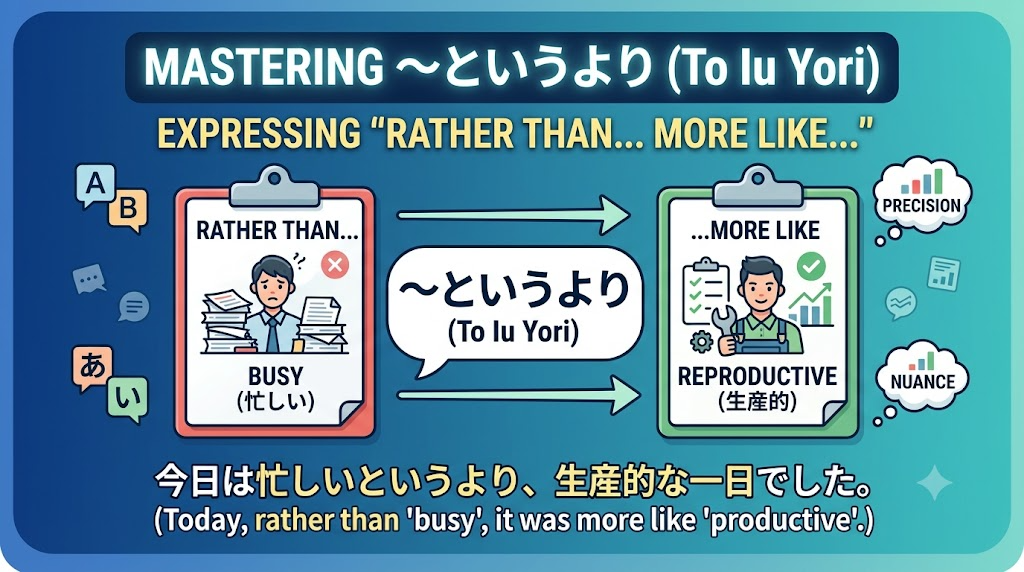
In Japanese, the go-to grammar structure for this phrasing is ~というより (to iu yori).
While textbooks give a brief translation like “rather than,” using it naturally requires understanding its pragmatic function: reframing a situation to provide a more accurate description.
Grammar Structure & Break Down
The phrase is built from three distinct linguistic components:
- という (to iu): “To say that…” (quotative particle と + verb 言う)
- より (yori): “More than…” or “rather than…” (comparison particle)
- (Optional) ひらがな/漢字: Written almost exclusively in hiragana as というより.
Core Formula:
[ Statement A ] というより [ Statement B ]
“Rather than Statement A, it is more accurate to say Statement B.”
How to Form ~というより
One reason learners love this pattern is its flexible connection rules. You can attach it directly to plain form verbs, adjectives, and nouns without complex conjugations.
| Part of Speech | Pattern | Example |
| Nouns | Noun + というより | 友達というより家族 (More like family than a friend) |
| i-Adjectives | i-Adj + というより | 寒いというより痛い (It’s more painful than cold) |
| na-Adjectives | na-Adj + というより | 静かというより寂しい (It’s more lonely than quiet) |
| Verbs (Plain) | Verb + というより | 歩くというより走る (It’s more like running than walking) |
Variations You Will Hear in Conversation
Native speakers tweak this pattern depending on formality and casual speech flow:
- というよりは (to iu yori wa): Adds the topic particle は for contrastive emphasis. Very common in written Japanese and formal discussions.
- っていうか (tte iu ka) / っていうより (tte iu yori): Highly casual spoken variations. Use these with friends when correcting yourself or refining a point.
- というか (to iu ka): Functions almost identically to “or rather…” at the start of a sentence.
Real-World Example Sentences
To build intuition, analyze how Statement B reframes Statement A in these practical contexts:
- Describing Relationships彼らは友達というより、ビジネスパートナーのような関係だ。Rather than friends, their relationship is more like business partners.
- Describing Feelings or Physical States今日の天気は、寒いというより風が強くて痛い感じがする。Today’s weather isn’t so much cold as it is painful because of the strong wind.
- Evaluating Work or Performanceこのプロジェクトは失敗したというより、いい勉強になったと思う。Rather than a failure, I think this project was a good learning experience.
- Refining Descriptions彼は真面目というより、融通が利かないだけかもしれない。Rather than being serious, it might just be that he’s inflexible.
Nuance Breakdown: というより vs. ではなく (Dewa Naku)
A common mistake intermediate students make is confusing ~というより with ~ではなく.
- AではなくB (Not A, but B): Strictly negates A. A is completely false; B is true.
- Example: 彼は日本人ではなく、中国人です。(He is not Japanese; he is Chinese.)
- AというよりB (Rather than A, B): A isn’t necessarily 100% wrong, but B is a far better, more accurate, or nuanced description.
- Example: 彼女は親切というより、おせっかいだ。(Rather than kind, she’s more like meddlesome.) — She does show kindness (A), but “meddlesome” (B) fits better.
Practice Exercises
Try translating these English thoughts into Japanese using ~というより:
- It’s not really delicious… it’s more like an unusual taste.
- Rather than smart, he is more like lucky.
- I didn’t quit; it’s more like I paused my studies.
Answer Keys:
- 美味しいというより、珍しい味ですね。
- 賢いというより、運がいいだけだ。
- 辞めたというより、勉強を一時休止している感じです。
Recommended Resources for JLPT Preparation
If you are systematically studying Japanese grammar patterns and want to test your understanding against official guidelines:
- Check out official test details and test site schedules on the official JLPT Japanese-Language Proficiency Test Website.
- Review expanded vocabulary lists and exercise sets on Tofugu’s Japanese Grammar Database.
- Practice real-world listening and natural sentence phrasing with interactive dialogues on NHK WORLD-JAPAN Japanese Lessons.
Mastering ~というより allows your spoken and written Japanese to sound thoughtful, precise, and natural. Try inserting it into your next conversation or writing practice!


