
Have you ever found yourself in a Japanese conversation where saying a firm “No” (iie) felt way too harsh, but staying silent felt like you were agreeing to something untrue?
Imagine a coworker asking: “So, you hate spicy food?”
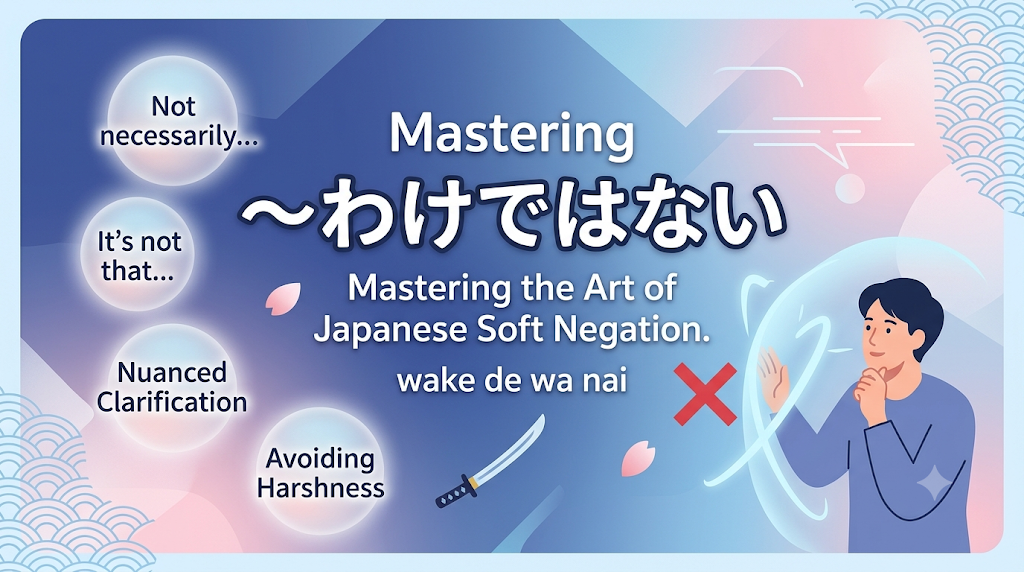
If you say “I don’t hate it,” you might sound overly defensive. If you say “I like it,” they might order the double-chili ramen for you. What you actually want to say is: “It’s not that I dislike it… (I just can’t eat it every single day).”
That delicate, crucial space in Japanese communication is where 〜わけではない (wake de wa nai) lives.
As a JLPT instructor and long-time student of Japanese pragmatics, I can tell you that mastering this single grammar structure marks a major turning point. It shifts your Japanese from literal translation to natural, culturally attuned communication. In this comprehensive guide, we will break down the structure, cultural nuances, everyday applications, and common traps of 〜わけではない so you can speak with subtlety and precision.
1. What Does 〜わけではない Really Mean?
At its core, 〜わけではない (wake de wa nai) translates to:
- “It doesn’t mean that…”
- “It’s not that…”
- “It isn’t necessarily the case that…”
Mathematically, think of it as partial negation. You are not denying the entire situation; you are simply denying a specific conclusion, assumption, or extreme interpretation that the listener might draw.
Full Negation:   "I don't like anime." (100% No)
Wake de wa nai: "It's not that I don't like anime... (I just haven't watched many recent shows)." (Partial Nuance)
Breakdown of the Structure
- わけ (wake): Originally written in kanji as 訳, meaning “reason,” “logic,” or “meaning.”
- ではない (de wa nai): The plain negative form of de aru (“is not”).
When put together, you are literally stating: “The logical conclusion/reason is not [X].”
2. How to Form Sentences (Grammar Rules)
The beauty of 〜わけではない is that it attaches directly to the plain form (dictionary form) of verbs, adjectives, and nouns. However, pay close attention to the connector rules for $N_a$-adjectives and Nouns.
| Part of Speech | Conjugation Rule | Example | English Translation |
| Verb | Plain Form + わけではない | 食べるわけではない | It’s not that I eat (it)… |
| i-Adjective | Keep ~い + わけではない | 高いわけではない | It’s not that it’s expensive… |
| na-Adjective | Add 〜な + わけではない | 嫌いなわけではない | It’s not that I dislike it… |
| Noun | Add 〜(である) + わけではない | 学生であるわけではない | It’s not that I am a student… |
Pro Tip for JLPT Test Takers: The most common mistake on the JLPT N3/N2 grammar section is forgetting to add 〜な for $na$-adjectives or using 〜の instead of 〜である for nouns before wake de wa nai.
3. Casual vs. Formal Variations
Japanese adjustments depend entirely on who you are talking to. Here is how 〜わけではない shifts across different registers of formality:
- Casual (Friends/Family): 〜わけじゃない (wake ja nai)
- Polite (Standard Business/Daily): 〜わけではありません (wake de wa arimasen) / 〜わけじゃないです (wake ja nai desu)
- Formal Written/Speeches: 〜わけではない (wake de wa nai)
4. Deep-Dive Examples in Real Contexts
To truly internalize this grammar point, let’s look at realistic conversational contexts rather than isolated, textbook sentences.
Context 1: Personal Preferences & Diet
Person A: 納豆、食べないの?嫌いなの?
(Nattou, tabenai no? Kirai na no?)
“You’re not eating the natto? Do you hate it?”
Person B: あ、嫌いなわけじゃないんだけど、匂いがちょっと苦手で…
(A, kirai na wake ja nai n da kedo, nioi ga chotto nigate de…)
“Ah, it’s not that I dislike it, it’s just that I’m a bit bad with the smell…”
Context 2: Work & Capability
Person A: このプロジェクト、一人でやるの?大変そうだね。
(Kono purojekuto, hitori de yaru no? Taihen sou da ne.)
“Are you doing this project alone? That looks tough.”
Person B: 全体的な流れが分からないわけではないんですが、細かい設定で迷っています。
(Zentaiteki na nagare ga wakaranai wake de wa nai n desu ga, komakai settei de mayotte imasu.)
“It’s not that I don’t understand the overall flow, but I’m getting stuck on the fine settings.”
Context 3: Relationships & Misunderstandings
Person A: 最近、佐藤さんと話してないね。喧嘩でもしたの?
(Saikin, Satou-san to hanashitenai ne. Kenka demo shita no?)
“You haven’t talked to Sato-san lately. Did you get into a fight?”
Person B: 怒っているわけではないよ。ただお互いに忙しいだけ。
(Okotteru wake de wa nai yo. Tada otagai ni isogashii dake.)
“It’s not that I’m angry. We’re just both busy.”
5. Nuance vs. Similar Grammar Points
One of the biggest hurdles in upper-intermediate Japanese is distinguishing between grammar structures that translate similarly in English. Let’s compare 〜わけではない with its closest relatives.
A. 〜わけではない vs. 〜とは限らない (to wa kagiranai)
- 〜わけではない: Denies a specific impression or current situation (“It’s not that…”).
- 〜とは限らない: Expresses a general rule or probability, meaning “It is not necessarily true in all cases that…”
Example:
- 高いものが必ずしも良いものとは限らない。(High-priced things are not necessarily good things in all cases.)
- 買えないわけではないが、今は買わない。(It’s not that I can’t buy it, but I won’t buy it right now.)
B. 〜わけがない (wake ga nai)
- 〜わけではない: Soft partial negation (“It’s not particularly the case that…”).
- 〜わけがない: Absolute strong impossibility (“There is no way that…”, “It’s impossible that…”).
Example:
- 彼は英語が話せないわけではない。(It’s not that he can’t speak English — he knows some.)
- 彼は英語が話せるわけがない。(There is no way he can speak English — he’s never studied it!)
6. Cultural Insight: Why Japanese Speakers Rely on “Wake de wa nai”
In Japanese social dynamics, maintaining harmony (wa) and avoiding direct confrontation is paramount. Stating a sharp negative can sound abrupt or overly assertive.
By framing your refusal or correction with 〜わけではない, you soften the blow. You acknowledge the other person’s thought process while gently nudging the context toward the truth. It gives both you and your conversation partner “social breathing room.”
For a deeper dive into how Japanese honorifics and indirect speech shape everyday communication, check out the insightful language breakdowns on Tofugu, which offers fantastic context on real-world Japanese usage.
7. Interactive Practice: Test Yourself!
Try translating the following sentences using 〜わけではない / 〜わけじゃない. (Answers below!)
- It’s not that I don’t have money, I just don’t want to spend it.
- It’s not that Japanese is easy, but it is fun.
- It’s not that I don’t want to go to the party, but I have work tomorrow.
Answer Key
- お金がないわけではない。使いたくないだけだ。(Okani ga nai wake de wa nai. Tsukai takunai dake da.)
- 日本語が簡単なわけではないが、楽しいです。(Nihongo ga kantan na wake de wa nai ga, tanoshii desu.)
- パーティーに行きたくないわけじゃないんだけど、明日仕事があるんだ。(Paatii ni ikitakunai wake ja nai n da kedo, ashita shigoto ga aru n da.)


