
If you have been studying Japanese for a few months, you have likely noticed a major turning point: moving from short, static descriptions like “I eat sushi” or “I can read kanji” to dynamic, nuanced expressions that describe how things change over time.
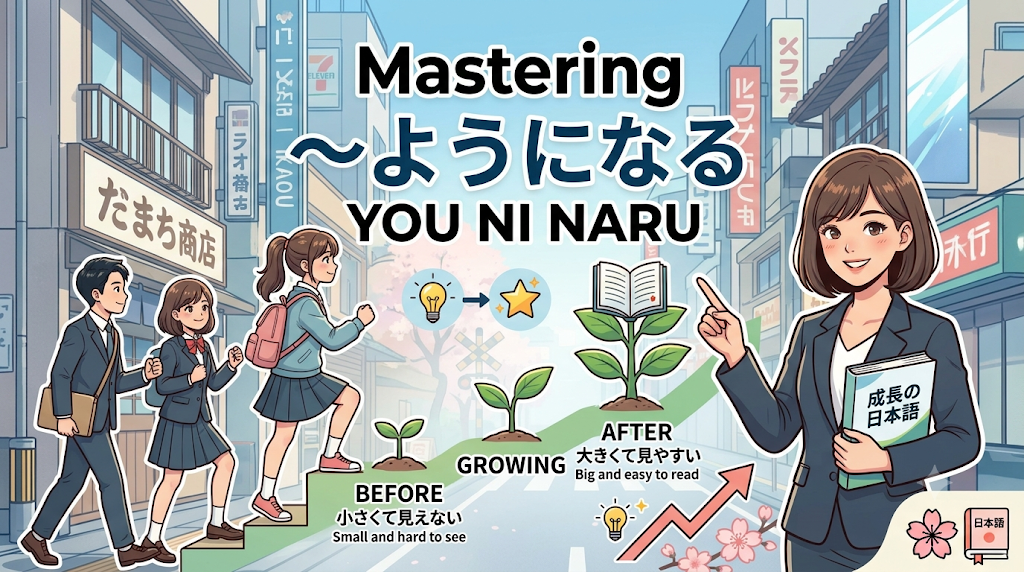
One of the most important grammar structures for bridging this gap is 〜ようになる (you ni naru).Includes real-world examples
Whether you are describing a skill you recently acquired, a shift in lifestyle, or a new habit, this single pattern acts as the primary engine for expressing personal progress and transition in everyday Japanese. In this comprehensive guide, we will break down 〜ようになる from its core concept and exact conjugation rules to real-life conversational nuances, subtle distinctions, and JLPT preparation strategies.
What Does 〜ようになる (You ni Naru) Mean?
At its core, 〜ようになる translates to:
- “To reach a point where…”
- “To become able to…”
- “To start doing (as a new habit/state)…”
It is formed by combining the noun よう (様 – appearance, way, state), the target particle に (ni), and the verb なる (成る – to become). Literally, you are saying that a situation or capability has “become a state where [verb] happens.”
It marks a transition from State A (cannot do / do not do) to State B (can do / regularly do).
Basic Structure and Conjugation
To form 〜ようになる, you attach the plain non-past form of a verb to ようになる.
1. Form Formula
$$\text{[Verb in Dictionary / Potential Form]} + \text{ようになる}$$
2. Verb Forms Used with 〜ようになる
A. Potential Verbs (Ability)
When paired with potential verbs (ability to do something), 〜ようになる means “to become able to do something” or “to gain the ability.”
- 話せる (can speak) $\rightarrow$ 話せるようになる (become able to speak)
- 泳げる (can swim) $\rightarrow$ 泳げるようになる (become able to swim)
- 理解できる (can understand) $\rightarrow$ 理解できるようになる (become able to understand)
B. Non-Potential / Volitional Verbs (Habitual / State Change)
When paired with standard dictionary forms, it indicates a shift in habit or lifestyle (“to start doing” or “come to do”).
- 食べる (eat) $\rightarrow$ 食べるようになる (start eating / come to eat)
- 使う (use) $\rightarrow$ 使うようになる (start using / come to use)
Clear Conjugation Breakdown Table
| Verb Category | Dictionary Form | Target Form for 〜ようになる | Example Sentence |
| Group 1 (U-Verbs) | 泳ぐ (oyogu) | 泳げるようになる (oyogeru you ni naru) | 毎日練習して、泳げるようになった。 (I practiced every day and became able to swim.) |
| Group 2 (Ru-Verbs) | 食べる (taberu) | 食べられるようになる (taberareru you ni naru) | 辛い料理が食べられるようになった。 (I became able to eat spicy food.) |
| Group 3 (Irregular) | する (suru) | できるようになる (dekiru you ni naru) | 日本語で会話ができるようになった。 (I became able to have conversations in Japanese.) |
| Group 3 (Irregular) | 来る (kuru) | 来られるようになる (korareru you ni naru) | 一人で病院へ来られるようになった。 (They became able to come to the hospital alone.) |
4 Main Ways to Use 〜ようになる in Real Life
1. Acquisition of Skills (Becoming Able To Do Something)
This is the most common usage tested on the JLPT N4 exam. It emphasizes gradual development or the result of effort.
- 日本語の新聞が読めるようになりました。Nihongo no shinbun ga yomeru you ni narimashita.“I have reached the point where I can read Japanese newspapers.”
- 半年間練習して、ピアノが弾けるようになりました。Hantoshi-kan renshuu shite, piano ga hikeru you ni narimashita.“After practicing for half a year, I became able to play the piano.”
2. Shifts in Habits and Lifestyle (Starting a New Routine)
You can use standard verbs to show that something was not part of your daily life before, but is now a regular practice.
- 健康のために、毎日野菜を食べるようになりました。Kenkou no tame ni, mainichi yasai o taberu you ni narimashita.“For my health, I have come to eat vegetables every day.”
- 最近、夜遅く寝るようになってしまった。Saikin, yoru osoku neru you ni natte shimatta.“Lately, I’ve ended up getting into the habit of going to bed late.”
3. Natural or Automatic Changes (Environmental/State Changes)
Sometimes the change is not about personal effort, but an external process, age, or passage of time.
- 春になると、暖かくなって花が咲くようになります。Haru ni naru to, atatakaku natte hana ga siku you ni narimasu.“When spring comes, it gets warm and flowers start to bloom.”
- メガネをかければ、遠くの文字も見えるようになります。Megane o kakereba, tooku no moji mo mieru you ni narimasu.“If you put on glasses, you will become able to see distant characters.”
4. Expressing the Negative: 〜なくなる (To Stop / Become Unable To)
To express the opposite shift—where you lose an ability or stop a habit—replace なる with なくなる (from ない $\rightarrow$ なくなる).
- 忙しくて、運動しなくなりました。Isogashikute, undou shinaku narimashita.“Because I’m busy, I have stopped exercising.”
- お酒を飲まなくなりました。Osake o nomanaku narimashita.“I have stopped drinking alcohol / I don’t drink alcohol anymore.”
Important Nuances and Expert Insights
1. 〜ようになる vs. 〜ことができる (Dekiru)
Many learners confuse these two patterns because both relate to ability.
- 〜ことができる (koto ga dekiru): States an absolute capacity at a specific moment.
- 例: 私は漢字を読むことができます。(I can read kanji.)
- 〜ようになる (you ni naru): Emphasizes the process of change over time.
- 例: 漢字が読めるようになりました。(I reached a point where I can read kanji.)
Pro Tip: Use 〜ようになる when you want to highlight growth, effort, aging, recovery, or habit changes over time.
2. Emotional Weight and Tense Usage
When you use the past tense 〜ようになった (you ni natta), it often conveys personal pride, relief, or noticeable change:
- 一人で電車に乗れるようになった!(I can finally ride the train by myself!)
When used with 〜ようになっている (you ni natte iru), it describes a mechanism, system, or established rule:
- このドアは自動で開くようになっている。(This door is designed to open automatically.)
Practical Applications for Everyday Speech
Here is how native speakers use this pattern in natural conversation:
Conversation Example 1: Language Learning
- A: 日本生活はどう?日本語に慣れた?(Nihon seikatsu wa dou? Nihongo ni nareta?)“How is life in Japan? Have you gotten used to Japanese?”
- B: うん、少しずつニュースが理解できるようになってきたよ。(Un, sukoshi zutsu nyuusu ga rikai dekiru you ni natte kita yo.)“Yeah, bit by bit I’ve come to understand the news.”
Conversation Example 2: Health & Habits
- A: 最近、顔色が良くなったね。(Saikin, kaoiro ga yokunatta ne.)“You look much healthier lately.”
- B: ありがとう!毎朝散歩するようになったからかな。(Arigatou! Maiasa sanpo suru you ni natta kara kana.)“Thanks! It’s probably because I started walking every morning.”
Recommended Learning Resources
To strengthen your understanding of Japanese grammar structures, explore these trusted learning tools:
- Practice grammar cards and spaced-repetition drills on Tofugu’s Japanese Grammar Guide.
- Check out comprehensive grammar points and example sentences at Maggie Sensei’s Japanese Lessons.
- Look up detailed dictionary definitions and usage examples on Jisho.org.
Quick Practice Quiz
Test your understanding! Translate the following sentences into Japanese using 〜ようになる:
- I became able to speak Japanese with my friends.
- My grandfather became able to walk again after surgery.
- I have started drinking coffee every morning.
Answers & Explanations:
- 友達と日本語で話せるようになりました。(Tomodachi to Nihongo de hanaseru you ni narimashita.)
- 祖父は手術の後、また歩けるようになりました。(Sofu wa shujutsu no ato, mata arukeru you ni narimashita.)
- 毎朝コーヒーを飲むようになりました。(Maiasa koohii o nomu you ni narimashita.)
Final Thoughts
Mastering 〜ようになる is an essential milestone in your Japanese learning journey. It allows you to speak naturally about your personal progress, changes in routine, and newly acquired skills.
Practice creating 3 to 5 sentences today about changes in your own life—whether it’s a new habit you’ve formed or a skill you’ve developed since starting your study of Japanese!


