
If you have been studying Japanese for a few months, you’ve likely reached that exciting phase where your sentences start expanding beyond simple subject-verb structures. You are no longer just saying “I went to Tokyo” or “I bought a souvenir.” Instead, you want to express richer, more layered thoughts like “Every time I go to Tokyo, I buy a local souvenir” or “Whenever I hear that song, I think of my high school days.”
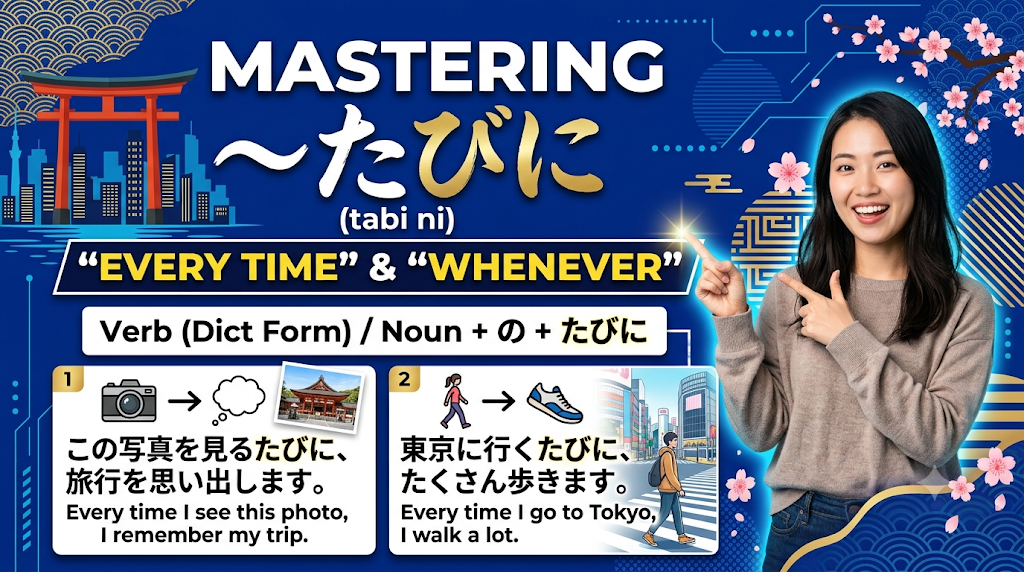
In Japanese, the natural, go-to grammar pattern for expressing this recurring connection between two actions is 〜たびに (tabi ni).
Classified as a core JLPT N4 grammar point, 〜たびに translates to “every time,” “whenever,” or “each time.” While the structural rule for using it is relatively straightforward, mastering its nuanced undertones—and knowing when not to use it—is what separates a mechanical test-taker from a natural speaker.
In this deep-dive guide, we will break down the mechanics of 〜たびに, explore its real-world practical applications, clear up common confusions with similar structures like 〜とき and 〜と, and look at common test traps to ensure you pass your next JLPT exam with flying colors.
1. What Does 〜たびに (tabi ni) Mean?
At its core, 〜たびに connects two events, Action A and Action B, to express that every single time Action A happens, Action B naturally or inevitably follows.
- Action A (Cause/Trigger): The recurring occasion or event.
- Action B (Result/Consequence): The action or state that happens every single time Action A occurs.
Kanzen Breakdown: The Kanji Behind the Pattern
The Japanese word たび (度) means “times,” “occasions,” or “occurrences.” When paired with the target particle に (ni), it literally translates to “on the occasion of.”
While you will frequently see it written in hiragana as 〜たびに, it occasionally appears in kanji as 〜度に. Both mean the exact same thing, though hiragana is standard in modern casual writing and on the JLPT exam paper.
2. How to Form Sentences with 〜たびに (Grammar Rules)
The grammar pattern for 〜たびに is clean and consistent. It attaches directly to two primary parts of speech: Verbs and Nouns.
| Part of Speech | Rule / Connection | Example Pattern |
| Verb | Dictionary Form (Plain Form) + たびに | 会う + たびに $\rightarrow$ 会うたびに (every time we meet) |
| Noun | Noun + の + たびに | 旅行 + の + たびに $\rightarrow$ 旅行のたびに (every time I take a trip) |
Critical Rule 1: Always Use the Plain Dictionary Form for Verbs
A very common mistake among intermediate students is trying to put the first verb into the past tense ($\text{〜た}$-form) because they feel the action has already happened. Do not do this.
Even if you are talking about a past habit, the verb directly before たびに MUST remain in the dictionary form (non-past plain form).
- Correct: 京都に行くたびに、八ツ橋を買います。(Every time I go to Kyoto, I buy Yatsuhashi.)
- Incorrect: 京都に行ったたびに、八ツ橋を買います。
Critical Rule 2: Connecting Nouns Requires の
When connecting a noun directly to たびに, you must insert the possessive/modifying particle の (no). The noun used must represent an event, action, or occasion (e.g., travel, shopping, match, visit).
- Correct: 出張(しゅっちょう)のたびに、お土産を買う。(Every time I go on a business trip, I buy souvenirs.)
- Incorrect: 出張たびに、お土産を買う。
3. Sentence Structure & Realistic Examples
To help you internalize how this pattern flows naturally, let’s analyze several realistic examples divided into everyday categories.
Category A: Everyday Routines & Personal Habits
These sentences illustrate predictable human behaviors tied to specific recurring triggers.
- 父は散歩に行くたびに、近所の保護猫に餌をあげる。
- Romaji: Chichi wa sanpo ni iku tabi ni, kinjo no hogoneko ni esa o ageru.
- English: Every time my father goes for a walk, he feeds the neighborhood rescue cat.
- 母は買い物に行くたびに、余計なものまで買ってしまう。
- Romaji: Haha wa kaimono ni iku tabi ni, yokei na mono made kaite shimau.
- English: Whenever my mother goes grocery shopping, she ends up buying things she doesn’t need.
- この本は読むたびに、新しい発見がある。
- Romaji: Kono hon wa yumu tabi ni, atarashii hakken ga aru.
- English: Every time I read this book, I make new discoveries.
Category B: Emotional Triggers & Memories
〜たびに is frequently used to express how a specific trigger consistently evokes a specific feeling or memory.
- この写真を見るたびに、学生時代を思い出す。
- Romaji: Kono shashin o miru tabi ni, gakusei jidai o omoidasu.
- English: Every time I look at this photo, I remember my student days.
- あの曲を聴くたびに、初めての失恋を思い出して胸が痛む。
- Romaji: Ano kyoku o kiku tabi ni, hajimete no shitsuren o omoidashite mune ga itamu.
- English: Whenever I listen to that song, I remember my first heartbreak and my chest hurts.
Category C: Event-Based Occasions (Noun + の + たびに)
- テストのたびに、緊張してお腹が痛くなる。
- Romaji: Tesuto no tabi ni, kinchou shite onaka ga itaku naru.
- English: Every time there is a test, I get nervous and my stomach aches.
- サッカーの試合のたびに、家族みんなでテレビの前で応援する。
- Romaji: Sakkā no shiai no tabi ni, kazoku minna de terebi no mae de ouen suru.
- English: Whenever there is a soccer match, the whole family cheers together in front of the TV.
4. Crucial Nuances & Limitations: When NOT to Use 〜たびに
Understanding where a grammar point fails is just as important as knowing where it works. Here are three important rules regarding the limitations of 〜たびに.
1. No Everyday Natural Phenomena or Constant States
You cannot use 〜たびに for routine state-of-being conditions or natural daily cycles that happen without exception as part of regular physics or daily schedules (like waking up or sunrise).
- Incorrect: 朝起きるたびに、顔を洗う。(Every time I wake up in the morning, I wash my face.)
- Why? Washing your face upon waking up is a routine habit, not an event-based recurrence that warrants “whenever/every time” emphasis. Use 〜と or simple sequential structures ($\text{〜てから}$) instead.
2. Action B Cannot Be a Continuous State
Action B (the consequence) must be an event or discrete action that takes place, not a ongoing state.
- Incorrect: 日本にいるたびに、日本語が上手だ。(Whenever I am in Japan, my Japanese is good.)
- Correct: 日本に行くたびに、日本語が上手になる。(Every time I go to Japan, my Japanese improves.)
3. Emphasizing High Frequency / Habitual Nature
〜たびに carries a subtle rhetorical weight. It highlights the repetition and consistency between two actions. If you just want to state a general conditional rule (“If X happens, Y happens”), standard conditionals are better suited.
5. Comparative Analysis: 〜たびに vs. 〜とき vs. 〜と vs. 〜ごとに
Japanese has multiple ways to connect timed events. Let’s look at how 〜たびに compares to similar structures so you never get confused during reading comprehension.
+------------------+----------------------------------+------------------------------------+
| Grammar Point    | Primary Meaning                  | Key Distinction                    |
+------------------+----------------------------------+------------------------------------+
| 〜たびに (tabi ni)| Every single time / Whenever     | Emphasizes 100% repeated correlation|
| 〜とき (toki)    | When / At the time of            | Neutral point in time (single/gen) |
| 〜と (to)        | When / If (natural result)       | Automatic consequence/natural laws |
| 〜ごとに (goto ni)| Every [X interval/unit]          | Focuses on regular intervals/units |
+------------------+----------------------------------+------------------------------------+
1. 〜たびに vs. 〜とき (toki)
- とき (Toki): Refers to a specific point in time or a general time frame. It does not inherently emphasize repetition.
- 例: 日本へ行ったとき、寿司を食べた。(When I went to Japan, I ate sushi. — Refers to one specific trip.)
- たびに (Tabi ni): Specifically highlights that this happens every single time without fail.
- 例: 日本へ行くたびに、寿司を食べる。(Every time I go to Japan, I eat sushi. — Refers to a repeated habit across multiple trips.)
2. 〜たびに vs. 〜ごとに (goto ni)
Both can translate to “every,” but their applications differ:
- ごとに (Goto ni): Used with units of time, space, or distribution (e.g., “every 3 hours,” “every person,” “every door”).
- 例: 3時間ごとに薬を飲んでください。(Please take the medicine every 3 hours.)
- たびに (Tabi ni): Used with discrete events or actions, not fixed physical or temporal measurement units.
6. JLPT N4 Exam Prep: Spotting Traps & Practice Exercises
On the JLPT N4 exam, 〜たびに appears in Grammar Questions, Sentence Ordering (star questions), and Reading Comprehension.
Common Test Traps to Avoid
- Tense Trap: Watch out for options that place past tense before たびに (e.g., 食べたたびに). Always select the dictionary form (食べるたびに).
- Particle Trap with Nouns: Remember that nouns require の. Test choices will try to trick you with 散歩たびに instead of 散歩のたびに.
- Choice between 〜たびに and 〜あとで: Remember that 〜あとで means “after doing X” (a sequence of events), whereas 〜たびに implies “every time X happens, Y also occurs.”
Interactive Practice Quiz
Test your knowledge with these 4 quick practice questions. (Answers provided at the end of this section!)
Q1. Complete the sentence with the correct form:
彼らは( Meet )たびに、喧嘩(けんか)をしている。
a) 会った
b) 会う
c) 会いに
d) 会合
Q2. Choose the correct particle setup:
旅行( ___ )たびに、ご当地(ごとうち)キーホルダーを集めています。
a) に
b) で
c) の
d) を
Q3. Which sentence is grammatically CORRECT?
a) 映画を見たたびに、泣いてしまう。
b) 映画を見るたびに、泣いてしまう。
c) 映画のたびに見る、泣いてしまう。
d) 映画が見るたびに、泣いてしまう。
Quiz Answer Key
- Q1 Answer: b) 会う (Rule: Plain dictionary form verb + たびに)
- Q2 Answer: c) の (Rule: Noun + の + たびに)
- Q3 Answer: b) 映画を見るたびに、泣いてしまう。 (Translation: Every time I watch a movie, I end up crying.)
7. Useful Resources for Further Japanese Study
To continue strengthening your Japanese grammar foundation and prepare effectively for test day, explore these trusted learning resources:
- For official test guidelines, test dates, and structural breakdowns, visit the Official JLPT Website.
- For comprehensive grammar indexes and practice problems across all N5–N1 levels, reference the detailed guides on Maggie Sensei’s Japanese Lessons.
- If you are preparing for N4 or N3 exams, review structured vocabulary and Kanji lists using the open-source materials available at Tae Kim’s Guide to Learning Japanese.
Final Thoughts
The key to mastering Japanese grammar is not just memorizing translation equivalents in your native language, but understanding the speaker’s intent. When you use 〜たびに, you are inviting the listener to notice a pattern—a recurring beat in your life, your emotions, or your experiences.


