
If you have ever been right in the middle of a hot shower when the water suddenly turned ice-cold, or right in the middle of an intense presentation when your phone started blasting your favorite anime opening, you already understand the emotional core of today’s grammar point.
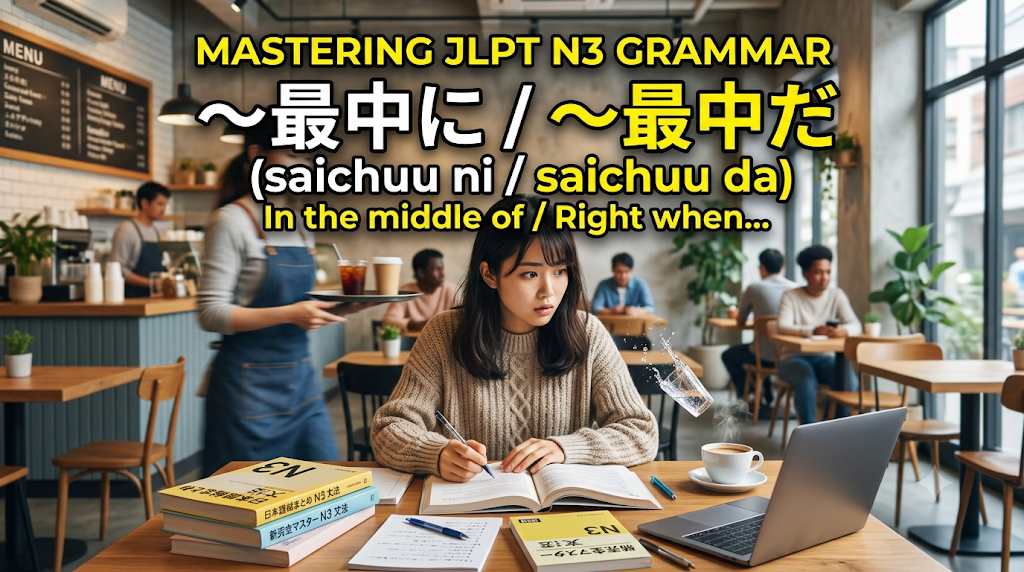
In Japanese, when an unexpected event interrupts you precisely at the peak or middle of an ongoing action, standard continuous forms like 〜ているときに (te iru toki ni) often fall flat. They state time, but they lack drama.
That is where ~最中に (saichuu ni) and ~最中だ (saichuu da) come in.
In this comprehensive guide, we are going to unpack everything you need to know about this JLPT N3 powerhouse—how it works structurally, how it differs from similar time-oriented grammar structures, how native speakers use it in daily life, and the exact traps test-makers set to catch you off guard.
What Does ~最中に / ~最中だ Mean?
At its core, 最中 (さいちゅう / saichuu) consists of two kanji:
- 最 (sai): Utmost, peak, most.
- 中 (chuu / naka): Middle, inside.
When combined, the word literally translates to “in the absolute peak middle of.”
When you attach grammar particles to it, you get two main functional variations:
- 〜最中に (saichuu ni): “Right in the middle of doing [Action A], [Action B happened / interrupted].”
- 〜最中だ (saichuu da): “I am / Someone is currently right in the middle of [Action A].”
Core Nuance: Interruption and Climax
While English translations usually say “right in the middle of,” the Japanese structure carries a distinct pragmatic nuance:
- High Focus / Concentration: Action A is typically something that requires focus, continuous movement, or occupies full mental/physical space.
- Unexpected Interruption: When 〜最中に is used, Action B is almost always an unexpected, disruptive, or surprising event that cuts into Action A.
- Peak Timing: Action B does not just happen during Action A—it happens right when Action A was at its height or critical point.
Sentence Construction & Conjugation Rules
To use this pattern accurately, you need to know how to connect it to verbs and nouns. Fortunately, the connection rules are straightforward.
| Part of Speech | Pattern | Example |
| Verb (V-て form) | V-ている + 最中に / 最中だ | 食べている最中に (Right in the middle of eating) |
| Noun | Noun + の + 最中に / 最中だ | 会議の最中に (Right in the middle of the meeting) |
1. Verb Connection (V-ている)
The verb must always be in its progressive form (〜ている). You cannot attach 最中 directly to a dictionary form verb or a past tense verb.
- Correct: 会議で発言している最中に、マイクが切れた。(Right in the middle of speaking at the meeting, the microphone cut out.)
- Incorrect:
会議で発言する最中に - Incorrect:
会議で発言した最中に
2. Noun Connection (Noun + の)
When attaching to nouns, the noun must be an action noun (a noun that implies an activity unfolding over time, often used with する).
- Correct: 試合の最中に雨が降り出した。(Rain started falling right in the middle of the match.)
- Correct: 事態の調査の最中だ。(We are right in the middle of investigating the situation.)
- Incorrect:
本を最中に(A physical item like a book is not an ongoing event; use 読書の最中に or 本を読んでいる最中に instead).
~最中に vs. ~最中だ: What’s the Difference?
The difference lies entirely in sentence position and function.
Case A: ~最中に (Used in the middle of a sentence)
Use 〜最中に as a conjunction when an external event cuts into an ongoing action.
- 授業中に居眠りしている最中に、先生に指名された。(Right in the middle of dozing off during class, the teacher called on me.)
- 家族で食事している最中に、大きな地震が起きた。(Right in the middle of eating dinner with my family, a major earthquake struck.)
Case B: ~最中だ (Used at the end of a sentence)
Use 〜最中だ (or its polite form 〜最中です) at the end of a clause to describe someone’s current state or ongoing status.
- A: 今、ちょっとお時間よろしいですか?(A: Do you have a moment right now?)B: すみません、今重要な書類を作成している最中なので、後でもいいですか?(B: I’m sorry, I am right in the middle of preparing an important document, so could we do it later?)
- 彼は今、来週のプレゼンの準備の最中だ。(He is currently right in the middle of preparing for next week’s presentation.)
Detailed Practical Examples
To build strong intuition, examine these examples grouped by everyday scenarios.
Scenario 1: Work and Business Settings
In professional settings, 〜最中です is a valuable phrase for politely establishing boundaries without being rude.
- 電話で話している最中に、突然回線が切れてしまった。Denwa de hanashite iru saichuu ni, totsuzen kaisen ga kirete shimatta.(Right in the middle of talking on the phone, the line suddenly got disconnected.)
- 申し訳ありません。社長は現在、来客の対応をしている最中です。Moushiwake arimasen. Shachou wa genzai, raikyaku no taiou o shite iru saichuu desu.(I am terribly sorry. The president is currently right in the middle of attending to a visitor.)
- 新しいシステムのテストを実行している最中にエラーが発生した。Atarashii sistemu no tesuto o jikkou shite iru saichuu ni eraa ga hassei shita.(An error occurred right in the middle of running tests on the new system.)
Scenario 2: Daily Life and Mishaps
Most textbook examples focus on inconvenient interruptions. Notice the tone of mild annoyance, surprise, or helplessness in these sentences.
- シャワーを浴びている最中に、ガスが止まってお湯が水になった。Shawaa o abite iru saichuu ni, gasu ga tomatte oyu ga mizu ni natta.(Right in the middle of taking a shower, the gas turned off and the hot water became ice-cold.)
- 料理を作っている最中に電話がかかってきて、焦げついてしまった。Ryouri o tsukutte iru saichuu ni denwa ga kakatte kite, kogetsuite shimatta.(A call came right in the middle of my cooking, and the food got burnt.)
- いい気持ちで寝ている最中に、蚊の羽音で目を覚まされた。Ii kimochi de nete iru saichuu ni, ka no haoto de me o samasareda.(Right in the middle of sleeping peacefully, I was woken up by the buzzing of a mosquito.)
For expanded vocabulary lists and sentence drills covering JLPT N3 structures, you can reference the complete grammar catalog at JLPT Sensei N3 Grammar Master List to complement your daily study.
Deep-Dive Comparison: Nuance & Similar Grammar Points
Understanding JLPT grammar requires knowing what not to choose in multiple-choice questions. Let’s compare ~最中に with its closest functional cousins.
+------------------+------------------------------+------------------------------------+
| Grammar Point    | Primary Focus                | Key Distinction                    |
+------------------+------------------------------+------------------------------------+
| ~最中に         | Peak climax / Interruption   | Emphasizes peak activity & impact  |
| ~ているときに   | Neutral background time      | Factual, no inherent drama         |
| ~うちに         | Time window / State change   | Focuses on changing before time    |
|                  |                              | runs out                           |
| ~あいだに       | Parallel duration            | Focuses on entire duration interval|
+------------------+------------------------------+------------------------------------+
1. ~最中に vs. ~ているときに
- ~ているときに: A neutral statement indicating that Action B occurred during the timeframe of Action A.
- ~最中に: Implies that Action A was actively at its peak, and Action B was an unexpected or disruptive event.
- Example:
- 勉強しているときに、友達が来た。(When I was studying, my friend came. — Neutral fact)
- 勉強している最中に、友達が来た。(Right in the middle of my intense studying, my friend dropped in. — Implication: My concentration was broken)
2. ~最中に vs. ~うちに
- ~うちに (Uchi ni): Means “while a certain state persists, do something before it changes.” It emphasizes taking advantage of an opportunity within a temporary window of time.
- ~最中に: Focuses on the continuous movement of an action being interrupted, not on timing an action before a state changes.
- Example:
- 日本にいるうちに、富士山に登りたい。(While I am in Japan [before I leave], I want to climb Mt. Fuji.)
- 日本を旅行している最中に、パスポートをなくした。(Right in the middle of traveling in Japan, I lost my passport.)
3. ~最中に vs. ~あいだに
- ~あいだに (Aida ni): Refers to a specific event happening at some point during a continuous period of time.
- ~最中に: Emphasizes that the event happened at the most active or vital moment of that period.
Subtle Native Usage Rules & Common Traps
To sound natural—and to score high on test day—keep these key constraints in mind:
Trap 1: Verb Selection Restrictions
You cannot use ~最中に with momentary verbs (verbs that happen in an instant without a continuous duration), such as 死ぬ (to die), 結婚する (to marry), or 着く (to arrive), unless they are describing a broader continuous process.
- Incorrect:
家に着いた最中に、雨が降った。 - Correct: 家に向かって歩いている最中に、雨が降った。(Right in the middle of walking toward home, it rained.)
Trap 2: Intentional vs. Unintentional Interruption
The event that follows 〜最中に (Action B) should generally be unintentional, natural, or unexpected. You rarely use it for intentional, pre-planned second actions by the same subject.
- Incorrect:
勉強している最中に、コーヒーを飲みに行った。(I went to drink coffee intentionally.) - Correct: 勉強している最中に、急にお腹が痛くなった。(Right in the middle of studying, my stomach suddenly began to hurt.)
JLPT Test-Taking Strategies & Practice Exercises
In the JLPT N3 exam, ~最中に frequently appears in both the Grammar Selection section and the Text Ordering (Star Questions) section. Here is how to tackle them quickly.
Diagnostic Practice Questions
Try answering these standard questions before reviewing the explanations below.
Question 1 (Grammar Selection)
会議の( )、非常ベルが鳴り響いて全員が避難した。
- 最中に
- うちに
- とおりに
- たびに
Question 2 (Sentence Construction)
映画の________ ________ ★ ________ パソコンがフリーズした。
- 最中に
- クライマックスの
- 見ていた
- シーンを
Answer Explanations
Question 1 Answer: 1 (最中に)
- Explanation: Emergency alarms ringing and forcing everyone to evacuate is an unexpected, disruptive event occurring right in the peak of an activity. “会議” is a noun, connecting via “の” -> 会議の最中に. Option 2 (うちに) does not fit the interruption context; 3 (とおりに) means “as / in accordance with”; 4 (たびに) means “whenever.”
Question 2 Answer Sequence: 2 -> 4 -> 3 -> 1
- Full Sentence: 映画のクライマックスのシーンを見ている最中にパソコンがフリーズした。(Right in the middle of watching the movie’s climax scene, my computer froze.)
- Star Position (★): Option 3 (見ている/見ていた) occupies the third position in this chain before connecting to 最中に.
For further clarification on Japanese kanji compounds like 最中 and their official readings across test levels, consult the searchable entries on the official JLPT Official Website Exam Guide.
Real-World Applications & Cultural Nuances
Understanding grammar in context helps solidify how native speakers actually use these phrases daily.
1. Excusing Yourself in Business (ビジネスの断り方)
In Japanese work culture, directly declining a request can sound harsh. Using 〜最中 lets you show that you are occupied with something pressing, softening the refusal:
「申し訳ありません、ただいま来期の予算案を作成している最中でして、本日17時以降に折り返しご連絡してもよろしいでしょうか。」
(I am so sorry, I am right in the middle of putting together next term’s budget proposal; would it be alright if I called you back after 5:00 PM today?)
2. Manga and Anime Drama Contexts
If you consume Japanese media, you will notice this grammar point frequently in moments of sudden comedy or tension:
- 「いいところだったのに!一番面白い最中に邪魔するなよ!」(We were just getting to the good part! Don’t interrupt right in the middle of the best scene!)
Quick Reference Summary Sheet
When reviewing before test day, keep this quick reference guide in mind:
- Meaning: Right in the middle of [Action A], [Action B unexpectedly happened].
- Connection Rules:
- Verb: V-ている + 最中に / 最中だ
- Noun: Noun + の + 最中に / 最中だ
- Key Nuance: Focuses on peak activity and unexpected interruptions or disturbances.
- Avoid Using With: Instantaneous non-continuous verbs or planned/intentional personal decisions for Action B.


