Introduction
Learning Japanese is an exciting journey, but with so many apps available, it’s hard to know which one suits your needs. Some focus on vocabulary, others on grammar, and a few even help with speaking practice.
As someone who’s tested dozens of language apps (and even failed a few JLPT levels before passing), I know how overwhelming it can be. That’s why I’ve compared the best Japanese learning apps—breaking down their strengths, weaknesses, and who they’re best for.
By the end of this guide, you’ll know exactly which app (or combination) will help you master Japanese faster.
How We Evaluated These Japanese Learning Apps
Before diving in, let’s clarify what makes a great Japanese learning app:
✅ Effective Teaching Method – Does it use spaced repetition, real-life dialogues, or structured lessons?
✅ Grammar & Vocabulary Coverage – Does it explain Japanese sentence structure well?
✅ Listening & Speaking Practice – Are there audio clips or speech recognition?
✅ JLPT Preparation – Does it align with N5 to N1 levels?
✅ User Experience – Is the app engaging and easy to use?
Now, let’s compare the top contenders.
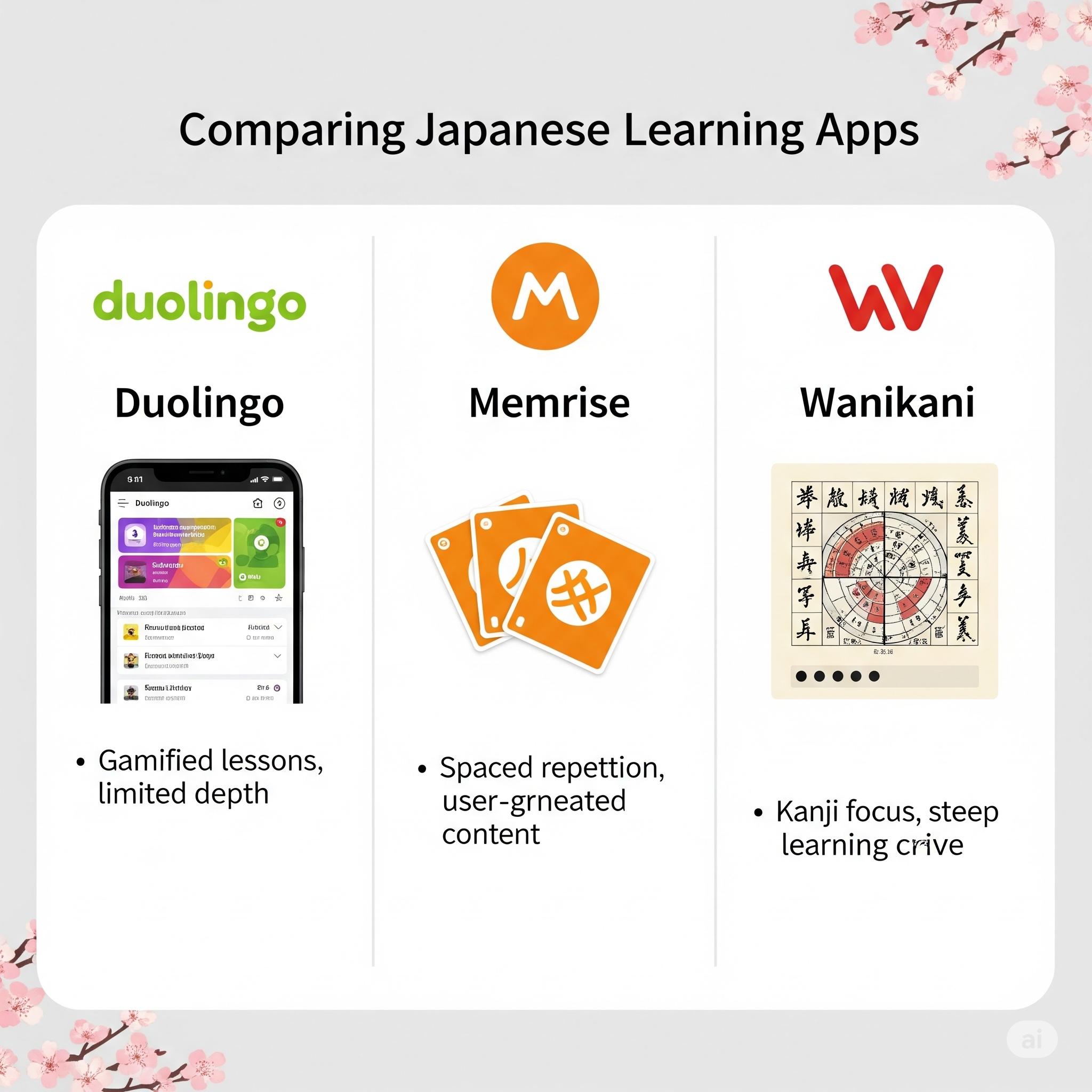
1. Duolingo – Best for Casual Learners
Duolingo is one of the most popular free language apps, but how well does it work for Japanese?
Pros:
✔ Gamified learning – Fun, bite-sized lessons.
✔ Free version available – Great for beginners on a budget.
✔ Good for basic vocabulary – Helps with hiragana, katakana, and simple phrases.
Cons:
❌ Weak on grammar explanations – Often leaves users confused about sentence structure.
❌ Repetitive exercises – Can feel robotic over time.
❌ Limited advanced content – Not ideal for JLPT N4+.
Best For:
- Absolute beginners
- People who want a free, low-pressure way to start
Alternatives: If you like Duolingo but want deeper explanations, try LingoDeer.
2. LingoDeer – Best for Structured Learning
LingoDeer is designed specifically for Asian languages, making it one of the best apps for learning Japanese grammar.
Pros:
✔ Clear grammar breakdowns – Explains particles (は vs. が) better than most apps.
✔ Structured lessons – Follows a logical progression from N5 to N3.
✔ Offline mode – Great for studying on the go.
Cons:
❌ Paid content gets pricey – Free version is limited.
❌ Less speaking practice – Focuses more on reading/writing.
Best For:
- Serious learners who want a textbook-like structure
- JLPT students (N5-N3)
Want more speaking practice? Pair it with Pimsleur.
3. Pimsleur – Best for Speaking & Listening
If you struggle with Japanese pronunciation, Pimsleur is a game-changer.
Pros:
✔ Audio-focused lessons – Trains your ear and speaking skills.
✔ Natural conversations – Teaches practical phrases, not just random words.
✔ 30-minute daily lessons – Perfect for commuters.
Cons:
❌ Expensive – No free version.
❌ Minimal reading/writing practice – Best used alongside another app.
Best For:
- Auditory learners
- People preparing for travel or conversations
Pro Tip: Combine Pimsleur with WaniKani for balanced skills.
4. WaniKani – Best for Kanji
Kanji is a major hurdle for Japanese learners, but WaniKani makes it manageable.
Pros:
✔ Mnemonic-based learning – Helps you remember kanji meanings and readings.
✔ Spaced repetition – Ensures long-term retention.
✔ Covers 2,000+ kanji – Enough for JLPT N1.
Cons:
❌ Only focuses on kanji/vocab – No grammar or speaking.
❌ Slow start – Free version limits progress.
Best For:
- Learners struggling with kanji
- JLPT students needing kanji reinforcement
Alternative: Anki (free but requires setup).
5. Anki – Best for Customizable Flashcards
Anki is a powerful flashcard app used by serious language learners.
Pros:
✔ Highly customizable – Add your own decks or download pre-made ones.
✔ Spaced repetition – Optimizes review timing.
✔ Free (except iOS) – Great for budget learners.
Cons:
❌ Steep learning curve – Not as user-friendly as other apps.
❌ No built-in lessons – Best for supplementing other study methods.
Best For:
- Self-motivated learners
- JLPT test-takers using pre-made decks
Recommended Deck: Tango N5 (great for beginners).
6. Bunpo – Best for JLPT Preparation
If you’re studying for the JLPT, Bunpo is a hidden gem.
Pros:
✔ JLPT-focused lessons – Covers N5 to N1.
✔ Grammar explanations – Breaks down complex concepts clearly.
✔ Practice quizzes – Reinforces learning.
Cons:
❌ Smaller content library – Not as extensive as LingoDeer.
❌ Subscription required – Free version is limited.
Best For:
- JLPT students
- Learners who need targeted grammar practice
Which Japanese Learning App Should You Choose?
| App | Best For | Price |
|---|---|---|
| Duolingo | Casual, fun learning | Free (with ads) |
| LingoDeer | Structured grammar | Paid ($14.99/mo) |
| Pimsleur | Speaking & listening | Paid ($19.95/mo) |
| WaniKani | Kanji mastery | Paid ($9/mo) |
| Anki | Custom flashcards | Free (except iOS) |
| Bunpo | JLPT prep | Paid ($4.99/mo) |
Final Recommendations:
- Complete Beginners: Start with Duolingo or LingoDeer.
- JLPT Students: Combine Bunpo + WaniKani + Anki.
- Conversation Focus: Use Pimsleur + HelloTalk (for speaking with natives).
Bonus: Free Resources to Supplement Your Learning
While apps are great, don’t forget these free tools:
- Tae Kim’s Grammar Guide (Best free Japanese grammar resource)
- NHK Easy Japanese (News articles in simple Japanese)
- Jisho.org (Best online Japanese dictionary)
Conclusion: Mix & Match for Best Results
No single app will make you fluent—the key is combining tools that cover speaking, listening, reading, and writing.
If I had to pick just three apps, I’d recommend:
- LingoDeer (Grammar & Structure)
- WaniKani (Kanji & Vocabulary)
- Pimsleur (Speaking & Listening)
But the best app is the one you’ll actually use consistently. Try a few, see what clicks, and stick with it!
What’s your favorite Japanese learning app? Let me know in the comments!
More Japanese Learning Resources:
- How to Pass the JLPT N5: Study Plan & Tips
- Best Japanese YouTube Channels for Learners
- Japanese Slang You Won’t Find in Textbooks
Happy studying! 頑張って!(Ganbatte!)