In the high-stakes world of Japanese commerce, a small piece of cardstock—measuring exactly 91 by 55 millimeters—holds more weight than a multi-page contract. This is the meishi (名刺).
To a Westerner, a business card is a convenient way to share contact details. To a Japanese professional, the meishi is a physical extension of their personhood, their rank, and their company’s honor. If you treat a meishi with disrespect, you are effectively disrespecting the person who gave it to you.
As a Japanese language expert and JLPT specialist, I have seen countless deals nearly collapse because a visiting executive shoved a card into their back pocket or, worse, used it as a coaster. In this guide, part of our comprehensive series on The Ultimate Guide to Japanese Business Etiquette & Culture (2025-26 Edition), we will dive deep into meishi culture and the rigid Japanese business card rules that govern professional life in Tokyo, Osaka, and beyond.
1. The Philosophy of Meishi Culture: More Than Just Paper
The first thing you must understand is that Japan is a high-context, hierarchical society. Before a single word of business is discussed, everyone in the room needs to know where they stand. Japanese business card etiquette serves as the “social lubricant” that establishes this hierarchy.
The exchange, known as meishi koukan (名刺交換), is a ritual that signals the official start of a relationship. It is a moment of mutual respect. In my years of preparing students for the JLPT N2 and N1 levels—where business honorifics (keigo) become vital—I always emphasize that the “language” of the card exchange is just as important as the spoken words.
Why Is It So Important?
- Identity: The card represents the company’s brand and the individual’s hard-earned title.
- Hierarchy: It allows participants to identify who the decision-maker is.
- Memorization: It provides a visual reference for names and titles, which is crucial given the complexity of Japanese surnames and kanji.
2. Preparation: The Gear You Need Before the Meeting
You cannot simply pull a card out of your wallet or a plastic bag. If you want to master Japanese business card rules, you need the right tools.
The Meishi-ire (Business Card Case)
You must carry your cards in a dedicated meishi-ire (business card case). These are typically made of high-quality leather. Carrying cards in your wallet is a major faux pas because it implies the cards (and the people they represent) are “sitting” on your money or being squeezed by your pocket.
Quality and Quantity
Always ensure your cards are pristine. A dog-eared or dirty card suggests a lack of attention to detail—a trait that can be fatal in Japanese manufacturing or finance sectors. Furthermore, never run out of cards. Bringing 50 cards to a 10-person meeting might seem like overkill, but it shows you are prepared for anything.
Pro-Insight: If you are visiting Japan from abroad, have one side of your card translated into Japanese. It shows immense respect for the local culture and ensures that even those who aren’t fluent in English can understand your rank and department.
3. The Step-by-Step Ritual of Japanese Business Card Exchange Etiquette
The exchange itself is a choreographed dance. If you are meeting multiple people, the exchange follows the hierarchy—starting with the highest-ranking person from the visiting party exchanging with the highest-ranking person of the host party.
Step 1: The Presentation
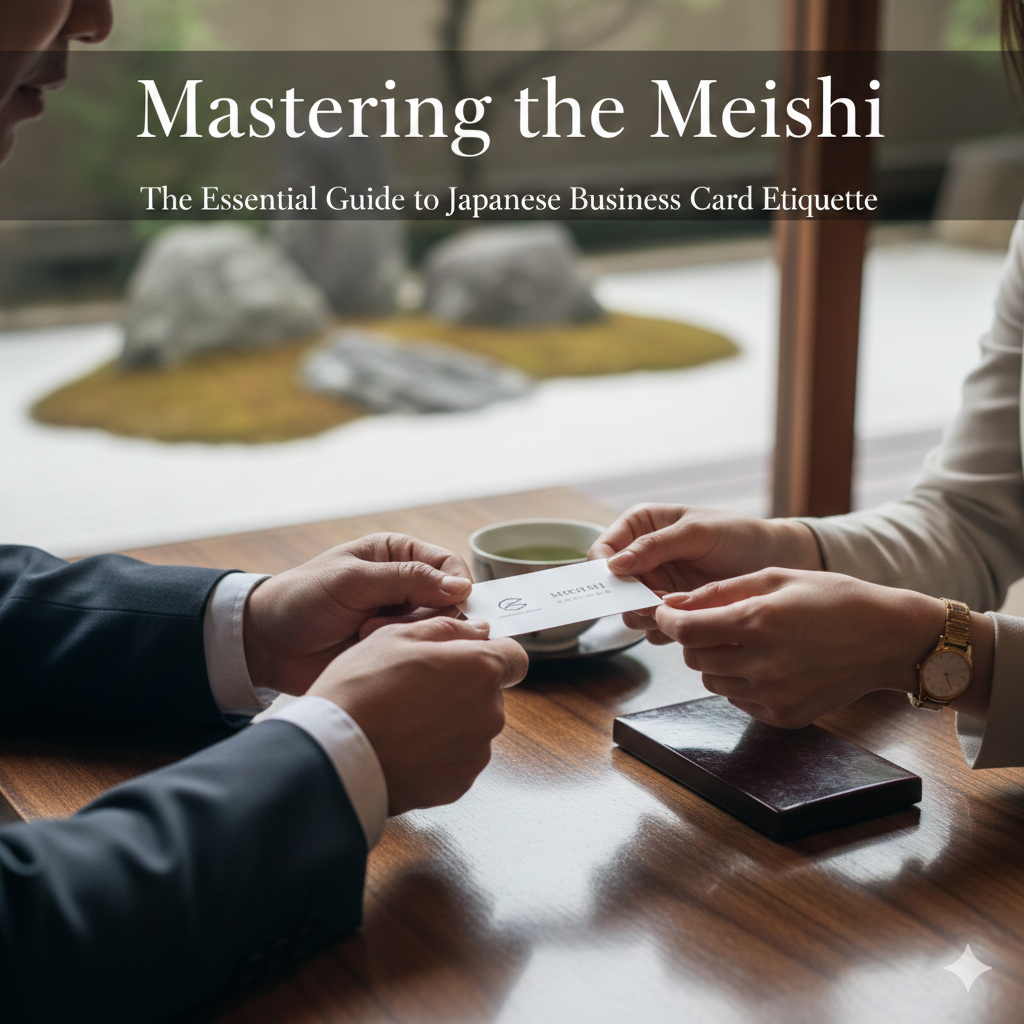
Stand up. Never exchange cards across a table if you can help it; move to the side or meet in an open space. Hold your card with both hands at the top corners, ensuring your thumbs do not cover the company logo or the person’s name.
The card should be facing the receiver so they can read it immediately.
Step 2: The Bow and the Phrase
As you present the card, perform a slight bow (about 15 to 30 degrees). You should introduce yourself using a standard business greeting.
- Self-introduction: “Hajimemashite. [Company name] no [Surname] to moshimasu. Yoroshiku onegaishimasu.”(Nice to meet you. I am [Surname] from [Company]. Please treat me kindly.)
Step 3: The “Lowest Hand” Rule
This is a subtle nuance many foreigners miss. In meishi culture, the person of lower status (or the person showing the most respect) should aim to offer their card at a slightly lower physical level than the other person’s card. It’s a silent battle of humility!
Step 4: Receiving the Card
When you receive the other person’s card, take it with both hands. Look at it intensely for a few seconds. Acknowledge their title or name. You might say, “[Surname]-san, gomeishi choudai itashimasu” (I gratefully receive your card).
Step 5: Simultaneous Exchange
In reality, both people often try to give and receive at the same time. In this case, use your right hand to give and your left hand to receive, then immediately bring both hands to the received card to show respect.
4. After the Exchange: The Table Layout
The etiquette doesn’t end when the cards are in your hand. Where you put the cards during the meeting is just as critical as how you received them.
- The “Map” Strategy: If you are sitting at a conference table, place the cards on the table in front of you. Arrange them in the exact order that the people are sitting. This acts as a “cheat sheet” so you don’t forget names or titles during the discussion.
- The Seat of Honor (Kamiza): The highest-ranking person’s card should be placed on top of your own leather card case to “elevate” it. The other cards can sit on the table surface.
- Avoid the “Pocket Shove”: Never, under any circumstances, put the cards away until the meeting is over.
5. The Cardinal Sins: What NOT to Do
To truly master japanese business card etiquette, you must avoid these common mistakes:
- Writing on the card: Never write notes on a person’s card in their presence. If you must record details, do it later in private.
- Fidgeting: Don’t play with the card, bend it, or use it to clean your fingernails (yes, it has happened!).
- The Wallet Slide: As mentioned, avoid the wallet. It’s seen as cheap and disrespectful.
- Forgetting the Card: Leaving a card behind at the end of a meeting is a signal that the relationship is over before it began.
- Passing like a playing card: Never “flick” a card or pass it with one hand.
If you find yourself in a more casual setting, like a post-work drink, the rules soften slightly, but the respect remains. Learn more about this in The Nomikai Survival Guide: Japanese Business Dining and Drinking Etiquette.
6. Language Insights for the JLPT Student
If you are studying for the JLPT, you’ll know that Keigo (honorific language) is a significant hurdle. The meishi exchange is the perfect practical application of Sonkeigo (respectful language) and Kenjougo (humble language).
When you say “Choudai itashimasu,” you are using the humble form of “to receive.” This tells your Japanese counterpart that you understand the social fabric of their country.
For a deeper dive into the verbal side of things, see our article on Beyond the Bow: Formal Greetings and Body Language in Japanese Business.
7. Digital Meishi in the Modern Era
Since 2020, “Digital Meishi” have gained traction. Platforms like Sansan or Eight allow professionals to exchange contact info via QR codes during Zoom or Microsoft Teams calls.
However, even in 2025, the physical exchange remains the “gold standard” for in-person meetings. If you are participating in a hybrid environment, knowing how to transition between digital and physical etiquette is vital. For tips on virtual professionalism, refer to How to Write Professional Japanese Business Emails: Etiquette, Phrases, and Zoom Rules.
8. Summary Table: Meishi Etiquette At-A-Glance
| Action | The Correct Way (Do) | The Incorrect Way (Don’t) |
| Handling | Use both hands at all times. | Use one hand or cover the logo. |
| Storage | Use a dedicated leather card case. | Use a wallet or pocket. |
| Placement | Arrange on the table to match seating. | Put it away immediately. |
| Condition | Pristine, clean, and updated. | Folded, dirty, or outdated. |
| Greeting | State name and company clearly. | Stay silent or just say “Hello.” |
9. Unique Insight: The “Meishi-Bowing” Angle
Most guides tell you to bow. But here is a unique insight: The angle of your bow should match the person you are meeting. If you are a vendor meeting a potential client, your bow should be slightly deeper than theirs. If you are of equal status, try to synchronize the depth. This level of “social mirroring” is highly valued in Japanese culture as it demonstrates wa (harmony). It shows you aren’t just following a checklist—you are feeling the atmosphere (kuuki wo yomu or “reading the air”).
10. Conclusion: First Impressions Last a Lifetime
Mastering the meishi is your entry ticket into the Japanese business world. It’s a small gesture that carries the weight of centuries of tradition. By following these japanese business card rules, you prove that you are not just a “gaikokujin” (foreigner) doing business, but a partner who respects the local culture.
Remember, the goal of meishi culture isn’t just to exchange phone numbers; it’s to build trust. When you hold that card with both hands and bow, you are saying, “I value your identity and our potential future together.”
What’s Your Next Move?
Are you worried about what to wear to that big meeting? Don’t let your clothes distract from your perfect meishi exchange. Check out our guide on What to Wear: The Modern Japanese Business Dress Code for Men and Women.
If you’re preparing for a visit where you’ll need to bring gifts along with your cards, don’t miss The Art of Giving: Japanese Business Gift Etiquette (Omiyage and Temiyage).