If you are climbing the Japanese language ladder, reaching the advanced tier is where everything changes. You move away from everyday conversational hurdles and step right into professional fluency. However, once learners cross or approach N2, a massive question always pops up: Is pushing from JLPT N2 to N1 actually worth the sheer amount of work required?
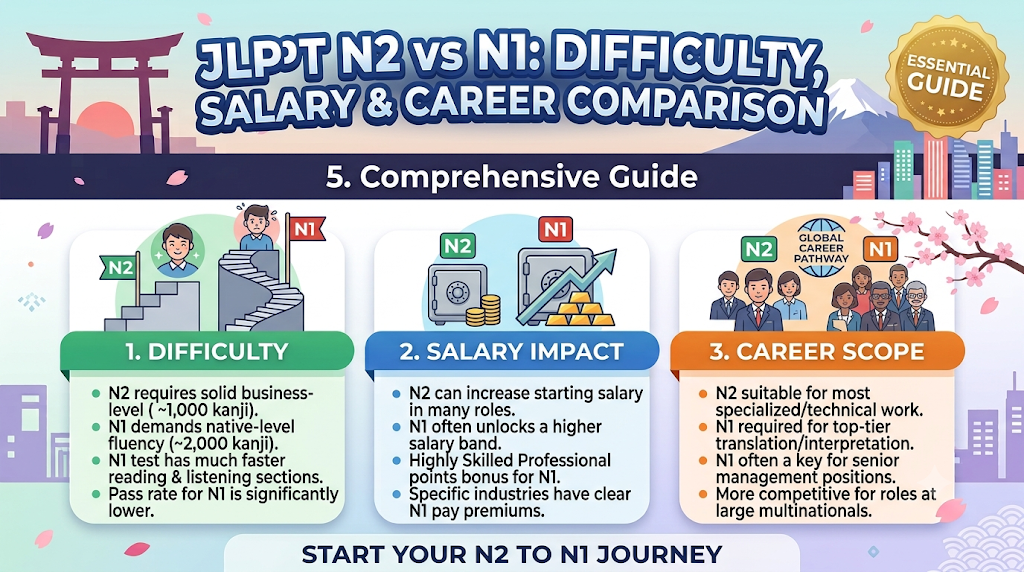
While N2 opens roughly 80% of corporate doors for foreign talent, N1 serves as the absolute gold standard for specialized roles, executive leadership, high-level translation, and diplomatic careers.
This comprehensive breakdown covers the difficulty jump, real-world career opportunities, global salary expectations, and practical strategic insights to help you decide your next move.
JLPT N2 vs JLPT N1: The Structural Breakdown
Understanding the exact Jump in quantitative requirements helps demystify why N1 feels like a completely different beast.
| Feature / Metric | JLPT N2 (Business Operational) | JLPT N1 (Native-Level Native Fluency) |
| Kanji Count | ~1,000 Kanji | ~2,130 Kanji (Full Joyo Set) |
| Vocabulary Size | ~6,000 Words | ~10,000+ Words |
| Study Hours Required | 1,600 – 2,200 Total Hours | 3,000 – 4,500 Total Hours |
| Reading Material | Newspaper summaries, workplace emails, commentary | Literary works, complex technical papers, philosophy |
| Listening Speed | Near-natural speed with standard business topics | Fast-paced, implicit meaning, heavy regional/casual accents |
| Target Competency | Practical business fluid comprehension | Full native comprehension across abstract & specialized contexts |
Difficulty Comparison: The Massive Gap Between N2 and N1
Passing N2 feels like graduating university, but preparing for N1 often feels like defending a doctoral thesis in linguistics. The jump isn’t linear—it’s exponential.
1. Vocabulary Depth and Abstract Nuances
N2 focuses heavily on practical grammar structures and concrete business vocabulary. N1, on the other hand, dives deep into classical Japanese expressions, archaic grammar forms, obscure idioms (yojijukugo), and abstract conceptual writing. You will encounter specialized academic terminology, formal political prose, and obscure literary expressions that even some native Japanese speakers rarely use in casual conversation.
2. Speed, Retention, and Dense Reading Passages
The reading section (dokkai) in N1 tests your cognitive stamina just as much as your language ability. You aren’t just reading for gist; you are analyzing implicit logic, author intent, tone shifts, and subtle rhetorical arguments under extreme time pressure.
Many test-takers discover that learning the grammar isn’t the hardest part. If you want to understand the psychological hurdles and structural traps of the top exam, check out our deep-dive analysis on Why JLPT N1 Is Hard (And How to Actually Pass It).
3. Listening Under Real-World Complexity
N2 listening tests clear, structured scenarios (e.g., train announcements, standard workplace updates). N1 listening includes fast-paced conversations where multiple speakers interrupt, use idiomatic expressions, talk around topics subtly, or express indirect hesitation—simulating real executive boardrooms.
Career Opportunities & Real-World Application
Having either certification instantly elevates your resume, but they qualify you for distinct career paths.
What JLPT N2 Opens Up
- IT Engineers & Developers: Foreign IT professionals with strong technical skills and N2 are in massive demand across Tokyo and global tech hubs.
- Bilingual Project Managers & Coordinators: Managing cross-functional teams where day-to-day workplace communication is conducted in Japanese.
- Sales & Account Executives: Handling standard client communications, business emails, and routine sales negotiations.
- Tourism, Hospitality & Service Management: Managing operations in luxury hotels, travel agencies, or international retail.
If you work in software, system architecture, or tech management, tailor your preparation specifically using our guide on the JLPT N2 Study Plan for Engineers & IT Professionals.
What JLPT N1 Unlocks
- In-House & Legal Translation / Interpretation: High-stakes simultaneous interpretation, legal contract translation, and publishing.
- Executive Leadership & Country Managers: Leading Japanese subsidiaries for Fortune 500 companies or driving international expansion for Japanese giants.
- Government, Diplomacy & Academic Research: Positions in embassies, trade ministries, policy research institutes, or university professorships.
- Keigo-Intensive Client Relations: Roles requiring mastery of complex honorifics, as detailed in our guide on Business Japanese for JLPT N1 Candidates.
Salary Potential & Industry Compensation Models
Your exact compensation depends heavily on industry, technical expertise, and geographic market, but language proficiency directly impacts base salary and language allowances (gogaku手当).
Salary Expectation Breakdown in Japan & International Markets
- Japan Market (Annual Base Salary):
- JLPT N2 Level: ¥4.5 Million – ¥8.5 Million JPY (Entry-to-Mid-level corporate/IT roles).
- JLPT N1 Level: ¥7.0 Million – ¥15.0+ Million JPY (Senior management, specialized translation, strategic consulting).
- Offshore Hubs (e.g., India, Southeast Asia):
- JLPT N2 Level: ₹8.0 LPA – ₹14.0 LPA / 25,000–30,000 THB monthly starting baseline.
- JLPT N1 Level: ₹15.0 LPA – ₹40.0+ LPA / 35,000+ THB monthly baseline + heavy language allowance.
Many Japanese corporations provide monthly language bonuses ranging from ¥10,000 to ¥30,000 JPY (or local currency equivalent) specifically for N1 holders compared to standard N2 allowances.
Should You Aim for N2 or N1? Making the Strategic Choice
Choose N2 First If:
- Your primary career skill is technical (Software Engineering, Product Design, Finance) and Japanese is a supporting skill.
- You want to enter the Japanese job market as quickly as possible.
- You prefer functional workplace communication over deep literary mastery.
Push for N1 If:
- Your core job role is language (Localization, Translation, Executive Interpretation).
- You aim for C-suite executive roles in Japanese corporate hierarchies.
- You are applying for permanent residency through Japan’s Highly Skilled Professional Visa (N1 grants 15 points, whereas N2 grants 10 points).
- You want to master the complete scope of the language without glass ceilings.
If you are balancing a full-time job while preparing for the top tier, optimize your routine with our actionable JLPT N1 Study Plan for Working Professionals.
For a complete roadmap covering both advanced tiers, review our master JLPT N1 & N2 Preparation Guide for Advanced Learners.
Official Resources & External References
To stay updated on official test schedules, scoring frameworks, and registration centers, visit these authoritative resources:
- Register for official exams and check global test dates on the Official Worldwide JLPT Website.
- Review official testing policies and administration details through the Japan Educational Exchanges and Services (JEES).
Final Verdict
JLPT N2 is the gateway that gets your foot firmly in the door, offering maximum return on investment for most working professionals. JLPT N1 is the master key that removes every remaining barrier, establishing you as an unquestioned linguistic expert in the corporate world. Choose the path that matches your long-term career vision, build a consistent daily routine, and stay dedicated to the journey.