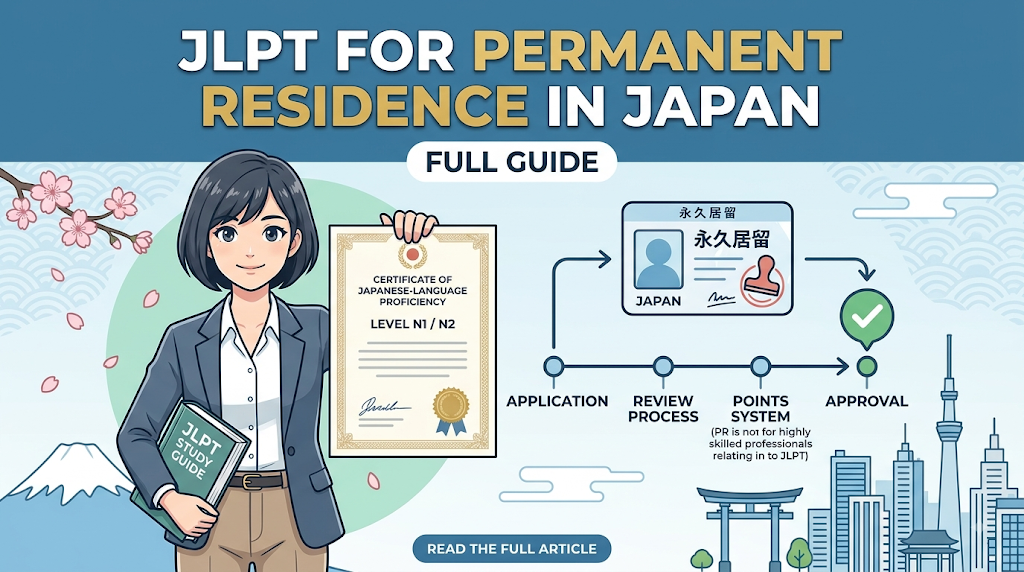
JLPT for Permanent Residence in Japan: Full Guide
Navigating Japan’s immigration landscape can feel like piecing together a complex puzzle. If your long-term dream is to secure Permanent Residence (PR) in Japan, you have likely heard mixed advice about language qualifications. Does passing the Japanese-Language Proficiency Test (JLPT) guarantee you PR? Is it strictly mandatory? And most importantly, how can your Japanese skills shave years—sometimes up to nine years—off your waiting period?
As a long-time educator and language consultant working directly with foreign professionals in Tokyo, I have watched hundreds of expats navigate this exact journey. In this complete guide, we will break down the exact role of JLPT permanent residence Japan strategy, how the points system works in your favor, and how to leverage your certificate to lock in permanent residency faster.
Before diving deep into the point calculations, if you are looking for an overarching overview of all visa pathways, check out our comprehensive flagship guide: JLPT for Immigration to Japan: Visa, PR & Work Permit Guide.
Official JLPT Certificate awarded for language proficiency. Source: MY JAPANESE ONLINE
1. Do You Need the JLPT to Apply for Permanent Residence in Japan?
The short answer is no, but practically speaking, yes—it makes your life infinitely easier.
Legally, Japan’s Immigration Services Agency (ISA) does not list a specific JLPT level as a strict, universal requirement for standard Permanent Residence applications. However, Japanese language proficiency plays two crucial roles in your PR trajectory:
- Standard PR Route (10-Year Requirement): Under the standard route, you need 10 consecutive years of residence in Japan (including at least 5 years on a valid working visa). While no JLPT certificate is legally required for the submission packet, your application includes a detailed Reason Statement (理由書 – Riyousho). Being able to write this in clear Japanese or demonstrating local integration significantly strengthens your profile during the discretionary evaluation by the immigration officer.
- Accelerated Points Route (1 to 3 Years): Under the Highly Skilled Professional (HSP) framework and the points-based PR pathway, a JLPT certificate becomes a game-changer. Holding an N1 or N2 certificate awards you direct bonus points that can shortcut your PR timeline from 10 years down to 3 years (with 70 points) or just 1 year (with 80 points). Japan Dev
If you are wondering how language testing fits into general employment before PR, read our detailed breakdown on Japanese Visa Language Requirements: Do You Really Need JLPT?.
2. How the JLPT Point System Speeds Up Your Japan PR Timeline
Japan introduced the points-based preferential immigration system to attract global talent, researchers, and specialized managers. Your total score is calculated based on academic background, professional experience, annual salary, age, and special qualifications.
Japan Dev+ 1
Here is where the JLPT permanent residence Japan correlation becomes invaluable:
Language Points Breakdown
| Language Qualification / Background | Points Awarded | Fast-Track Eligibility Impact |
|---|---|---|
| JLPT N1 Passed | 15 Points | Covers 50% of the gap between standard status and 70-point fast-track |
| JLPT N2 Passed | 10 Points | Equivalent to having 3 extra years of work experience or being under 35 |
| Graduated from a Japanese University | 10 Points | Stacks with general academic points |
| Graduated with a Japanese Major (Foreign University) | 15 Points | Treated as equivalent to JLPT N1 for scoring purposes |
japanpr.me+ 1
Note: You can review official criteria directly on the Immigration Services Agency of Japan (ISA) portal or verify exam structures on the Official JLPT Website.
To see how these language points blend with your age, salary, and degrees, explore our complete breakdown on How JLPT Points Work for Japanese Immigration.
3. The Two Fast-Track PR Pathways: 70 Points vs. 80 Points
To understand why 10 to 15 JLPT points are so impactful, look at the two fast-track thresholds established by the Ministry of Justice:
[Standard Route] -------> 10 Years Residence Required
[70 Points Route] ------> 3 Years Residence Required (Save 7 Years!)
[80 Points Route] ------> 1 Year Residence Required  (Save 9 Years!)
Scenario A: Reaching 70 Points (3-Year PR Pathway)
Imagine a 32-year-old Software Engineer working in Tokyo:
- Bachelor’s Degree: 10 Points Japan Dev
- 5 Years Work Experience: 10 Points
- Age (30–34): 10 Points
- Annual Salary (6 Million JPY): 20 Points japanpr.me
- Current Subtotal: 50 Points
Without Japanese language skills, this professional is stuck waiting out the 10-year standard route. But add JLPT N1 (+15 Points) or JLPT N2 (+10 Points) alongside a Japanese corporate training bonus, and they instantly jump past the 70-point mark, enabling a PR application after just 3 years in Japan.
Japan Dev
Scenario B: Reaching 80 Points (1-Year PR Pathway)
Consider a Senior Data Scientist earning 8 Million JPY with a Master’s degree:
- Master’s Degree: 20 Points japanpr.me
- Age (Under 30): 15 Points japanpr.me
- Salary (8 Million JPY): 30 Points japanpr.me
- Subtotal: 65 Points
Passing JLPT N1 (+15 Points) immediately propels this applicant to 80 Points. They become eligible to apply for Permanent Residence after a single year of living and working in Japan.
japanpr.me+ 1
Standard Application Form for Permanent Residence in Japan. Source: TKG Immigration Consulting Office
4. JLPT N1 vs. N2 for PR: Which One Should You Target?
A common question among my students is whether spending months grinding kanji for N1 is worth the extra 5 points over N2.
JLPT N2: The Realistic High-Yield Milestone
- Points: 10 Points japanpr.me
- Study Effort: Approx. 600–800 hours from beginner.
- Practical Benefit: N2 proves business-level conversational ability and basic reading comprehension. For most mid-career professionals, N2 provides the exact boost needed to reach 70 points without burnt-out study sessions.
JLPT N1: The Ultimate Accelerator
- Points: 15 Points japanpr.me
- Study Effort: Approx. 1,200–1,500+ total hours.
- Practical Benefit: N1 unlocks native-level corporate options, higher salary brackets, and provides maximum points. If you are targeting the 80-point 1-year fast-track, those extra 5 points often make or break your eligibility. Your Talent Research Team in Japan
If you are deciding between different testing options for work and residency status, check out our comparative analysis: JLPT vs JFT: Which Test Is Better for Visa Applications?.
5. Practical Steps: Documenting JLPT for Your PR Application
When submitting your PR application packet to the Regional Immigration Bureau (出入国在留管理局 – Shutsunyuumokukoku Zairyuu Kanrikyoku), claiming language points requires official verification.
Here is the exact step-by-step procedure:
- Obtain the Official Certificate: You cannot submit a simple printout of your online test results. You must submit the official Certificate of Result and Scores (合否結果通知書) or Certificate of Japanese-Language Proficiency (日本語能力認定書) issued by Japan Educational Exchanges and Services (JEES) or the Japan Foundation.
- Ensure Name Match: Verify that the Romanized name on your JLPT certificate matches your passport and Residence Card (Zairyu Card).
- Point Calculation Sheet: Attach the official Ministry of Justice Point Calculation Table (Point Keisansho), clearly ticking the N1 (15 pts) or N2 (10 pts) box. You can download the official point worksheets directly from the Japan Ministry of Justice Immigration Resources. japanpr.me
- Historical Proof: If you are applying under the retroactive fast-track (e.g., proving you had 70/80 points 1 or 3 years ago and maintained them), your JLPT certificate must have been issued before or during that baseline period.
6. Real-World Advice: Beyond the Point System
While the math is clear, immigration screening in Japan involves human review. Here are three practical insights I always share with applicants:
- Tax and Pension Compliance is Strict: You can have 100 points and N1, but if you paid your local inhabitant tax (Juminzei) or National Pension (Kokumin Nenkin) even a few days late during the observation period, your PR application will likely be rejected. Point eligibility gets you through the door, but flawless civic record-keeping secures the approval.
- The “3-Year or 5-Year Visa” Rule: To apply for PR, your current visa must have the maximum length granted for your category (usually 3 or 5 years). Holding a 1-year visa disqualifies you from submitting a PR application, regardless of how many points you score.
- Employer Stability Matters: Holding N1 or N2 shows long-term commitment to living in Japan, which gives immigration officers confidence that your employment in Japan is stable and sustainable.
If you are currently on an employment visa and wondering about initial entry requirements, refer to our guide on JLPT Required for Japanese Work Visa (Explained Clearly).
Summary Checklist for JLPT & Japan PR
To ensure your language qualification maximizes your Permanent Residence strategy:
- [ ] Determine if you qualify for the 70-point (3-year) or 80-point (1-year) PR route. Japan Dev
- [ ] Calculate whether JLPT N2 (+10 pts) or N1 (+15 pts) provides the necessary score boost. 日本語能力試験 JLPT
- [ ] Secure physical copies of your official JLPT score certificates.
- [ ] Verify your residence card validity (must be a 3-year or 5-year visa period).
- [ ] Maintain 100% on-time payments for Japanese taxes, health insurance, and pension.
Where would you like to go next with your Japan PR planning?
Calculate my exact HSP immigration score
Guide on writing the PR Reason Statement in Japanese
Compare JLPT N1 vs N2 study timelines