
Learning Japanese used to mean drowning in textbooks, flipping physical Anki flashcards until your eyes watered, and spending thousands of dollars on private tutors just to practice basic conversation.
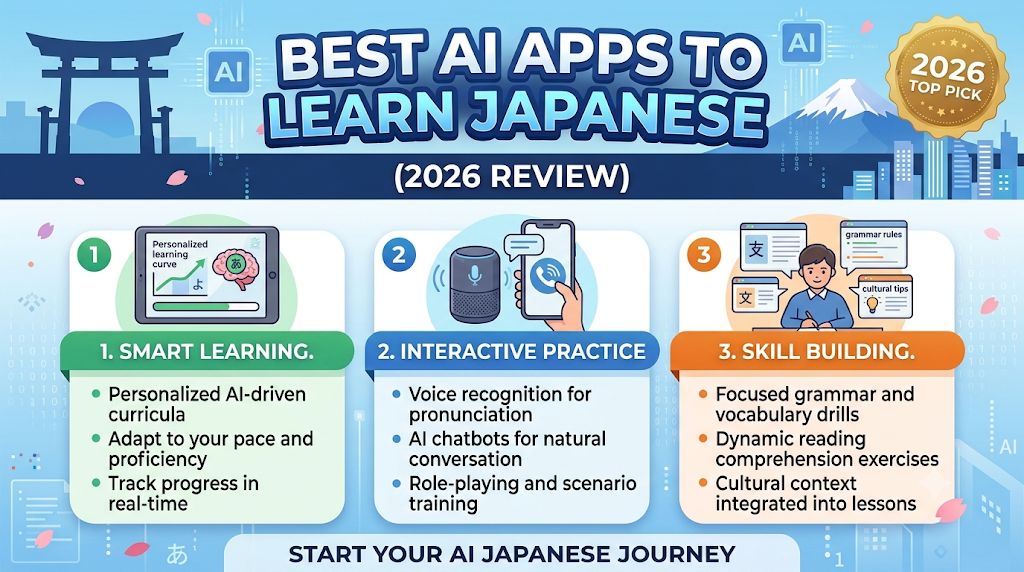
The digital landscape for language learning has shifted drastically. Artificial intelligence has fundamentally transformed how we acquire non-native languages, especially complex Asian languages like Japanese. However, with dozens of applications promising “instant fluency,” finding tools that actually deliver real results rather than clever marketing gimmicks can be overwhelming.
Whether you are preparing for the Japanese Language Proficiency Test (JLPT), planning a trip to Tokyo, or simply trying to understand anime without subtitles, this breakdown covers the best AI Japanese learning apps available in 2026.
The Landscape of AI Japanese Learning in 2026
Traditional language apps excel at teaching isolated vocabulary words and simple translations, but they often fail when it comes to sentence assembly, natural nuance, and spontaneous output. Japanese features layered politeness levels (Keigo), implicit context omission (high-context language), complex particle usage, and three distinct writing systems.
Modern AI-driven applications bridge this gap by offering dynamic conversational roleplays, instant contextual grammar corrections, personalized spaced-repetition memory schedules, and pitch accent feedback.
To build a well-rounded study plan, explore our central resource on AI Tools to Learn Japanese Faster in 2026 to see how various technologies fit together.
Top AI Japanese Learning Apps Reviewed
+------------------+------------------------------+---------------------------+------------------------+
| App              | Primary Strength             | Target Level              | Pricing Model          |
+------------------+------------------------------+---------------------------+------------------------+
| Lingrow / Pingo  | AI Roleplay & Voice Output   | Beginner to Advanced      | Subscription           |
| Sensei Japanese  | JLPT Prep & News Reader      | N5 to N1 Candidates       | Freemium               |
| LingoDeer        | Structured Grammar Foundations| Absolute Beginner to N3   | Subscription           |
| Bunpro (AI)      | Spaced-Repetition Grammar    | N5 to N1                  | Freemium / Subscription|
| Satori Reader    | Contextual Reading & AI Lookup| Intermediate (N4+)       | Freemium / Subscription|
+------------------+------------------------------+---------------------------+------------------------+
1. Lingrow & Pingo AI — Best for Conversational & Interactive Speaking Practice
If speaking anxiety is holding you back, dedicated conversational AI apps like Lingrow and Pingo AI provide safe, stress-free environments to practice real-time output.
Practical Applications
Instead of picking words from a multiple-choice menu, you talk directly to a responsive AI tutor. You can simulate scenarios like:
- Ordering regional ramen in an izakaya using casual phrasing.
- Asking for directions at Kyoto Station while managing polite desu/masu forms.
- Negotiating business meetings in formal Keigo.
Pros
- Real-time corrections on sentence construction and natural phrasing.
- Adjusts speaking speed to match your listening comprehension.
- Reduces the social pressure associated with talking to human native speakers.
Cons
- Requires strong baseline knowledge of Hiragana/Katakana to read along.
- Subscription-based pricing with limited free trials.
2. Sensei Japanese — Best for JLPT Test Preparation
Preparing for the official JLPT requires structured study routines, exact kanji lists, and dedicated reading comprehension drills. Sensei Japanese utilizes AI algorithms to turn exam preparation into a targeted, feedback-heavy process.
Practical Applications
- Mock exam simulations spanning levels N5 to N1 with immediate AI feedback breaking down where you made errors.
- Integrated reading materials featuring real-time, one-tap AI dictionaries and dynamic furigana toggles.
- Visual kanji mnemonics paired with automated stroke-order checks.
Pros
- Excellent alignment with official JLPT examination structures.
- Deep answer breakdowns explain why a particular particle or grammar point was incorrect.
Cons
- The user interface can feel dense for complete beginners.
- Free tiers cap the daily amount of AI-generated answer breakdowns.
3. LingoDeer — Best for Structured Grammar Foundations
While general-purpose language platforms treat Japanese like an extension of Romance languages, LingoDeer was designed specifically for East Asian languages. Its integrated AI modules offer structured, step-by-step grammatical progression.
Practical Applications
- Clear breakdowns of Japanese particle mechanics (such as the distinction between は and が).
- Voice recognition modules that analyze pitch accent contours alongside basic pronunciation.
- Built-in review schedules that target your specific weak points automatically.
To ensure your written Japanese remains error-free while drafting essays or emails, check out our guide on the Best AI Grammar Checker for Japanese Learners.
Strategic AI Workflows for Japanese Learners
Relying on a single app is rarely enough to achieve true Japanese proficiency. Combining specialized tools into a cohesive routine yields better results.
+-----------------------------------------------------------------------------------+
|                            THE ULTIMATE 2026 AI STACK                             |
+-----------------------------------------------------------------------------------+
|  [ Morning Routine ]    -->  Anki / Satori Reader (Kanji & Reading Immersion)      |
|  [ Mid-day Practice ]   -->  Sensei / LingoDeer (Grammar & JLPT Drills)            |
|  [ Evening Session ]    -->  Lingrow / ChatGPT Voice (Open AI Conversational Output)|
+-----------------------------------------------------------------------------------+
Leveraging Custom Prompts for Direct Practice
When app-based routines feel restrictive, custom conversational setups give you complete freedom. Read our step-by-step tutorial on Using ChatGPT to Learn Japanese (Best Prompts) to transform general-purpose language models into personalized tutors.
Preparing for Official Exams
Many students ask if artificial intelligence can replace traditional classroom instruction when preparing for official tests. Dive into our critical assessment: Can AI Help You Pass JLPT? Reality vs Hype.
How to Maximize Your Results with AI Apps
- Prioritize Native Audio Verification: AI text-to-speech engine quality has improved significantly, but always supplement your studies with native audio sources (podcasts, anime, YouTube) to verify pitch accent accuracy.
- Embrace Mistakes in Low-Stakes Roleplays: The greatest advantage of an AI language partner is that it never gets tired, impatient, or judgmental. Use voice mode to practice speaking aloud every day.
- Double-Check Complex Nuances: LLMs can occasionally misinterpret formal nuances or regional dialects (Kansai-ben). Cross-reference complex grammar explanations with reputable resources like the JLPT Sensei Study Guide or the official Japan Foundation Educational Portal.
The Verdict
In 2026, the ideal Japanese learning stack is modular. Use Sensei Japanese or Bunpro to handle grammar and exam readiness, Anki for raw vocabulary retention, and Lingrow or Pingo AI to build real-time conversational confidence.
Consistency remains key: 20 minutes of active speaking and review with an AI app every day will always yield better long-term results than hours of passive textbook reading once a week.