
If you have been studying Japanese past the beginner level, you have likely run into moments where direct dictionary translations fail you. You know how to say “This looks like an apple” or “It is raining,” but how do you express those subtle, everyday observations like.
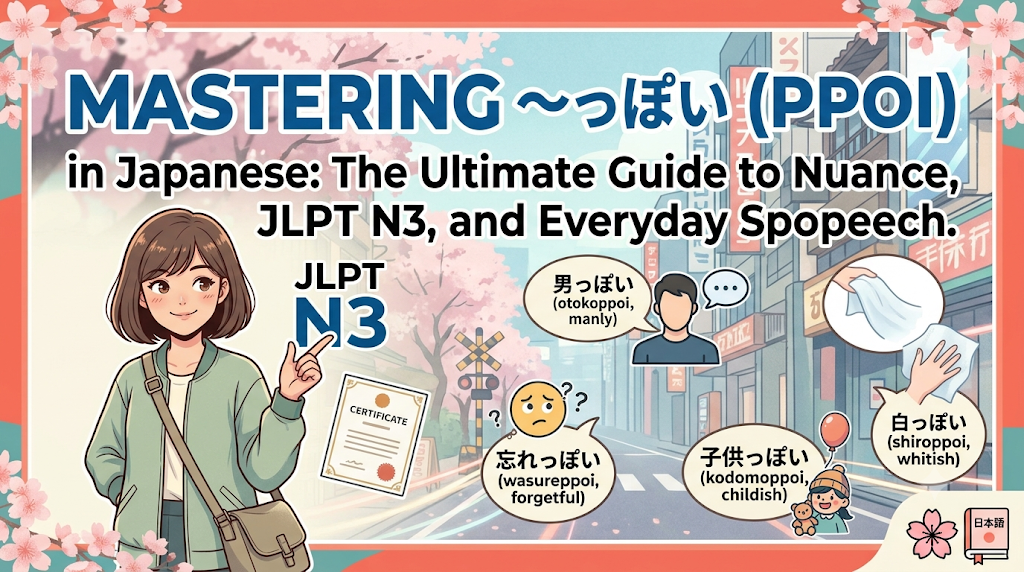
- “That guy acts so childish.”
- “This tea tastes a bit watery.”
- “Lately, I’ve been feeling forgetful.”
In natural Japanese, native speakers reach for one incredibly versatile suffix: 〜っぽい (ppoi).
Whether you are preparing for the JLPT N3 exam or trying to sound less like a textbook and more like a local walking through Shibuya, mastering 〜っぽい is a major milestone. In this deep dive, we will unpack everything about 〜っぽい—from its primary meanings and grammatical patterns to subtle nuances, practical real-world usage, common mistakes, and how it stacks up against close relatives like 〜らしい and 〜みたい.
What Does 〜っぽい (ppoi) Actually Mean?
At its core, 〜っぽい attaches to the end of nouns, adjectives, or verb stems to create an adjective that means “-ish,” “looking like,” “resembling,” or “prone to.”
Grammatically, once you attach っぽい to a word, the newly formed word behaves like a standard い-adjective (i-adjective).
Because it turns solid concepts into flexible, descriptive impressions, it carries three distinct core functions in everyday conversation:
- Appearance or Quality (-ish, like): Describing something that resembles a quality, even if it isn’t literally that thing.
- Tendency or Disposition (prone to / easy to): Expressing an inherent habit, personality trait, or frequent state of mind.
- Overabundance / Flavor Profile (watery, whitish): Describing a dominant visual or sensory sensation (e.g., taste, color, or texture).
1. The Core Grammar Rules and Conjugation
Before using 〜っぽい in conversation, you need to understand how to attach it correctly. The good news: attaching っぽい is straightforward once you know the basic word types.
Conjugation Chart
| Word Class | Base Form | Formula | Example | Meaning |
| Noun | 子供 (kodomo / child) | Noun + っぽい | 子供っぽい (kodomoppoi) | Childish / Child-like |
| い-Adjective | 黒い (kuroi / black) | Drop 〜い + っぽい | 黒っぽい (kuroppoi) | Blackish / Darkish |
| な-Adjective | 俗っぽい (zokuppoi) | Drop 〜な + っぽい | 俗っぽい (zokuppoi) | Worldly / Vulgar / Common |
| Verb (Masu-stem) | 忘れる (wasureru / to forget) | Verb Stem + っぽい | 忘れっぽい (wasureppoi) | Forgetful / Prone to forgetting |
Step-by-Step Breakdown by Word Type
A. Attaching to Nouns
When paired with nouns, 〜っぽい attributes the characteristics or vibes of that noun to something else.
- 男 (otoko / man) $\rightarrow$ 男っぽい (otokoppoi / manly, masculine)
- 安物 (yasumono / cheap item) $\rightarrow$ 安物っぽい (yasumonoppoi / cheap-looking)
Example:
彼女の服装は少し男っぽいですね。
(Kanojo no fukusou wa sukoshi otokoppoi desu ne.)
Her clothing is a bit masculine/boyish.
B. Attaching to い-Adjectives
To combine っぽい with an い-adjective, drop the final い and add っぽい.
- 白い (shiroi / white) $\rightarrow$ 白っぽい (shiroppoi / whitish)
- 油過ぎる $\rightarrow$ 油っぽい (aburappoi / oily, greasy)
Example:
このスープはちょっと油っぽい気がする。
(Kono suupu wa chotto aburappoi ki ga suru.)
I feel like this soup is a bit too greasy.
C. Attaching to Verb Stems (Tendency/Habit)
Take the ます-stem (the form of the verb before ます) and attach っぽい. This specific pattern indicates a personal weakness, tendency, or habit.
- 忘れる (wasureru $\rightarrow$ wasure) $\rightarrow$ 忘れっぽい (wasureppoi / forgetful)
- 怒る (okoru $\rightarrow$ okori) $\rightarrow$ 怒りっぽい (okorippoi / quick-tempered)
- 飽きる (akiru $\rightarrow$ aki) $\rightarrow$ 飽きっぽい (akippoi / easily bored)
Example:
歳をとってから、最近忘れっぽくなった。
(Toshi o totte kara, saikin wasureppoku natta.)
Since getting older, I’ve become quite forgetful lately.
To verify your grasp of base verb stems and elementary conjugation rules, check out the comprehensive JLPT N5 Grammar Guide provided on the official JLPT site.
2. Deep Dive into Nuances and Meanings
Understanding the mechanics is step one. Knowing when and why to use 〜っぽい over other expressions is what makes your Japanese sound natural.
       [ Core Concept: 〜っぽい (ppoi) ]
                      |
     +----------------+----------------+
     |                |                |
[ Resemblance ]  [ Tendency ]   [ Sensory ]
"Looks like..."  "Prone to..."  "Dominant quality"
Nuance 1: “Childish” vs. “Child-like” (Negative vs. Neutral)
One of the most essential cultural nuances of 〜っぽい is that it often carries a slightly critical or negative connotation when applied to people or behavior.
Consider the difference between two common ways to say “childlike” or “childish”:
- 子供っぽい (kodomoppoi): Childish, immature (usually critical or casual).
- 子供らしい (kodomorashii): Childlike in a healthy, fitting way (innocent, lively, behaving as a child properly should).
If an adult gets mad over losing a simple game, you would say:
大人なのに、すごく子供っぽいね。
(Otona nano ni, sugoku kodomoppoi ne.)
You’re an adult, but you’re being so childish.
Here, using っぽい highlights that the behavior is unsuited for an adult.
Nuance 2: Sensations and Flavors
When applied to foods, drinks, or physical elements, っぽい denotes an exaggerated or diluted sensory trait:
- 水っぽい (mizuppoi): Watery, diluted, washed out (e.g., watery coffee or over-boiled soup).
- 油っぽい (aburappoi): Greasy, heavy with oil.
- 湿気っぽい (shikkeppoi): Damp, humid, muggy.
Example:
このコーヒー、水を入れすぎて水っぽいよ。
(Kono koohii, mizu o iresugi te mizuppoi yo.)
This coffee is really watery because you added too much water.
3. Comparing 〜っぽい, 〜らしい, and 〜みたい
One of the biggest hurdles for learners studying for JLPT N3 is separating 〜っぽい, 〜らしい, and 〜みたい ( / 〜ようだ). They all translate roughly to “looks like” or “seems like” in English, but they function differently in practice.
Let’s break them down side-by-side.
| Grammar Pattern | Primary Nuance | Literal Truth | Example | Translation |
| 〜っぽい | Visual impression, subjective vibe, critical tone | Not actually the thing (usually) | 男っぽい女 (otokoppoi onna) | A masculine woman (She is female) |
| 〜らしい | True to character, ideal standard, typical | Is actually the thing | 男らしい男 (otokorashii otoko) | A manly man (He is male, acting like a true man) |
| 〜みたい | Visual similarity, direct metaphor/simile | Can be literal or metaphorical | 夢みたい (yume mitai) | Like a dream (It feels like a dream) |
Contextual Comparison Examples
1. Talking About a Man
- 彼、男っぽいね。 (Kare, otokoppoi ne.)Vibe: He has masculine features/style (casual observation).
- 彼、男らしいね。 (Kare, otokorashii ne.)Vibe: He exhibits true manly qualities like strength, dependability, or chivalry (praise).
2. Talking About Weather
- 春っぽい天気。 (Haruppoi tenki.)Vibe: It feels spring-ish today (even if it’s actually February).
- 春らしい天気。 (Harurashii tenki.)Vibe: It’s typical spring weather (and it is currently spring).
For structured lessons on parsing these subtle differences across intermediate levels, explore the curated exercises available on Maggie Sensei, a popular resource for practical, real-world Japanese usage.
4. Real-World Dialogue Examples
To help you put this grammar into context, here are everyday conversations using 〜っぽい in natural contexts.
Scenario A: Shopping for Clothes
A: この黒いジャケット、どう思う?
(Kono kuroi jaketto, dou omou?)
“What do you think of this black jacket?”
B: うーん、ちょっと安物っぽく見えるかも。デザインはかっこいいけどね。
(Uun, chotto yasumonoppoku mieru kamo. Dezain wa kakkoii kedo ne.)
“Hmm, it looks a bit cheap-ish. The design is cool, though.”
Scenario B: Talking About Habits at Work
A: 田中さん、また鍵をどこかに置き忘れたらしいよ。
(Tanaka-san, mata kagi o dokoka ni okiwasureta rashii yo.)
“Looks like Tanaka-san misplaced his keys again.”
B: あはは、彼は本当に忘れっぽい性格だなあ。
(Ahaha, kare wa hontou ni wasureppoi seikaku da naa.)
“Ahaha, he really has a forgetful personality, doesn’t he?”
Scenario C: Casual Speculation (Colloquial Usage)
In casual spoken Japanese, young adults frequently drop っぽい at the very end of a sentence as a quick particle meaning “It seems like…” or “Sounds like it.”
A: 明日のコンパ、佐藤くん来るの?
(Ashita no konpa, Satou-kun kuru no?)
“Is Satou coming to the mixer tomorrow?”
B: ううん、仕事が終わらないっぽい。
(Uun, shigoto ga owaranai ppoi.)
“Nah, looks like he won’t finish work in time.”
5. Common Pitfalls and Mistakes to Avoid
Even intermediate students make predictable errors with 〜っぽい. Keeping these two edge cases in mind will keep your speech accurate:
Pitfall 1: Confusing っぽい with 〜がち (Gachi)
Both 〜っぽい and 〜がち can mean “tending to do something,” but their contexts differ:
- 〜っぽい: Refers to a natural tendency, personality trait, or emotional state (e.g., 怒りっぽい = quick to anger, 忘れる $\rightarrow$ 忘れっぽい = naturally forgetful).
- 〜がち: Refers to frequent events, habits, or negative occurrences happening often over time (e.g., 病気になりがち = prone to getting sick, 遅刻しがち = tends to be late).
Pitfall 2: Double Inflexion Errors
Remember that once っぽい attaches to a word, the whole compound turns into an い-adjective.
- Incorrect: 安物っぽいの車 (yasumonoppoi no kuruma)
- Correct: 安物っぽい車 (yasumonoppoi kuruma) $\rightarrow$ A cheap-looking car.
- Incorrect: 忘れっぽいですでした (wasureppoi desu deshita)
- Correct: 忘れっぽかったです (wasureppokatta desu) $\rightarrow$ I was forgetful.
To cross-reference sentence patterns and formal JLPT testing guidelines, consult the extensive breakdown hosted on the Tofugu Grammar Database, an invaluable tool for mastering Japanese structures.
Key Takeaways
To recap your study session today:
- Meaning: 〜っぽい means “-ish,” “looking like,” “resembling,” or “prone to.”
- Grammar: Attaches directly to Nouns, drops final い from い-adjectives, and attaches to the ます-stem of Verbs.
- Inflexion: Operates like a standard い-adjective (〜っぽい $\rightarrow$ 〜っぽく $\rightarrow$ 〜っぽかった).
- Tone: Highly conversational, slightly casual, and often carries a minor negative or critical edge compared to 〜らしい.


