
If you’ve been studying Japanese for a while, you’ve probably run into moments where you felt a little bit sick, a tiny bit tired, or noticed a slight upward trend in prices.
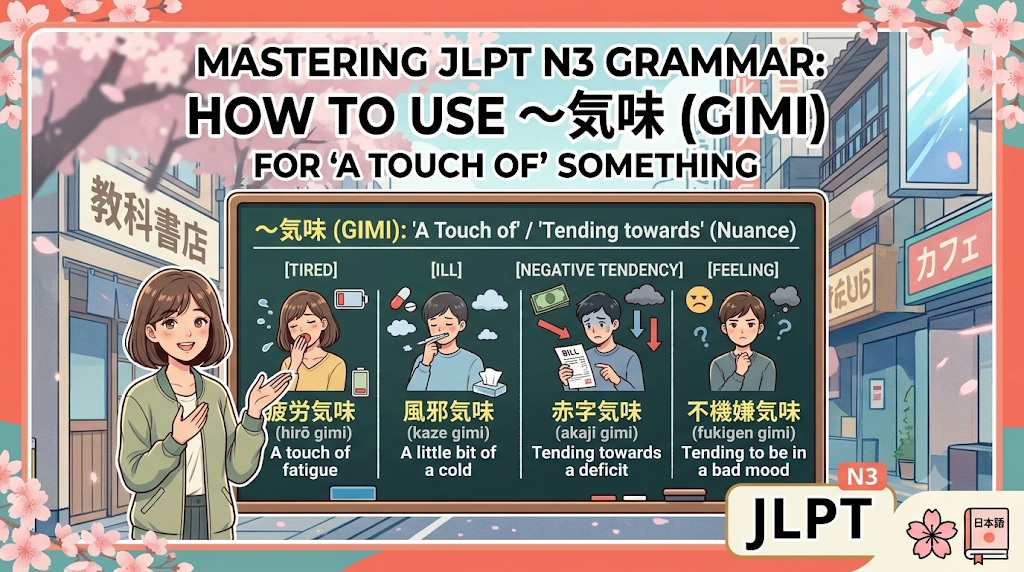
In English, we use soft expressions like “a touch of a cold,” “a bit on the heavy side,” or “leaning towards.” In Japanese, one of the most natural, native-sounding ways to express this subtle shift is with the grammar point 〜気味 (ぎみ / gimi).
Understanding 〜気味 is an important stepping stone when moving from upper-beginner (JLPT N4) to intermediate (JLPT N3) Japanese. It moves your speech away from textbook-rigid sentences like 「ちょっと風邪をひきました」 to expressive, native-level nuances like 「風邪気味です」.
In this guide, we will break down everything you need to know about 〜気味: its exact meaning, formation rules, real-world examples, key differences from tricky lookalikes like 〜勝ち (gachi), and how to apply it naturally in daily conversation.
What Does 〜気味 (Gimi) Mean?
At its core, 〜気味 (ぎみ) translates to:
- A touch of…
- A slight feeling of…
- A bit…
- Leaning towards…
- Tendency to be slightly…
The word 気味 comes from 気 (ki – spirit, feeling, atmosphere) and 味 (aji – taste, sense). Combined, it describes a subtle physical sensation, psychological state, or observed condition that is just beginning to manifest.
Key Insight: 〜気味 is almost always used for negative or undesirable states. You wouldn’t use it to say you are “a touch too happy” or “slightly winning.” Instead, it applies to physical ailments, negative emotional trends, or unfavorable physical changes (like gaining weight or running late).
How to Form Sentences with 〜気味
The structural formation of 〜気味 is straightforward, but you must pay close attention to which verb form you use.
| Part of Speech | Connection Pattern | Example |
| Noun | Noun + 気味 | 風邪気味 (kaze-gimi – a touch of a cold) |
| Verb (Stem Form) | Verb (MASU stem) + 気味 | 疲れ気味 (tsukare-gimi – slightly tired) |
1. Noun + 気味
Attach 気味 directly to the noun without adding の (no) or に (ni).
- 風邪 (cold) $\rightarrow$ 風邪気味 (kaze-gimi) — A bit of a cold
- 寝不足 (lack of sleep) $\rightarrow$ 寝不足気味 (nebusoku-gimi) — Slightly sleep-deprived
- 太り (weight gain) $\rightarrow$ 太り気味 (futori-gimi) — A bit on the heavier side
2. Verb Stem + 気味
Take a verb in its ます (masu) form, drop the ます, and attach 気味.
- 疲れます (tsukaremasu / to get tired) $\rightarrow$ 疲れ気味 (tsukare-gimi)
- 遅れます (okuremasu / to be late) $\rightarrow$ 遅れ気味 (okure-gimi)
- 上がります (agaremasu / to go up) $\rightarrow$ 上がり気味 (agari-gimi)
Modifying Nouns and Verbs with 〜気味
Depending on where 〜気味 sits in your sentence, its suffix form changes:
- At the end of a sentence (Predicate):
- 〜気味だ (gimi da) — Informal
- 〜気味です (gimi desu) — Formal
- Example: 最近、少々風邪気味です。 (Saikin, shou shou kaze-gimi desu. / Lately, I’ve got a bit of a cold.)
- Modifying a Noun: Use 〜気味の + Noun
- Example: 太り気味の体型を改善したい。 (Futori-gimi no taikei wo kaizen shitai. / I want to improve my slightly overweight physique.)
- Modifying a Verb or Adjective: Use 〜気味に + Verb/Adjective
- Example: 彼はうつむき気味に話した。 (Kare wa utsumuki-gimi ni hanashita. / He spoke looking slightly downward.)
Essential Real-Life Examples
To get comfortable with this grammar point, let’s examine practical categories where you will hear 〜気味 used in Japan every day.
Physical Ailments & Health
- 風邪気味なので、今日は早く寝ます。Kaze-gimi nano de, kyou wa hayaku nemasu.I have a touch of a cold, so I’m going to go to sleep early today.
- 最近、ずっと寝不足気味で頭が重い。Saikin, zutto nebusoku-gimi de atama ga omoi.Lately, I’ve been slightly sleep-deprived and my head feels heavy.
Physical/Work Trends & Schedules
- 今月はプロジェクトの進捗が遅れ気味だ。Kongetsu wa purojekuto no shinchoku ga okure-gimi da.This month, the project’s progress is running a little behind schedule.
- 最近は外食続きで、太り気味になってきた。Saikin wa gaishoku tsuzuki de, futori-gimi ni natte kita.Since I’ve been eating out continuously lately, I’ve started putting on a bit of weight.
Emotional States & Psychological Sensations
- 新入社員の田中さんは、連日の残業で緊張気味の表情をしている。Shin’nyuu shain no Tanaka-san wa, renjitsu no zangyou de kinchou-gimi no hyoujou wo shite iru.Tanaka, the new employee, has a slightly nervous expression due to working overtime days in a row.
〜気味 (Gimi) vs. 〜勝ち (Gachi): Avoiding the Common Trap
One of the most frequent mistakes JLPT test-takers make is confusing 〜気味 (gimi) with 〜勝ち (gachi). Both are intermediate grammar points used to express tendencies or slight conditions, but their nuances are distinctly different.
| Grammar Point | Core Meaning | Frequency / Nature | Typical Usage |
| 〜気味 (gimi) | “Slight feeling of…” / “A touch of…” | A present state or current trend happening right now. | Single instances, health states, physical feelings. |
| 〜勝ち (gachi) | “A habit of…” / “Tends to frequently…” | A repeated habit or ongoing tendency over time. | Repeated actions, general habits, character traits. |
Compare These Two Sentences:
- 遅れ気味です (Okure-gimi desu)Meaning: “We are running a bit late right now.” (Refers to the current situation/trend of a specific project or event).
- 遅れ勝ちです (Okure-gachi desu)Meaning: “It tends to be late frequently.” (Refers to a repeated habit, e.g., train delays that happen regularly).
Practical Insights: Why Native Speakers Prefer 〜気味
In Japanese culture, わび・さび (Wabi-Sabi) and politeness dictate that direct declarations can sometimes feel harsh or overly dramatic.
If you tell your boss, 「風邪をひきましたから休みたいです」 (I caught a cold so I want to take a day off), it sounds absolute. However, saying 「少し風邪気味なので…」 soft-pedals the condition, giving off a humble, non-dramatic tone while still clearly communicating that you aren’t feeling 100%.
Using 〜気味 helps you:
- Avoid absolute statements when describing your health or emotions.
- Express subtle physical changes without sounding overly self-critical.
- sound natural, mature, and considerate in business settings.
Practical Study Resources
To master grammar structures like 〜気味 and excel in your Japanese language journey, practicing with authentic study materials and official test prep sites is essential. Here are recommended resources to deepen your understanding:
- For comprehensive grammar practice, detailed JLPT guides, and complete vocabulary lists across all levels, visit the official JLPT Sensei Study Resource to build your test-taking confidence.
- To practice real-world reading comprehension and keep up with news in clear Japanese, check out NHK News Web Easy, a fantastic tool for learning intermediate grammar in context.
Test Yourself: Quick Exercise
Try translating the following sentences into Japanese using 〜気味 (gimi):
- I feel a bit tired today, so I’ll skip the gym.
- Prices have been slightly rising lately.
- He answered the question with a touch of anxiety/nervousness.
Answers:
- 今日は疲れ気味だから、ジムに行くのをやめます。(Kyou wa tsukare-gimi da kara, jimu ni iku no wo yamemasu.)
- 最近、物価が上がり気味だ。(Saikin, bukka ga agari-gimi da.)
- 彼は不安気味に答えた。(Kare wa huan-gimi ni kotaeta.)
Summary
The grammar point 〜気味 (gimi) is an indispensable tool for anyone aiming for fluency in Japanese. By attaching it to nouns or verb stems, you can softly express minor health issues, slight physical changes, or temporary negative trends. Keep practicing by incorporating it into your daily self-talk or study journals!If you’ve been studying Japanese for a while, you’ve probably run into moments where you felt a little bit sick, a tiny bit tired, or noticed a slight upward trend in prices.
In English, we use soft expressions like “a touch of a cold,” “a bit on the heavy side,” or “leaning towards.” In Japanese, one of the most natural, native-sounding ways to express this subtle shift is with the grammar point 〜気味 (ぎみ / gimi).
Understanding 〜気味 is an important stepping stone when moving from upper-beginner (JLPT N4) to intermediate (JLPT N3) Japanese. It moves your speech away from textbook-rigid sentences like 「ちょっと風邪をひきました」 to expressive, native-level nuances like 「風邪気味です」.
In this guide, we will break down everything you need to know about 〜気味: its exact meaning, formation rules, real-world examples, key differences from tricky lookalikes like 〜勝ち (gachi), and how to apply it naturally in daily conversation.
What Does 〜気味 (Gimi) Mean?
At its core, 〜気味 (ぎみ) translates to:
- A touch of…
- A slight feeling of…
- A bit…
- Leaning towards…
- Tendency to be slightly…
The word 気味 comes from 気 (ki – spirit, feeling, atmosphere) and 味 (aji – taste, sense). Combined, it describes a subtle physical sensation, psychological state, or observed condition that is just beginning to manifest.
Key Insight: 〜気味 is almost always used for negative or undesirable states. You wouldn’t use it to say you are “a touch too happy” or “slightly winning.” Instead, it applies to physical ailments, negative emotional trends, or unfavorable physical changes (like gaining weight or running late).
How to Form Sentences with 〜気味
The structural formation of 〜気味 is straightforward, but you must pay close attention to which verb form you use.
| Part of Speech | Connection Pattern | Example |
| Noun | Noun + 気味 | 風邪気味 (kaze-gimi – a touch of a cold) |
| Verb (Stem Form) | Verb (MASU stem) + 気味 | 疲れ気味 (tsukare-gimi – slightly tired) |
1. Noun + 気味
Attach 気味 directly to the noun without adding の (no) or に (ni).
- 風邪 (cold) $\rightarrow$ 風邪気味 (kaze-gimi) — A bit of a cold
- 寝不足 (lack of sleep) $\rightarrow$ 寝不足気味 (nebusoku-gimi) — Slightly sleep-deprived
- 太り (weight gain) $\rightarrow$ 太り気味 (futori-gimi) — A bit on the heavier side
2. Verb Stem + 気味
Take a verb in its ます (masu) form, drop the ます, and attach 気味.
- 疲れます (tsukaremasu / to get tired) $\rightarrow$ 疲れ気味 (tsukare-gimi)
- 遅れます (okuremasu / to be late) $\rightarrow$ 遅れ気味 (okure-gimi)
- 上がります (agaremasu / to go up) $\rightarrow$ 上がり気味 (agari-gimi)
Modifying Nouns and Verbs with 〜気味
Depending on where 〜気味 sits in your sentence, its suffix form changes:
- At the end of a sentence (Predicate):
- 〜気味だ (gimi da) — Informal
- 〜気味です (gimi desu) — Formal
- Example: 最近、少々風邪気味です。 (Saikin, shou shou kaze-gimi desu. / Lately, I’ve got a bit of a cold.)
- Modifying a Noun: Use 〜気味の + Noun
- Example: 太り気味の体型を改善したい。 (Futori-gimi no taikei wo kaizen shitai. / I want to improve my slightly overweight physique.)
- Modifying a Verb or Adjective: Use 〜気味に + Verb/Adjective
- Example: 彼はうつむき気味に話した。 (Kare wa utsumuki-gimi ni hanashita. / He spoke looking slightly downward.)
Essential Real-Life Examples
To get comfortable with this grammar point, let’s examine practical categories where you will hear 〜気味 used in Japan every day.
Physical Ailments & Health
- 風邪気味なので、今日は早く寝ます。Kaze-gimi nano de, kyou wa hayaku nemasu.I have a touch of a cold, so I’m going to go to sleep early today.
- 最近、ずっと寝不足気味で頭が重い。Saikin, zutto nebusoku-gimi de atama ga omoi.Lately, I’ve been slightly sleep-deprived and my head feels heavy.
Physical/Work Trends & Schedules
- 今月はプロジェクトの進捗が遅れ気味だ。Kongetsu wa purojekuto no shinchoku ga okure-gimi da.This month, the project’s progress is running a little behind schedule.
- 最近は外食続きで、太り気味になってきた。Saikin wa gaishoku tsuzuki de, futori-gimi ni natte kita.Since I’ve been eating out continuously lately, I’ve started putting on a bit of weight.
Emotional States & Psychological Sensations
- 新入社員の田中さんは、連日の残業で緊張気味の表情をしている。Shin’nyuu shain no Tanaka-san wa, renjitsu no zangyou de kinchou-gimi no hyoujou wo shite iru.Tanaka, the new employee, has a slightly nervous expression due to working overtime days in a row.
〜気味 (Gimi) vs. 〜勝ち (Gachi): Avoiding the Common Trap
One of the most frequent mistakes JLPT test-takers make is confusing 〜気味 (gimi) with 〜勝ち (gachi). Both are intermediate grammar points used to express tendencies or slight conditions, but their nuances are distinctly different.
| Grammar Point | Core Meaning | Frequency / Nature | Typical Usage |
| 〜気味 (gimi) | “Slight feeling of…” / “A touch of…” | A present state or current trend happening right now. | Single instances, health states, physical feelings. |
| 〜勝ち (gachi) | “A habit of…” / “Tends to frequently…” | A repeated habit or ongoing tendency over time. | Repeated actions, general habits, character traits. |
Compare These Two Sentences:
- 遅れ気味です (Okure-gimi desu)Meaning: “We are running a bit late right now.” (Refers to the current situation/trend of a specific project or event).
- 遅れ勝ちです (Okure-gachi desu)Meaning: “It tends to be late frequently.” (Refers to a repeated habit, e.g., train delays that happen regularly).
Practical Insights: Why Native Speakers Prefer 〜気味
In Japanese culture, わび・さび (Wabi-Sabi) and politeness dictate that direct declarations can sometimes feel harsh or overly dramatic.
If you tell your boss, 「風邪をひきましたから休みたいです」 (I caught a cold so I want to take a day off), it sounds absolute. However, saying 「少し風邪気味なので…」 soft-pedals the condition, giving off a humble, non-dramatic tone while still clearly communicating that you aren’t feeling 100%.
Using 〜気味 helps you:
- Avoid absolute statements when describing your health or emotions.
- Express subtle physical changes without sounding overly self-critical.
- sound natural, mature, and considerate in business settings.
Practical Study Resources
To master grammar structures like 〜気味 and excel in your Japanese language journey, practicing with authentic study materials and official test prep sites is essential. Here are recommended resources to deepen your understanding:
- For comprehensive grammar practice, detailed JLPT guides, and complete vocabulary lists across all levels, visit the official JLPT Sensei Study Resource to build your test-taking confidence.
- To practice real-world reading comprehension and keep up with news in clear Japanese, check out NHK News Web Easy, a fantastic tool for learning intermediate grammar in context.
Test Yourself: Quick Exercise
Try translating the following sentences into Japanese using 〜気味 (gimi):
- I feel a bit tired today, so I’ll skip the gym.
- Prices have been slightly rising lately.
- He answered the question with a touch of anxiety/nervousness.
Answers:
- 今日は疲れ気味だから、ジムに行くのをやめます。(Kyou wa tsukare-gimi da kara, jimu ni iku no wo yamemasu.)
- 最近、物価が上がり気味だ。(Saikin, bukka ga agari-gimi da.)
- 彼は不安気味に答えた。(Kare wa huan-gimi ni kotaeta.)
Summary
The grammar point 〜気味 (gimi) is an indispensable tool for anyone aiming for fluency in Japanese. By attaching it to nouns or verb stems, you can softly express minor health issues, slight physical changes, or temporary negative trends. Keep practicing by incorporating it into your daily self-talk or study journals!


