Have you ever walked down a street in Tokyo, spotted someone you vaguely knew from language school, and suddenly found your eyes glued to your phone?
You weren’t actually reading a breaking news alert. You were pretending to be busy.
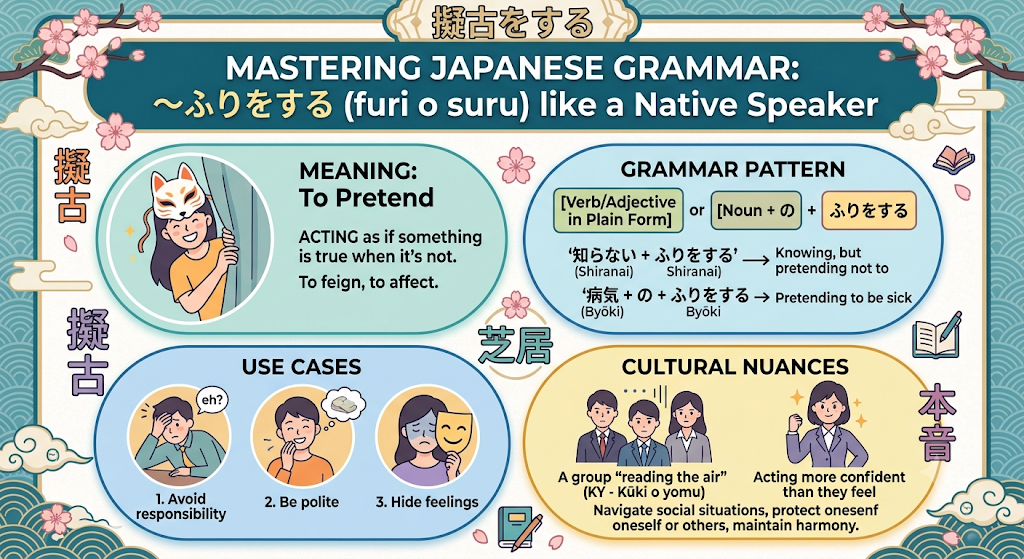
In Japanese, that exact human behavior—putting on an act, feigning ignorance, or pretending to be something you’re not—is captured by a single, versatile grammar pattern: ~ふりをする (furi o suru).
Whether you’re prepping for the JLPT N3 exam, striving to sound more natural in casual daily conversations, or deciphering nuance in modern Japanese drama, understanding how to use ~ふりをする correctly is a game-changer.
In this deep dive, we’ll break down the meaning, construction rules, hidden emotional nuances, and real-world applications of ~ふりをする so you can speak Japanese with confidence and authentic flair.
1. What Does ~ふりをする (furi o suru) Mean?
At its core, ~ふりをする translates to:
- “To pretend to…”
- “To act as if…”
- “To feign…”
- “To make out like…”
The core word ふり (振るい / 振り) refers to behavior, posture, or appearance. When combined with the verb をする (to do), it literally means “to put on the behavior/appearance of [X].”
Kanji Notation: 振る舞い / 振り
While you will almost always see this pattern written in hiragana as ふりをする in modern textbooks, manga, and JLPT exams, it derives from the kanji 振 (furi), which relates to movement or posture (as in 振る舞う furumau – to behave).
Expert Tip: On the JLPT N3 exam, stick to recognizing and writing it in hiragana. Writing it as 振りをする isn’t incorrect in everyday texts, but standard JLPT questions favor ~ふりをする.
2. Structural Breakdown & How to Conjugate
The beauty of ~ふりをする lies in its flexibility. You can attach it to verbs, i-adjectives, na-adjectives, and nouns. However, because ふり functions grammatically as a noun, everything attaching to it must be in a noun-modifying form (plain form).
Let’s look at the exact connection rules across all word categories:
+------------------+--------------------------------------+---------------------------------------+
| Category         | Connection Formula                   | Example                               |
+------------------+--------------------------------------+---------------------------------------+
| Verbs            | Verb (Plain Form) + ふりをする        | 知っている + ふりをする                |
|                  |                                      | (pretend to know)                     |
+------------------+--------------------------------------+---------------------------------------+
| i-Adjectives     | i-Adj (Plain Form) + ふりをする       | 忙しい + ふりをする                   |
|                  |                                      | (pretend to be busy)                  |
+------------------+--------------------------------------+---------------------------------------+
| na-Adjectives    | na-Adj + な + ふりをする             | 親切な + ふりをする                   |
|                  |                                      | (pretend to be kind)                  |
+------------------+--------------------------------------+---------------------------------------+
| Nouns            | Noun + の + ふりをする               | 独身の + ふりをする                   |
|                  |                                      | (pretend to be single)                |
+------------------+--------------------------------------+---------------------------------------+
Step-by-Step Conjugation Breakdown
A. Verbs (動詞)
You can use dictionary form, past tense (~ta form), or negative form (~nai form).
- Positive / Present:
- 聞こえる (kikoeru – to hear) → 聞こえるふりをする (pretend to hear)
- Past Tense:
- 寝た (neta – slept) → 寝たふりをする (pretend to have fallen asleep)
- Negative:
- 知らない (shiranai – don’t know) → 知らんふりをする / 知らぬふりをする (pretend not to know)
Pro Tip on “Feigned Ignorance”: The phrase “pretending not to know” has two famous idiomatic shortcuts in spoken Japanese:
- 知らんふりをする (shiran-furi o suru) — Very common in casual speech.
- 知らぬふりをする (shiranu-furi o suru) — Slightly literary or formal.
B. i-Adjectives (い形容詞)
Keep the final ~い attached before adding ふりをする.
- 忙しい (isogashii – busy) → 忙しいふりをする (pretend to be busy)
- 痛い (itai – painful) → 痛いふりをする (pretend to be in pain)
C. na-Adjectives (な形容詞)
Don’t forget to keep the ~な!
- 元気 (genki – energetic/fine) → 元気なふりをする (pretend to be fine/energetic)
- 上手 (jouzu – skillful) → 上手なふりをする (pretend to be good at something)
D. Nouns (名詞)
Insert ~の between the noun and ふりをする.
- 独身 (dokushin – single/unmarried) → 独身のふりをする (pretend to be single)
- 初心者 (shoshinsha – beginner) → 初心者のふりをする (pretend to be a beginner)
3. Nuance Check: What Are You Really Saying?
When you use ~ふりをする, you are explicitly stating that the action or condition is a facade. The speaker and the listener both understand that the reality is the exact opposite of what is being portrayed.
Social and Cultural Nuance in Japan
In Japanese society, where maintaining 和 (wa – harmony) and navigating 本音 (honne – true feelings) versus 建前 (tatemae – public persona) is daily life, ~ふりをする appears constantly.
It isn’t always used to describe malicious deceit or lying. Often, it describes:
- Polite coping mechanisms: Pretending to understand an explanation in class so you don’t slow down the teacher.
- Self-preservation: Pretending to sleep on a crowded train (狸寝入り – tanuki neiri) to avoid awkward eye contact.
- Emotional protection: Pretending you aren’t hurt after a breakup.
To dive deeper into how grammar points reflect social interactions, check out the detailed lesson guides on JLPT Sensei N3 Grammar List for additional real-world sentences.
4. Key Variations and Common Patterns
You will frequently encounter variations of this grammar in daily speech, literature, and news.
1. ふりをする vs. ふりをしている
- ~ふりをする focuses on the act of starting the pretense.
- ~ふりをしている describes the ongoing state of pretending.
彼はお金持ちのふりをしている。
Kare wa okamemochi no furi o shite iru.
He is walking around pretending to be rich.
2. ふりをして (Linking Sentences)
Used to show an action performed while pretending.
彼は聞こえないふりをして、私の質問を無視した。
Kare wa kikoenai furi o shite, watashi no shitsumon o mushi shita.
Pretending not to hear, he ignored my question.
3. ~ふり (As a Noun Ending)
Sometimes をする is dropped when ending a clause or forming compound nouns:
- 見ないふり (minai-furi) → Turning a blind eye / pretending not to see.
- 気取り (kidori) / 格好つけ (kakkou-tsuke) → Related terms for showing off or striking a pose.
For systematic practice with sentence structures and particle rules, you can review comprehensive learning resources like Tae Kim’s Guide to Learning Japanese to reinforce foundational connections.
5. Practical Example Sentences with Detailed Context
To help you internalize how this works in real life, here are natural, high-frequency examples divided by situation:
Scenario A: Workplace & Everyday Awkwardness
- 田中さんは仕事が忙しいふりをして、残業を避けている。Tanaka-san wa shigoto ga isogashii furi o shite, zangyou o sakete iru.Tanaka-san pretends to be busy with work to avoid working overtime.
- 困ったとき、彼はいつも知らないふりをする。Komatta toki, kare wa itsumo shiranai furi o suru.When trouble arises, he always acts as if he doesn’t know anything about it.
Scenario B: Emotional Realities & Relationships
- 振られたばかりなのに、彼女は強がりを言って元気なふりをした。Furareta bakari nano ni, kanojyo wa tsuyogari o itte genki na furi o shita.Even though she was just dumped, she put on a brave face and pretended to be okay.
- 英語が全然わからないのに、理解しているふりをして頷いてしまった。Eigo ga zenzen wakaranai ni, rikai shite iru furi o shite nodded.Even though I didn’t understand English at all, I pretended to understand and nodded along.
Scenario C: Social Media & Public Perception
- SNSでは、誰もが幸せな生活を送っているふりをする傾向がある。SNS de wa, daremo ga shiawasa na seikatsu o okotte iru furi o suru keikou ga aru.On social media, people tend to pretend they are living happy lives.
6. How to Avoid Common Mistakes on the JLPT
When sitting for the JLPT N3, test writers like to trick students with particle choices and false synonyms. Watch out for these three major traps:
Trap #1: Confusion with ~ことにする (koto ni suru)
- ~ことにする = “To decide to do something.”
- ~ふりをする = “To pretend to do something.”
❌ 勉強したことにする。(I decided to study / I made it so I studied.)
⭕ 勉強したふりをする。(I pretended to study.)
Trap #2: Forgetting particles on Nouns and Na-Adjectives
- Wrong: 独身ふりをする ❌
- Right: 独身のふりをする ⭕
- Wrong: 親切ふりをする ❌
- Right: 親切なふりをする ⭕
Trap #3: Particle Dropping in Spoken Japanese
In natural conversation, Japanese speakers often drop the particle を (o):
「聞こえないふりすんなよ!」 (Kikoenai furi sun na yo!)
“Don’t pretend you can’t hear me!”
While this is standard in everyday talk, never drop the を on the official JLPT exam. Always look for the complete string ~ふりをする.
If you’re actively preparing for official testing, reviewing official test guidelines at the Official JLPT Website is a great way to verify exam formats and target level expectations.
7. Interactive Practice Test: Test Your Knowledge!
Try translating these sentences into Japanese using ~ふりをする. Answers are provided below!
- He pretended to be asleep when his mother came into the room.
- Don’t pretend to be an expert when you don’t know the topic.
- She saw her ex-boyfriend at the mall, but pretended not to notice.
Answer Key & Explanations
- お母さんが部屋に入ってきたとき、彼は寝たふりをした。(Okaasan ga heya ni hairitte kuta toki, kare wa neta furi o shita.)Note: Use past tense Verb (寝た) because the sleeping act was already established.
- 詳しくないなら、専門家のふりをするな。(Kwashikunai nara, senmonka no furi o suru na.)Note: Noun (専門家) + の + ふりをする.
- モールで元カレを見かけたが、気づかないふりをした。(Mooru de motokare o mikaketa ga, kizukanai furi o shita.)Note: Negative verb form (気づかない) + ふりをした.
Final Thoughts: Mastering Practical Japanese
Grammar points like ~ふりをする are what bridge the gap between textbook Japanese and natural, expressive communication. By mastering this expression, you gain a deeper window into Japanese social dynamics, nuanced conversation, and subtle storytelling techniques.
Keep practicing by making your own example sentences based on your daily life. The next time you pretend not to hear your alarm clock in the morning, pause and tell yourself in Japanese: 「目覚まし時計が聞こえないふりをした!」