
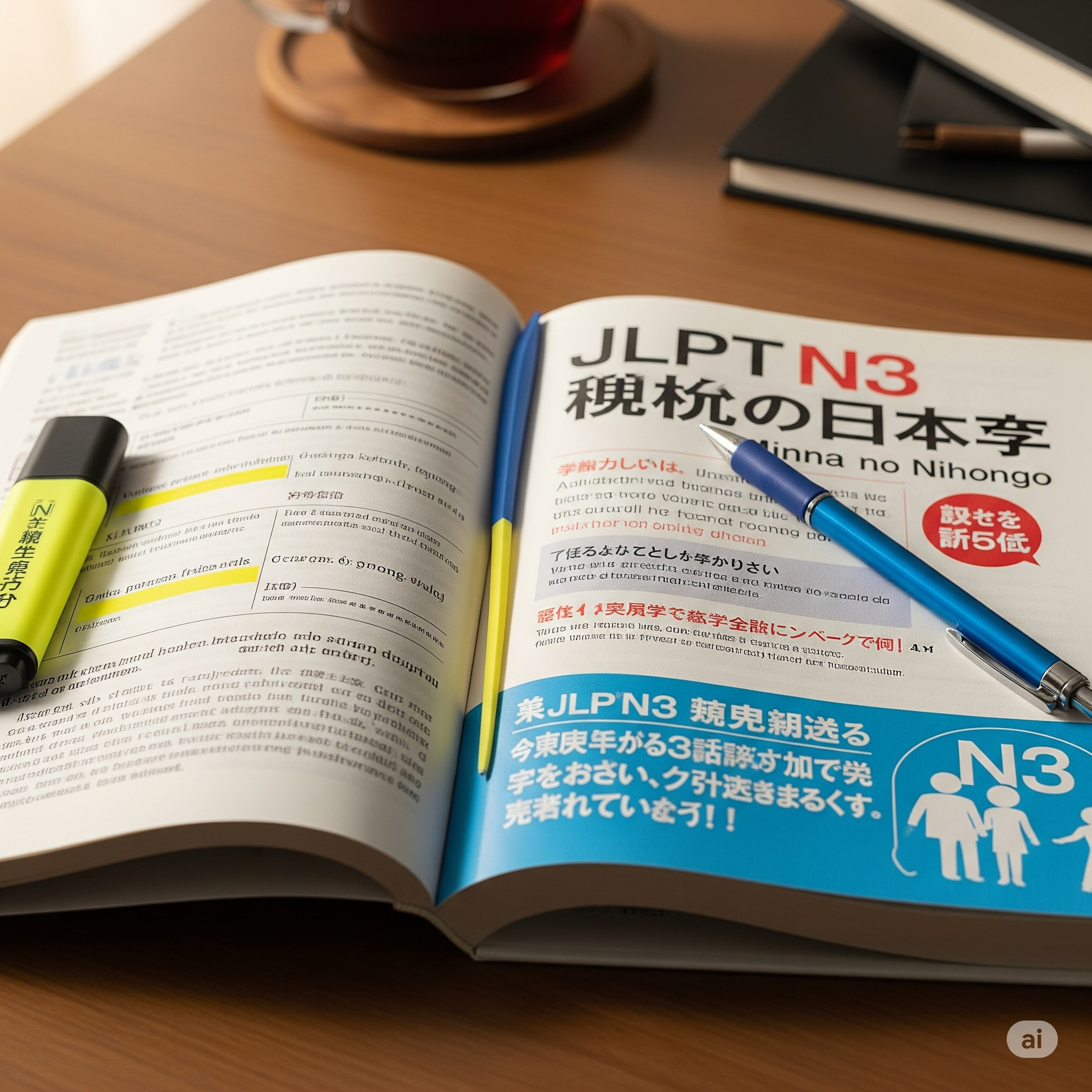
Konnichiwa, future N3 achievers!
If you’re preparing for the JLPT N3, you’ve probably heard of the Minna no Nihongo series. But here’s the big question: Can you really use Minna no Nihongo for N3 preparation?
The short answer? Yes, but with a strategic plan and the right supplementary tools.
The JLPT N3 is not just an intermediate test; it is the critical bridge that defines functional fluency in Japanese. To truly conquer this level, you need a comprehensive strategy that covers not just vocabulary and grammar, but also the strict [JLPT N3 Format Explained: Your Ultimate Guide to Sections, Time, and Question Types] and score requirements.
This guide will focus on how to strategically integrate the foundational strengths of Minna no Nihongo with specialized resources to create a winning study plan. We’ll break down:
✅ How Minna no Nihongo fits into N3 studies
✅ Key chapters & supplements to focus on
✅ Effective study techniques
✅ Alternative resources to fill gaps and guarantee N3 readiness
For a complete blueprint covering every aspect of the exam—from administrative logistics to scoring—make sure to visit our central guide: [Your Ultimate JLPT N3 Full Test Guide: Structure, Scoring, and Success Strategies](Pillar Post Link).
Let’s dive in and transform your textbook into a powerful study ally!
Why Use Minna no Nihongo for JLPT N3?
First, let’s clarify: Minna no Nihongo doesn’t have a dedicated N3 book. The main Shokyu (Beginner) series covers N5 to early N4 content. However, the Chūkyū (Intermediate) books (which follow the beginner series) can help bridge the gap to N3 by providing conversational practice and exposure to more complex sentence structures.
Pros of Using Minna no Nihongo for N3:
| Benefit | Explanation |
| Strong Grammar Foundation | The explanations are clear and practical, covering the complex conjugation and particle usage that forms the backbone of N3 structures. |
| Real-Life Dialogues | The conversations mimic natural speed and context, which is excellent preparation for the Listening Comprehension section. |
| Workbook Exercises | The Hyōjun Mondaishū (Standard Problem Collection) and grammar workbooks offer repetitive practice essential for solidifying grammar patterns. |
| Kanji & Vocabulary Integration | While not exhaustive, the lists establish a strong base of essential N4/early N3 vocabulary and common kanji readings. |
Cons to Be Aware Of:
| Drawback | Solution |
| Not JLPT-Specific | You’ll need additional N3-focused materials to cover exam-only vocabulary and grammar points. |
| Limited Advanced Grammar | Some high-frequency N3 grammar points (like advanced nuances of conjecture) aren’t covered. |
| No Mock Tests | Doesn’t simulate the challenging [JLPT N3 Duration & Exam Time: How Long Does It Really Take?](Cluster 1: Exam Format & Time Link). |
Bottom line: Minna no Nihongo is a great supplementary tool but shouldn’t be your only resource for N3. For a comprehensive look at the best specialized textbooks, consult our guide: [Best JLPT N3 Books for Self-Study and Exam Preparation]
The Strategic Guide: How to Use Minna no Nihongo for JLPT N3 Preparation
Using this series effectively requires a phased approach that acknowledges its limitations.
1. Focus on the Right Books (The Chūkyū Bridge)
Since the beginner series (Shokyu) won’t fully cover N3, your primary focus should be on the intermediate volumes:
- 📘 Minna no Nihongo Chūkyū 1 (Intermediate 1): This volume is crucial as it covers late N4 to early N3 content, solidifying verb conjugations and complex sentence formation.
- 📘 Minna no Nihongo Chūkyū 2 (Intermediate 2): This book touches on mid-to-upper N3, introducing expressions necessary for nuanced conversation.
- 📘 Kanji & Vocabulary Supplements: Essential for mastering the ~3,750 vocabulary words and ~650 kanji required for N3.
Pro Tip: Pair these with dedicated JLPT study books. For highly effective test simulation and comprehensive review, the Shin Kanzen Master N3 or Sō Matome N3 series are universally recommended. Find out why in our review: [Top JLPT N3 Books for Passing the Exam in 2025 – The Ultimate Guide](Cluster 2: Books Link).
2. Master Key Grammar Points
The JLPT N3 grammar list includes about 150 structures. Minna no Nihongo Chūkyū excels at teaching foundational structures necessary for N3, such as:
- ~ばかり (bakari) – “Nothing but…” / “Just finished doing…”
- ~たびに (tabi ni) – “Every time…”
- ~ほど (hodo) – “To the extent that…”
How to study effectively:
- Make Flashcards: Utilize digital tools for efficient memorization. We highly recommend using specialized decks for this level—learn how with [How to Use Anki for JLPT N3: Study Smarter With Spaced Repetition]
- Write Example Sentences: Create sentences that connect the grammar point to your daily life. This is the difference between rote memorization and true functional understanding.
- Practice with the Workbook Exercises: Complete the exercises, then re-read the dialogues to see the grammar used naturally.
3. Strengthen Vocabulary & Kanji (Going Beyond the Textbook)
N3 requires a vocabulary base far exceeding what the Minna no Nihongo series provides. You must be proactive in expanding your word bank.
How to boost your vocab:
- Digital Flashcards: Supplement your textbook with high-quality digital tools. Read our detailed analysis on which ones are best for rote memorization: [Best JLPT N3 Anki Decks for Vocabulary, Kanji & Grammar (Free Download)] Reading Immersion: This is key for Reading Comprehension.
- Read NHK News Easy (outbound link) to see words in context.
- Use vocabulary acquired from the Minna no Nihongo dialogues and look for them in real-world Japanese articles.
- Kanji Reinforcement: Tools like WaniKani (outbound link) or Kanji Study App (outbound link) are essential for systematic kanji acquisition.
4. Improve Listening Skills
The Minna no Nihongo listening CDs (or audio files) are excellent for:
- Shadowing practice: Repeat after native speakers to internalize rhythm and intonation.
- Dictation exercises: Write what you hear to improve word recognition speed.
Extra Tip: Supplementing with natural Japanese audio is vital. Watch Japanese dramas or YouTube channels like “Japanese Ammo with Misa” (outbound link) for natural listening practice. For a curated list of all the top digital tools, see: [Best App for JLPT N3 Prep: Top Recommendations for Learners]
5. Take Practice Tests (Simulate Exam Conditions)
Since Minna no Nihongo doesn’t have JLPT-style tests, you must dedicate time to external practice tests. This is not optional. It is the only way to master the time pressure and question types outlined in the main [Your Ultimate JLPT N3 Full Test Guide: Structure, Scoring, and Success Strategies]
- 📝 Official JLPT N3 Past Papers (outbound link)
- 📝 Sō Matome or Shin Kanzen Master Mock Tests
Addressing Common Study Roadblocks
While Minna no Nihongo is a beloved series, many learners transition from it to the N3 and hit specific walls.
1. The Minna no Nihongo to JLPT Gap
The philosophy of Minna no Nihongo is communicative language teaching, while the JLPT is a discrete-point multiple-choice test.
- Problem: You can understand the grammar, but you struggle with the obscure, formal synonyms often tested in the 言い換え類義 (Paraphrasing / Synonyms) section.
- Solution: Don’t rely only on Minna no Nihongo. You must supplement with specialized books like the Sō Matome or Shin Kanzen Master series, which are explicitly designed to cover those tricky, exam-specific nuances.
2. The Genki Conundrum
Many learners come from the Genki series, which is similar in scope to Minna no Nihongo.
- Problem: Learners wonder if they can skip straight to N3 study after Genki II.
- Solution: Genki is an incredible foundational tool, but it is not sufficient for N3. For a full breakdown on where Genki falls short and what steps you need to take next, read: [Genki and JLPT N3: Is This Classic Textbook Enough to Pass the Exam?]
3. Ignoring the Investment
The cost of test preparation often outweighs the test fee itself.
- Problem: Sticking only to free or low-cost resources out of budget concerns.
- Solution: While you can find fantastic free content (see: [Free JLPT N3 Books and PDF Resources for Self-Study](Cluster 2: Books Link), investing in one or two high-quality, structured N3 workbooks is essential. Think of it as a small, necessary investment in a potentially career-changing qualification.
Your Comprehensive 2025 N3 Success Plan (Beyond the Books)
To hit that target N3 score, you need a holistic approach that maximizes efficiency and minimizes burnout.
1. Optimize Your Digital Workflow
In today’s learning environment, digital tools are non-negotiable for N3 prep.
| Study Area | Recommended Tool/Technique | Why It Works |
| Vocabulary | Anki (Spaced Repetition) | It forces review of difficult words right before you forget them, maximizing retention for the Language Knowledge section. |
| Reading | Manga/Blogs/NHK Easy | Builds reading stamina and familiarity with different text formats required for Information Retrieval passages. |
| Grammar | Bunpro (outbound link) or Try! N3 | Offers sentence-based drilling of the specific 150 N3 grammar points. |
2. Conquer Time Management
The biggest enemy on test day is the clock. The 70-minute Language Knowledge/Reading section is a test of speed, not just knowledge.
- Rule of Thumb: Budget less than 1 minute per question in the Language Knowledge section to save time for the lengthy Reading passages.
3. Final Administrative Check
You cannot study if you cannot register. Make sure you are on track with the administrative side of the exam.
- Registration Alarms: Confirm your local registration deadlines and fees. Our guide provides an administrative breakdown: [JLPT N3 Exam Date 2025: Registration, Schedule, and Deadlines]
- Cost vs. Benefit: Ensure your investment is sound. The N3 is worth the effort, as detailed in our analysis: JLPT N3 Cost vs. Benefits: Is It Worth the Investment? (Placeholder link to be created).
Conclusion: Strategic Use of Minna no Nihongo for N3
Can you use Minna no Nihongo for JLPT N3 preparation? Yes—but only as a high-quality foundation.
Strategically, you should:
- Focus on the Intermediate books (Chūkyū 1 & 2) for grammar and dialogue practice.
- Supplement immediately with JLPT-specific resources (Shin Kanzen Master or Sō Matome) to cover all exam content.
- Practice real exam conditions using external mock tests and follow the administrative guidance in [Your Ultimate JLPT N3 Full Test Guide: Structure, Scoring, and Success Strategies]
This level of preparation guarantees that you are not only learning the language but are also learning how to pass the test.
Start Studying Today: The clock is ticking, but don’t be overwhelmed. Consistency beats cramming every single time.
Ganbatte kudasai! (Do your best!)
がんばってください!(Good luck!)


