
If you have been studying Japanese for a few months, you have likely run into a frustrating wall: expressing what you intend to do without sounding like a rigid dictionary. In English, we fluidly shift between “I’m going to,” “I plan to,” “I intend to,” and “I thought I was.”
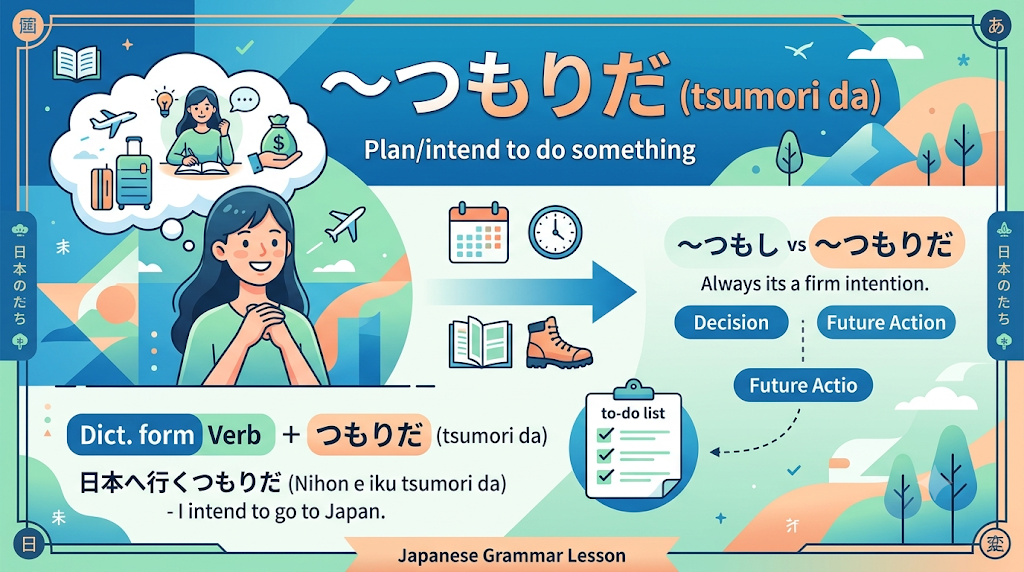
In Japanese, one of the most essential building blocks for talking about future intentions is ~つもりだ (tsumori da).
Covered thoroughly in the JLPT N4 syllabus, this structure bridges the gap between basic present-tense statements and nuanced, personal planning. Understanding ~つもりだ is not just about passing a test; it’s about expressing your inner thoughts, goals, and mindset authentically.
What Does ~つもりだ (Tsumori Da) Mean?
At its core, ~つもりだ expresses a personal intention, plan, or mental determination to do (or not do) something.
The word つもり (積もり) historically relates to accumulation or conviction in one’s mind. When attached to a verb, it shifts the focus from a plain action to the state of mind regarding that action.
- English equivalents: “I plan to…”, “I intend to…”, “I am going to…”, “I decided in my mind that…”
Core Nuance: It’s All in Your Head
Unlike scheduled events on a calendar—which often use structures like ~予定だ (yotei da)—~つもりだ focuses heavily on personal intent. It doesn’t guarantee that the event is officially booked or 100% happening; it tells the listener what you have decided in your own mind.
How to Form ~つもりだ (Grammar Rules)
Forming ~つもりだ is straightforward because it directly attaches to the Plain Form (Casual Form) of verbs.
1. Affirmative Intentions (“I plan to…”)
Attach つもりだ directly to the Dictionary Form of the verb.
$$\text{Verb (Dictionary Form)} + \text{つもりだ / つもりです}$$
- 食べる (taberu / to eat) $\rightarrow$ 食べるつもりだ (taberu tsumori da)
- 行く (iku / to go) $\rightarrow$ 行くつもりだ (iku tsumori da)
- 勉強する (benkyou suru / to study) $\rightarrow$ 勉強するつもりだ (benkyou suru tsumori da)
2. Negative Intentions (“I plan NOT to…”)
There are two primary ways to express a negative intention, with a subtle difference in strength.
Method A: Verb (Nai-form) + つもりだ (Most Common)
$$\text{Verb (ない-form)} + \text{つもりだ}$$
- 行かないつもりだ (ikanai tsumori da) — I plan not to go.
Method B: Verb (Dictionary Form) + つもりはない (Stronger Denial)
$$\text{Verb (Dictionary Form)} + \text{つもりはない}$$
- 行くつもりはない (iku tsumori wa nai) — I have no intention of going.
Structural Breakdown Table
| Type | Formula | Japanese Example | English Translation |
| Affirmative (Casual) | Verb (Dict) + つもりだ | 来年日本に行くつもりだ。 | I plan to go to Japan next year. |
| Affirmative (Polite) | Verb (Dict) + つもりです | 週末は家で休むつもりです。 | I intend to rest at home this weekend. |
| Negative (Standard) | Verb (ない) + つもりです | お酒を飲まないつもりです。 | I plan not to drink alcohol. |
| Negative (Strong) | Verb (Dict) + つもりはない | 彼と話すつもりはありません。 | I have no intention of speaking with him. |
| Past Intention | Verb (Dict) + つもりだった | 買つつもりだったが、やめた。 | I intended to buy it, but I gave up. |
Real-World Sentence Examples
To build genuine fluency, look at how this pattern functions across daily conversation:
Everyday Plans
- 来月、新しいパソコンを買うつもりです。(Raigetsu, atarashii pasokon o kau tsumori desu.)I plan to buy a new laptop next month.
- 今日の夜は自炊するつもりだ。(Kyou no yoru wa jisui suru tsumori da.)I intend to cook for myself tonight.
Expressing Changing Plans (~つもりだった)
When you pair the dictionary form with the past tense つもりだった (tsumori datta), you describe an intention you held in the past—which often didn’t happen due to changed circumstances.
- 映画を見に行くつもりだったが、雨が降ったのでやめた。(Eiga o mii ni iku tsumori datta ga, ame ga futta node yameta.)I intended to go see a movie, but it rained, so I dropped the idea.
Native Nuances & Practical Warnings
1. Don’t Use It directly for Superiors
Because ~つもりだ reflects an internal personal desire, using it directly when asking a superior about their plans can sound impolite or overly inquisitive.
- Awkward: 社長、明日どこへ行くつもりですか? (President, where do you plan to go tomorrow?)
- Natural/Polite: 社長、明日どこへいらっしゃいますか? (President, where will you be heading tomorrow?)
2. Difference Between つもりだ (Tsumori da) and 予定だ (Yotei da)
- つもりだ (Tsumori da): Driven by individual intent. (e.g., “I plan to start exercising every morning.”)
- 予定だ (Yotei da): Driven by an objective schedule, arrangement, or timetable. (e.g., “The train is scheduled to arrive at 3 PM.”)
Deep-Dive Insight: The Secret Meaning of “つもり”
Beyond plans, advanced Japanese speakers use ~つもり to describe acting as if or believing something to be true, even if reality differs.
- 若いつもりでいる。 (Wakai tsumori de iru.)He acts/feels as though he is still young (even if he isn’t).
- 鍵をかけたつもりだった。 (Kagi o kaketa tsumori datta.)I was convinced I locked the door (but turned out I didn’t).
Recognizing this nuance will help you significantly when moving beyond the N4 level into N3 reading passages.
Practice Quiz
Test your understanding by translating these sentences into Japanese:
- I plan to study Japanese every day.
- I had intended to call her, but I forgot.
- I have no intention of quitting my job.
(Answers: 1. 毎日日本語を勉強するつもりです。 2. 彼女に電話するつもりだったが、忘れた。 3. 仕事をやめるつもりはありません。)
Useful Resources & External Links
To build a well-rounded foundation in Japanese grammar and prepare thoroughly for proficiency tests, explore these valuable study tools:
- Practice basic vocabulary, kanji, and grammar lists on the official JLPT Sensei N4 Grammar Master List.
- Review official test structures, schedules, and registration procedures on the Official JLPT Website.
- Deepen your understanding of Japanese verb conjugations and sentence patterns through the Tae Kim’s Guide to Learning Japanese.


