
If you have been studying Japanese for a while, you have probably noticed that saying “should” in Japanese is not as simple as looking up a single English word in a dictionary.
Earlier in your Japanese journey—around the JLPT N4 level—you likely learned 〜ほうがいい (hou ga ii) to give advice or make suggestions. But as you progress into intermediate Japanese (JLPT N3), you quickly realize that 〜ほうがいい often feels too soft, personal, or conversational for certain situations.
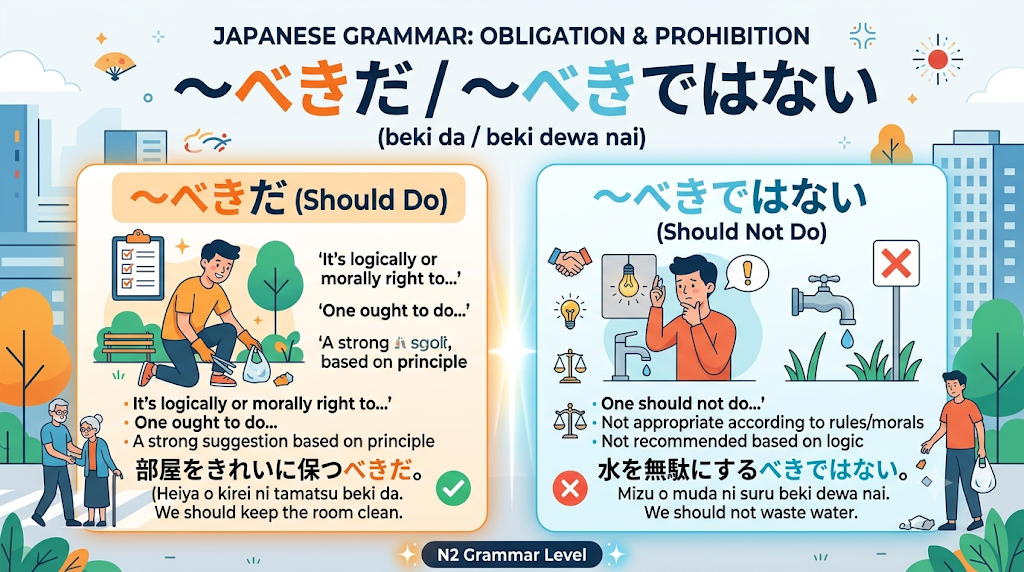
What happens when you need to express a strong social expectation, a professional standard, a moral duty, or a logical necessity?
That is where 〜べきだ (beki da) and its negative counterpart 〜べきではない (beki dewa nai) come in.
In this complete guide, we will break down how to form and use 〜べきだ, explore its subtle nuances, highlight critical exceptions (like what happens to the verb suru), and look at real-world examples so you can speak and write natural, idiomatic Japanese.
1. Core Meaning & Cultural Nuance
At its heart, 〜べきだ translates to “should,” “ought to,” or “must.” Conversely, 〜べきではない means “should not” or “ought not to.”
However, unlike English—where “should” gets tossed around casually for everything from ordering food (“I should get the ramen”) to high-minded ethics (“We should protect the environment”)—〜べきだ carries specific weight in Japanese.
The Nuance: Objective Obligation
〜べきだ expresses an obligation based on:
- Common Sense (常識 – Joushiki): General societal norms or expected behavior.
- Moral / Ethical Duties (道徳 – Doutoku): Doing what is right versus what is wrong.
- Logical Conclusions: Actions that naturally follow from rules, professional roles, or social positions.
When you use 〜べきだ, you are not expressing a personal opinion or a subjective preference. You are stating that an action is objectively the right, proper, or expected thing to do according to common sense or social norms.
2. How to Form 〜べきだ and 〜べきではない
Forming 〜べきだ is relatively straightforward because it attaches directly to the dictionary form (plain form) of verbs.
Standard Rule (All Verb Groups)
Attach べきだ directly to the plain, present-affirmative dictionary form of the verb.
- Group 1 (U-verbs / Ichidan):
- 行く (iku / to go) → 行くべきだ (iku beki da)
- 話す (hanasu / to speak) → 話すべきだ (hanasu beki da)
- Group 2 (Ru-verbs / Godan):
- 食べる (taberu / to eat) → 食べるべきだ (taberu beki da)
- 見る (miru / to see) → 見るべきだ (miru beki da)
- Group 3 (Irregular verbs):
- 来る (kuru / to come) → 来るべきだ (kuru beki da)
⚠️ The Irregular Exception: する (Suru)
This is the most critical rule to remember for JLPT exams and natural speech. For the verb する (suru – to do), you have two grammatically correct choices:
- するべきだ (suru beki da) – Modern, widely used, especially in spoken Japanese.
- すべきだ (subeki da) – Traditional, slightly more formal, and extremely common in written text and news.
Both forms mean the exact same thing (“should do”), but すべきだ is heavily favored in formal writing and standardized test questions.
Quick Conjugation Table
| Verb Type | Dictionary Form | Affirmative (“Should”) | Negative (“Should not”) |
| Group 1 (U-verb) | 言う (iu / say) | 言うべきだ (iu beki da) | 言うべきではない (iu beki dewa nai) |
| Group 2 (Ru-verb) | 覚える (oboeru / memorize) | 覚えるべきだ (oboeru beki da) | 覚えるべきではない (oboeru beki dewa nai) |
| Irregular | 来る (kuru / come) | 来るべきだ (kuru beki da) | 来るべきではない (kuru beki dewa nai) |
| Irregular | する (suru / do) | するべきだ / すべきだ | するべきではない / すべきではない |
Politeness Variations
You can adjust the end of the phrase depending on how polite or formal you need to be:
- Plain / Casual: 〜べきだ (beki da) / 〜べきではない (beki dewa nai)
- Polite / Formality: 〜べきです (beki desu) / 〜べきではありません (beki dewa arimasen)
- Noun Modifier: 〜べき + [Noun] (e.g., 做すべきこと – surubeki koto = “things that ought to be done”)
If you want to review basic verb classes or double-check dictionary conjugations while studying this rule, check out the comprehensive verb charts on Tofugu’s Japanese Grammar Guide.
3. Deep Dive: Key Differences Between 〜べきだ, 〜ほうがいい, and 〜なければならない
One of the biggest hurdles for intermediate Japanese learners is knowing when to choose 〜べきだ over other obligation structures. Let’s compare them side by side.
1. 〜べきだ (Beki da) vs. 〜ほうがいい (Hou ga ii)
- 〜ほうがいい (Hou ga ii): Gives a recommendation or personal suggestion. It implies “it would be better for you to do X (rather than Y).”
- Example: 風邪だから、早く寝たほうがいいよ。(Since you have a cold, it’s better if you go to bed early. — Personal advice)
- 〜べきだ (Beki da): Expresses a standard, ethical duty, or social rule.
- Example: 約束は守るべきだ。(One should keep their promises. — Social norm / moral rule)
2. 〜べきだ (Beki da) vs. 〜なければならない (Nakereba naranai)
- 〜なければならない (Nakereba naranai): Expresses an explicit, unavoidable obligation or rule (“must / have to”). If you don’t do it, there are immediate consequences (e.g., legal, rules, physical necessity).
- Example: パスポートを提示しなければならない。(You must present your passport. — A strict requirement)
- 〜べきだ (Beki da): Focuses on what is morally, logically, or socially correct. Failing to do it might make you look rude, irresponsible, or immoral, but it is not strictly an outright absolute rule in every context.
4. Sentence Examples in Context
To truly lock this grammar point into your memory, let’s examine practical, everyday scenarios.
Moral & Social Obligations
- 若者は年上の方を敬うべきだ。Wakamono wa toshiue no kata o uyamau beki da.Young people should respect their elders.
- 電車の中では、お年寄りに席を譲るべきです。Densha no naka de wa, otoshiyori ni seki o yuzuru beki desu.On the train, one should offer their seat to the elderly.
- 借りたお金はすぐに返すべきだ。Karita okane wa sugu ni kaesu beki da.You should return borrowed money immediately.
Professional Standards & Duty
- プロとして、締め切りは守るべきだ。Puro to shite, shimekiri wa mamoru beki da.As a professional, one should meet deadlines.
- 医者は患者のプライバシーを保護すべきではない。 ❌ (Incorrect)医者は患者のプライバシーを保護すべきだ。 ⭕Isha wa kanja no puraibasī o hogo subeki da.Doctors should protect patient privacy.
Negative Form: 〜べきではない (Should Not)
- 子供の前で嘘をつくべきではない。Kodomo no mae de uso o tsuku beki dewa nai.One should not tell lies in front of children.
- 運転中にスマートフォンを操作するべきではありません。Unten-chū ni sumātofon o sōsa suru beki dewa arimasen.You should not operate a smartphone while driving.
5. Common Nuances & Pragmatic Traps
While 〜べきだ is an essential grammar tool, using it incorrectly in Japanese conversation can cause social friction. Here are three pragmatic traps to avoid:
1. Directing 〜べきだ at Superiors or Elders
Because 〜べきだ carries a tone of authoritative moral judgment, never use it directly toward a boss, teacher, or elder to tell them what to do.
- ❌ To your boss: 社長、もっと休むべきですよ。 (Shachou, motto yasumu beki desu yo. – Sounds preachy and patronizing.)
- ⭕ Better alternative: 社長、少し休まれたほうがよろしいかと思います。 (Shachou, sukoshi yasumareta hou ga yoroshii ka to omoimasu.)
2. Standard Rules vs. Personal Directives
〜べきだ sounds best when speaking generally about groups (“Students should study,” “Drivers should stop at red lights”) or when stating general principles. Expressing direct commands with 〜べきだ to an equal can sometimes come across as bossy.
3. Past Tense: 〜べきだった (Beki datta)
When you put 〜べき into the past tense (〜べきだった / beki datta), it translates to “should have [done]” or “ought to have [done].” This expression is commonly used to express regret or criticism.
- もっと勉強するべきだった。Motto benkyou suru beki datta.I should have studied more. (Expressing personal regret)
- あの時、本当のことを言うべきだったのに…Ano toki, hontou no koto o iu beki datta noni…I should have told the truth back then, but…
6. JLPT N3 Strategy: Spotting 〜べきだ on Exam Day
If you are preparing for the JLPT N3, 〜べきだ appears regularly in reading comprehension (読解) and grammar structure questions.
To boost your official preparation and practice test scores, refer to official testing resources on the Official JLPT Website. You can also check out comprehensive grammar index listings on Maggie Sensei’s Japanese Lessons for additional native sentence samples and everyday dialogue breakdowns.
JLPT Quick Tips:
- Watch out for する conjugation: Look for
すべきin formal reading passages. Test items frequently pairすべきwith general nouns likeすべきこと(things one ought to do) or選択すべき道(the path one should choose). - Context Clues: If a reading passage discusses social responsibility, environmental ethics, or professional duty,
〜べきだis almost always the target pattern used to express the author’s final conclusion.
Practice Quiz
Test your understanding! Choose the correct expression or form for each sentence below:
- どんなに忙しくても、朝食は ( 食べるべきだ / 食べたほうが義務だ )。
- 学生として、校則は ( 守るべきではない / 守るべきだ )。
- 「する」の正しく硬い表現は? → ( しるべきだ / すべきだ )
(Answers: 1. 食べるべきだ, 2. 守るべきだ, 3. すべきだ)
Summary Checklist
- Meaning: Should / Ought to (moral, ethical, or logical obligation).
- Formation: Verb (Dictionary Form) + べきだ / べきではない.
- Special Rule: する → するべきだ or すべきだ.
- Tone: Objective, formal, principled. Avoid using it directly to instruct social superiors.
- Past Tense:
〜べきだった(Should have…).
Mastering 〜べきだ allows you to express mature, nuanced opinions in Japanese beyond basic preferences. Try writing 2–3 practice sentences in the comments or your notebook today using 〜べきだ and 〜べきではない!


