Balancing a demanding career in technology with high-level language acquisition is one of the toughest challenges an IT professional can take on. When you spend your day debugging code, writing system documentation, or managing deployment pipelines, your brain is already running at full mental capacity. Finding the bandwidth to memorize 1,000 kanji and master complex Japanese grammar structures feels overwhelming.
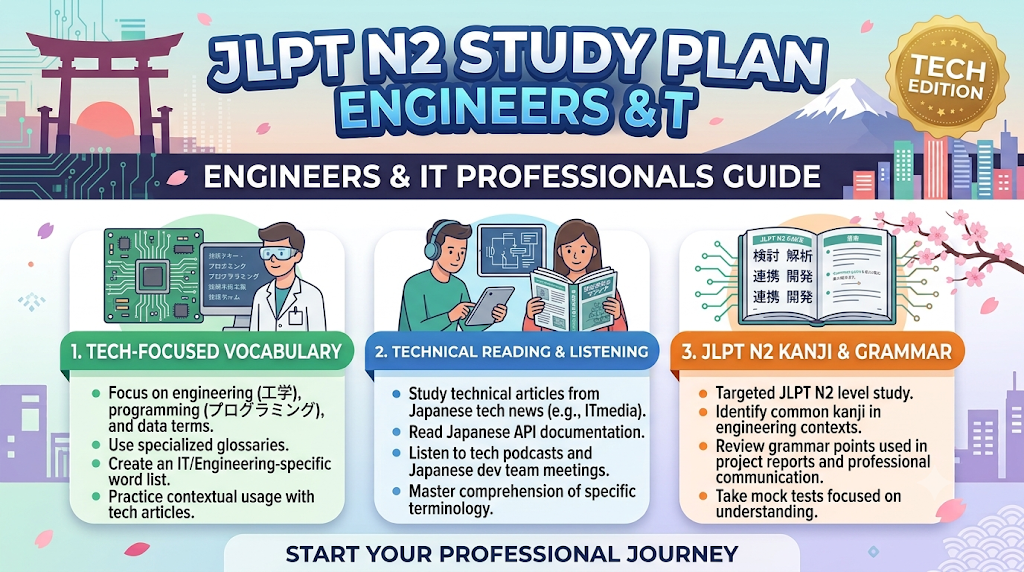
However, software engineers, DevOps specialists, and IT project managers actually possess a unique advantage when learning Japanese. Technical mindsets excel at pattern recognition, systems thinking, and structured logic—the exact cognitive tools needed to conquer the Japanese-Language Proficiency Test (JLPT) N2.
Passing the N2 level is the definitive golden ticket for tech workers in Japan. It bridges the gap between basic workplace conversations and full professional autonomy. Below is an actionable, field-tested study framework designed to take you across the finish line without burning out.
The Tech Professional’s Edge: Why N2 is Your Career Force Multiplier
In Japan’s tech sector, N3 proves you can order coffee and understand simple team updates, while N1 often demands deep literary nuance that isn’t strictly required for day-to-day software development. The JLPT N2 sits squarely in the sweet spot.
Earning your N2 certification opens high-paying engineering roles at top-tier Japanese tech companies and foreign multinationals operating in Tokyo. It signals to engineering managers that you can:
- Read spec sheets, pull requests, and technical tickets in native Japanese.
- Participate in daily standups and sprint planning without requiring a translator.
- Communicate effectively with non-English-speaking product managers and QA teams.
Before diving into the schedule, it helps to understand where N2 fits into the bigger career arc. If you are comparing your options or planning long-term growth, review our JLPT N2 vs N1: Difficulty, Salary & Career Comparison to evaluate how each level impacts software engineering compensation and promotion trajectories in Japan.
The 6-Month Agile JLPT N2 Study Framework
Engineers thrive on structured sprints, iterative progress, and measurable outputs. Instead of attempting traditional rote-learning methods that lead to fatigue, organize your preparation into three distinct two-month phases.
+-----------------------------------------------------------------------+
|                        6-MONTH JLPT N2 ROADMAP                        |
+-----------------------------------------------------------------------+
|  Months 1–2: Foundation Sprints (Vocabulary & Kanji Core)            |
|  Months 3–4: Grammar Architecture & Technical Integration             |
|  Months 5–6: Full-System Integration (Speed Reading & Mock Exams)     |
+-----------------------------------------------------------------------+
Phase 1: Months 1–2 — Foundation Sprints (Kanji & Core Vocabulary)
Your goal in this phase is raw input build-up. You need to expand your active vocabulary to around 6,000 words and master roughly 1,000 kanji.
- Targeted Anki Spaced Repetition (SRS): Limit daily deck reviews to 20–25 minutes every morning before opening your IDE. Focus on N2 vocabulary decks prioritized by frequency.
- Kanji by Radicals: Treat kanji components like modular functions or UI components. Do not memorize strokes individually; learn the foundational radicals to decode complex technical compounds effortlessly.
Phase 2: Months 3–4 — Grammar Architecture & Contextual Input
N2 grammar often acts like conditional logic in programming (e.g., ~わけがない, ~に際して, ~ざるを得ない). Focus on understanding the precise functional context of each particle and connector.
- Sentence Deconstruction: Break down sentence structures like code blocks. Identify the subject, main clause, and modifier chains to process technical expressions without translating back into English mentally.
- Passive Listening During Work Routine: Stream Japanese tech podcasts or developer talks on platforms like YouTube during low-cognition tasks like refactoring CSS or compiling builds.
Phase 3: Months 5–6 — Full-System Integration & Mock Stress-Testing
The N2 reading section is infamous for tight time limits. This final phase focuses purely on test-taking speed, stamina, and strategy.
- Time-Boxed Mock Exams: Complete full-length practice tests under strict time constraints on weekends.
- Error Log Analysis: Treat every incorrect answer as a bug report. Document why you missed a question—was it a vocabulary gap, a misunderstood grammar pattern, or a misread prompt? Fix the root cause immediately.
For official information on exam dates, registration windows, and test center logistics worldwide, refer to the Official Worldwide JLPT Website.
Integrating Study Habits into a Busy Engineering Workflow
Finding three uninterrupted hours to study every day is unrealistic for most working developers. The solution is micro-learning integration—embedding study habits directly into your existing developer daily workflow.
| Time Slot | Micro-Habit | Total Time |
| Morning Coffee (8:30 AM) | Complete 20 Anki vocabulary flashcards | 15 mins |
| Commute / Morning Routine | Listen to Japanese tech podcasts (Rebuild.fm or Yuyaku Japanese) | 30 mins |
| Lunch Break | Read 1 short article on Qiita or Zenn using a browser dictionary plugin | 20 mins |
| Evening (7:00 PM) | Practice 1 section of N2 Grammar (Shin Kanzen Master) | 30 mins |
| Before Bed | Read 2 Japanese short news summaries on NHK Easy News or Web Easy | 15 mins |
By distributing your efforts, you accumulate nearly two hours of focused daily practice without taking a massive chunk out of your personal time.
Leveraging Tech Tools to Automate Language Acquisition
Engineers love automation, so let software do the heavy lifting in your study process:
- YomiTan / Yomichan (Browser Extensions): Install an instant dictionary popup tool on Chrome or Firefox. When reading tech documentation on Japanese sites, hover over unfamiliar terms to instantly parse kanji and definitions.
- Qiita & Zenn as Reading Material: Instead of reading standard generic Japanese textbooks, spend 15 minutes a day reading developer blogs on Qiita or Zenn. You will learn N2 vocabulary alongside actual IT terminology used in Japanese engineering teams (開発, 導入, 障害, 修正, 移行).
- Anki Algorithms: Fine-tune your Anki settings to prioritize difficult cards. Use custom audio setups to train listening and reading speed simultaneously.
Essential Resources for IT Candidates
To study efficiently, choose materials known for clarity and rigorous structure:
- Shin Kanzen Master Series (N2 Grammar & Reading): Exceptional for logical learners who appreciate clear rules and edge-case explanations.
- Nihongo Sou Matome N2: Great for quick structured overviews during early study phases.
- JLPT Practice Test Books: Official practice workbooks provided by the Japan Foundation offer the exact formatting and audio pacing used in real examinations.
Long-Term Career Roadmap & Related Guides
Passing the JLPT N2 is a milestone that transforms your potential in the Japanese job market. Once you clear this hurdle, you can leverage your combined technical skills and language abilities to target senior engineering, system architecture, or management roles.
To plan your ongoing career journey beyond N2, explore our complete suite of strategy guides:
- Learn how to structure your learning schedule for the ultimate career goal in our overarching JLPT N1 & N2 Preparation Guide for Advanced Learners.
- Planning to push past N2 to executive leadership or bilingual architecture roles? Check out our tailored JLPT N1 Study Plan for Working Professionals and explore Business Japanese for JLPT N1 Candidates.
- Want to know what to expect when you take the final step in Japanese mastery? Read our deep dive on Why JLPT N1 Is Hard (And How to Actually Pass It).