
Deciding to study Japanese every single day, opting to quit drinking soda, or choosing to save money for a trip to Tokyo—what do all these life choices have in common? They are conscious decisions you make for yourself.
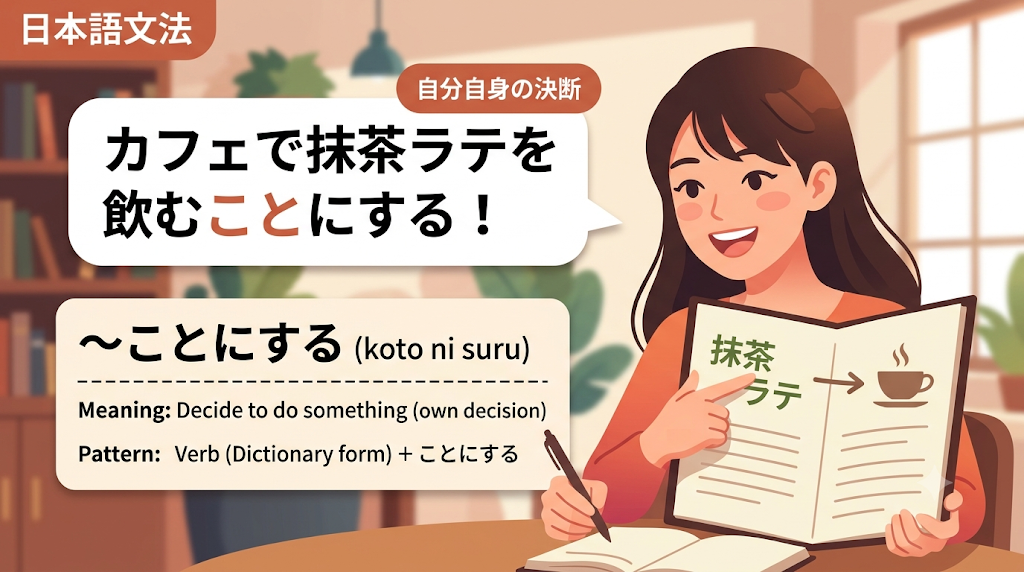
In Japanese, when you want to express a decision made through your own free will, you use the fundamental grammar structure 〜ことにする (koto ni suru).
Whether you are preparing for the JLPT N4 exam or trying to sound more natural in daily conversations, mastering this pattern is essential. Let’s break down how it works, how to conjugate it, and how to avoid the most common mistakes learners make.
The Core Concept: What Does 〜ことにする Mean?
At its heart, 〜ことにする translates to “to decide to do (something)” or “to make it a rule to (do something).”
The structure consists of three simple parts:
- Verb (Dictionary Form or Negative Form): The action you are choosing to do (or not do).
- こと (Koto): A nominalizer that turns the verb into a noun phrase (“the act of doing…”).
- する (Suru): The verb meaning “to do,” which here signifies taking action on that decision.
When put together, you are literally saying, “I do the act of [verb],” which means “I make the choice to [verb].”
How to Form 〜ことにする
Forming this grammar pattern is straightforward because it only attaches to the plain form (dictionary form or ない-form) of verbs.
1. Affirmative Decisions (Deciding TO do something)
- Formula: [Verb Dictionary Form] + ことにする
- Examples:
- 食べる (to eat) $\rightarrow$ 食べることにする (decide to eat)
- 行く (to go) $\rightarrow$ 行くことにする (decide to go)
- 勉強する (to study) $\rightarrow$ 勉強することにする (decide to study)
2. Negative Decisions (Deciding NOT to do something)
- Formula: [Verb ない-Form] + ことにする
- Examples:
- 飲まない (not drink) $\rightarrow$ 飲まないことにする (decide not to drink)
- 言わない (not say) $\rightarrow$ 言わないことにする (decide not to say)
- 開けない (not open) $\rightarrow$ 開けないことにする (decide not to open)
Understanding Tenses and Context
How you conjugate the ending する completely changes the nuance of your decision.
- 〜ことにする (Present/Future): Indicates a decision you are making right now or are about to make.
- 明日からジョギングをすることにする。(I decide / I’m going to decide to start jogging tomorrow.)
- 〜ことにした (Past): Indicates a single decision made in the past.
- 新しいPCを買うことにした。(I decided to buy a new PC.)
- 〜ことにしている (Habit / ongoing rule): Indicates a decision you made in the past that has turned into an ongoing routine or rule for yourself.
- 毎日、寝る前に英語の単語を10個覚えることにしている。(I make it a rule to memorize 10 English words every night before going to bed.)
Real-World Examples & Practical Usage
To get comfortable with this pattern, look at how it appears in everyday conversations:
- 来月、日本へ旅行に行くことにしました。(I decided to go on a trip to Japan next month.)
- 健康のために、毎日野菜を食べることにしています。(For my health, I make it a point to eat vegetables every day.)
- 高いから、この服は買わないことにした。(Since it was expensive, I decided not to buy these clothes.)
- 会議には出席しないことにします。(I will decide not to attend the meeting.)
Critical Nuance: 〜ことにする vs. 〜ことになる
The single biggest obstacle for learners studying JLPT N4 grammar is confusing 〜ことにする with 〜ことになる (koto ni naru). Both involve decisions, but the perspective of who holds the power is entirely different.
| Feature | 〜ことにする (Koto ni suru) | 〜ことになる (Koto ni naru) |
| Meaning | To decide to do something | It has been decided that… |
| Control | Internal: You made the personal choice. | External: The decision was made by a group, rule, boss, or circumstance. |
| Nuance | Personal volition, personal responsibility. | Outcome beyond individual control, official policy. |
| Example | 会社をやめることにした。 (I decided to quit the company.) | 来月、転勤することになった。 (It has been decided that I will transfer next month.) |
If you want to dive deeper into official JLPT N4 grammar structures, test dates, and level guidelines, check out the official JLPT Official Website for comprehensive test specifications. For additional study materials, practice tests, and grammar breakdowns, you can also explore resources on Tofugu.
Common Mistakes to Avoid
- Using noun phrases directly without こと:
- Incorrect: 勉強にする
- Correct: 勉強することにする
- Using Polite Forms before こと:
- Incorrect: 行きますことにした
- Correct: 行くことにした
- Confusing active choice with external rules:
- Don’t say 「明日から社則が変わることになりました」 using ことにした unless you are the CEO who single-handedly changed the rule!


