
If you have ever tried to explain that you were just about to step into the shower when the delivery driver rang the doorbell, or that your cat is persistently trying to jump onto the highest bookshelf, you have already encountered the need for today’s grammar point: 〜ようとする (you to suru).
As someone who has navigated the trenches of the Japanese Language Proficiency Test (JLPT) and spent years working in Japanese environments, I can tell you that this grammar pattern is a absolute game-changer. It bridges the gap between basic textbook sentences and natural, highly expressive Japanese.
In this guide, we will unpack everything you need to know about 〜ようとする: its form, its two distinct meanings, crucial nuances, natural everyday examples, and how to avoid the most common traps non-native speakers fall into.
What Does 〜ようとする (You to Suru) Mean?
At its core, 〜ようとする combines the volitional verb form (the “let’s” or “intent” form of a verb) with the helper verb とする (to act as / to set as).
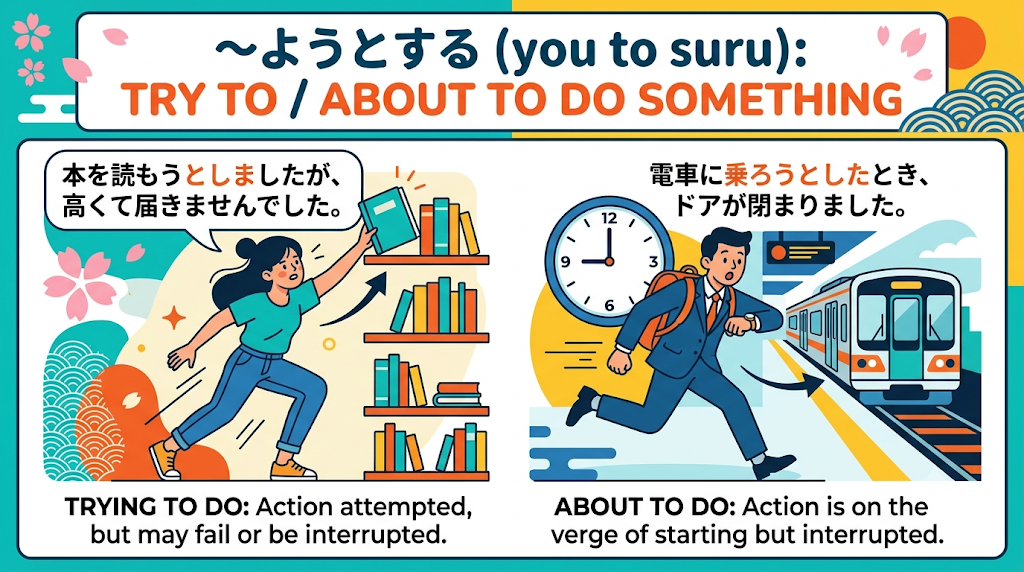
Depending on the context and the aspect of the verb する, this pattern carries two main meanings:
- “About to do something” — Expressing an action that is on the absolute verge of happening (point in time).
- “Try to do something” — Expressing an effort or attempt to accomplish an action (which often fails or is interrupted).
Let’s break these down step-by-step.
How to Form 〜ようとする: Conjugation Rules
Before diving into meaning, let’s master the mechanics. To use this structure, you first need to convert your target verb into its volitional form, then append とする (or its various conjugations like としている, とした, etc.).
1. Group 1 Verbs (U-Verbs / 五段):
Change the final -u sound to its corresponding -o sound and add う.
- 行く (iku – to go) → 行こう (ikou) → 行こうとする
- 話す (hanasu – to speak) → 話そう (hanasou) → 話そうとする
- 泳ぐ (oyogu – to swim) → 泳ごう (oyogou) → 泳ごうとする
2. Group 2 Verbs (Ru-Verbs / 一段):
Drop the る and add よう.
- 食べる (taberu – to eat) → 食べよう (tabeyou) → 食べようとする
- 見る (miru – to see) → 見よう (miyou) → 見ようとする
- 出る (deru – to leave) → 出よう (deyou) → 出ようとする
3. Group 3 Verbs (Irregular / 散発):
- する (suru – to do) → しよう (shiyou) → しようとする
- 来る (kuru – to come) → 来よう (koyou) → 来ようとする
Meaning 1: “On the Verge of” / “About to Do”
When conjugated as 〜ようとしている (continuous form), the pattern describes a moment immediately preceding an action. Think of it like a movie paused a split second before the main event.
- 家を出ようとしたとき、雨が降り出した。
- Ie o deyou to shita toki, ame ga furidashita.
- Just as I was about to leave the house, it started to rain.
- 電車が発車しようとしている。
- Densha ga hassha shiyou to shite iru.
- The train is about to depart.
Insight: Notice how 〜ようとしている creates a vivid sense of immediacy. It’s frequently used in creative writing, news broadcasts, or dramatic real-life story-telling.
Meaning 2: “Attempting to” / “Trying to”
When used in past tense (〜ようとした) or negative variations, it often implies making an effort to complete an action. Crucially, in Japanese, using this pattern strongly implies that the attempt was either interrupted, unsuccessful, or resisted.
- 開けようとしたが、鍵がかかっていた。
- Akeyou to shita ga, kagi ga kakatte ita.
- I tried to open it, but it was locked.
- 彼は本当のことを言おうとしない。
- Kare wa hontou no koto o iou to shinai.
- He refuses to try to speak the truth / He won’t even try to tell the truth.
The Nuance Goldmine: 〜ようとしない (Refusing to Do)
One of the most useful variations you will encounter on the JLPT N3 exam is the negative form: 〜ようとしない.
When applied to third parties (he, she, they, the dog, etc.), 〜ようとしない means “shows no intention of doing” or “stubbornly refuses to do.”
- うちの子供は野菜を食べようとしない。
- Uchi no kodomo wa yasai o tabeyou to shinai.
- My child shows no sign of trying to eat vegetables. (My child refuses to eat vegetables.)
- 彼は自分の間違いを認めようとしない。
- Kare wa jibun no machigai o mitomeyou to shinai.
- He won’t try to admit his mistake.
〜ようとする vs. 〜てみる: Avoid This Common Mistake!
English speakers often confuse 〜ようとする with 〜てみる because both can translate to “try to do something.” However, their core functions are entirely different:
| Pattern | Meaning | Example Nuance |
| 〜ようとする | Attempting/exerting effort to accomplish an action (often facing obstacles). | “I tried to climb the wall (but fell).” |
| 〜てみる | “Try and see” — testing an action to discover the result or experience. | “I tried eating natto (to see what it tasted like).” |
If you are experimenting with a new recipe, use 〜てみる (tabete miru). If you are struggling to swallow a giant pill, use 〜ようとする (nomou to suru).
For additional grammar tables and detailed breakdown charts across test levels, you can review comprehensive resources on the official JLPT Official Website.
Real-World Example Sentences
Everyday Conversations:
- 今、寝ようとしていたところだよ。
- Ima, neyou to shite ita tokoro da yo.
- I was just about to go to sleep.
- お風呂に入ろうとしたら、電話が鳴った。
- Ofuro ni harou to shitara, denwa ga natta.
- Right as I was about to get into the bath, the phone rang.
Formal / Written Contexts:
- 政府は新しい政策を実施しようとしている。
- Seifu wa atarashii seisaku o jisshi shiyou to shite iru.
- The government is preparing / attempting to implement new policies.
Practical Study Tip for JLPT Aspirants
When preparing for reading comprehension or listening sections, keep an eye out for how clauses connect after 〜ようとする:
- 〜ようとしたとき / 〜ようとしたら: Usually introduces an unexpected interruption (e.g., “Just as I was about to X, Y happened”).
- 〜ようとしたが / 〜ようとしたけれど: Introduces a failure or barrier (e.g., “I tried to X, but couldn’t”).
- 〜ようとしない: Indicates stubbornness or a lack of volition in others.
To further test your understanding of sentence structures and practice with active flashcards, explore curated grammar paths on Maggie Sensei’s Japanese Lessons or practice exercises via JALUP’s Japanese Learning Guides.
Quick Quiz: Check Your Understanding!
Translate the following sentences into Japanese using 〜ようとする:
- The cat was about to jump off the table.
- I tried to remember his name, but I couldn’t.
- My younger brother refuses to study for the test.
(Answers: 1. 猫がテーブルから飛び降りようとしていた。 2. 彼の名前を思い出すようとしたが、できなかった。 3. 弟はテストの勉強をしようとしない。)
Final Thoughts
Mastering 〜ようとする adds natural rhythm and precise timing to your Japanese. Instead of relying solely on simple present or past tense verbs, you can now frame events with dramatic tension, effort, and clear context.
Keep practicing by noticing this pattern in anime, drama dialogues, and news articles!


