
If you have ever found yourself struggling to give firm, practical advice in Japanese without sounding overly aggressive or grammatically incorrect, you are not alone. Expressing recommendations in Japanese requires subtle nuance. While beginners learn 〜ほうがいい (hō ga ii) for general suggestions, intermediate and advanced learners (especially those preparing for the JLPT N2) need a more authoritative tool for direct advice.
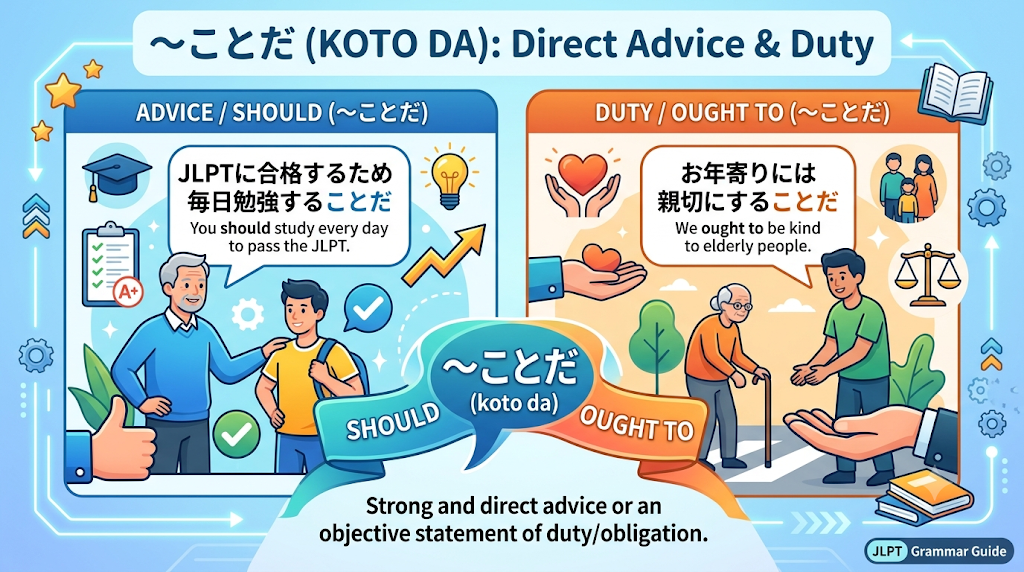
That tool is 〜ことだ (koto da).
In this comprehensive guide, we will break down everything you need to know about 〜ことだ: its precise structure, real-life usage contexts, subtle nuances, common pitfalls, and how it compares to similar grammar structures like 〜べきだ (beki da).
1. Understanding 〜ことだ: What Does It Mean?
At its core, 〜ことだ (koto da) translates to “should,” “ought to,” or “the best thing to do is…”
It is used when giving direct advice, strong suggestions, or practical solutions to a specific problem. When you use this phrase, you are effectively telling someone: “If you want to achieve X result, the most important or effective action you can take is Y.”
Key Characteristics:
- Target JLPT Level: N2
- Tone: Authoritative, instructional, direct, but caring.
- Speaker Perspective: Often used by teachers, seniors, mentors, doctors, or friends giving expert/practical guidance.
2. How to Form Sentences with 〜ことだ
The grammatical structure for 〜ことだ is straightforward because it attaches directly to verbs in their dictionary (plain) form.
| Verb Form | Structure | Example Verb | Conjugated Form |
| Dictionary Form (Affirmative) | Verb (Plain Form) + ことだ | 食べる (to eat) | 食べることだ |
| Negative Form (Nai-form) | Verb (Nai-form) + ことだ | 諦めない (not give up) | 諦めないことだ |
Crucial Rule: You cannot use this structure with nouns or adjectives directly to mean “should.” It must follow a verb in its plain present form (affirmative or negative).
3. Real-World Example Sentences
To truly understand how 〜ことだ flows in everyday speech, let us look at several practical examples categorized by context.
Context A: Health & Well-being
- 日本語: 風邪をひいた時は、暖かいものを食べて早く寝ることだ。Romaji: Kaze wo hiita toki wa, atatakai mono wo tabete hayaku neru koto da.English: When you catch a cold, the best thing to do is eat something warm and go to sleep early.
- 日本語: 健康を保ちたいなら、毎日無理のない範囲で運動することだ。Romaji: Ken-kō wo tamotai nara, mainichi muri no nai han’i de undō suru koto da.English: If you want to maintain your health, you should exercise daily within a reasonable range.
Context B: Language Learning & Skill Building
- 日本語: 日本語が上手になりたければ、失敗を恐れずにたくさん話すことだ。Romaji: Nihongo ga jōzu ni naritakereba, shippai wo osorezu ni takusan hanasu koto da.English: If you want to get good at Japanese, you ought to speak a lot without fearing mistakes.
- 日本語: JLPTに合格したいなら、過去問を繰り返し解くことだ。Romaji: JLPT ni gōkaku shitai nara, kakomon wo kurikaeshi tokukoto da.English: If you want to pass the JLPT, the best approach is to solve past exam papers repeatedly.
Context C: Negative Advice (What NOT to do)
- 日本語: 成功したいのなら、途中で諦めないことだ。Romaji: Seikō shitai no nara, tochū de akiramenai koto da.English: If you want to succeed, you should not give up halfway.
4. Nuance & Constraints: When NOT to Use 〜ことだ
While 〜ことだ means “should,” you cannot use it interchangeably in every situation. Misusing it can sound unnatural or culturally inappropriate.
Rule 1: It requires a specific condition or goal
〜ことだ is almost always used in response to a specific scenario, goal, or trouble. It often pairs naturally with conditional clauses like 〜なら (nara) or 〜たければ (takereba).
- Correct: 日本語を上達させたいなら、毎日勉強することだ。 (If you want to improve your Japanese, you should study every day.)
- Unnatural: 明日、スーパーに行くことだ。 (You should go to the supermarket tomorrow. — Too sudden and lacks conditional context).
Rule 2: Do not use it toward social superiors
Because 〜ことだ carries an instructional and authoritative tone, using it toward your boss, client, or elderly people can sound preachy or condescending.
- Avoid saying to your manager: 早く休むことだ (You ought to rest early).
- Instead, use softer expressions like 〜なさったほうがいいと思います or 〜をお勧めします.
5. 〜ことだ vs. 〜べきだ vs. 〜ほうがいい
Understanding how 〜ことだ differs from other advice-giving structures is essential for scoring high on the JLPT and speaking naturally.
| Grammar Point | Core Meaning | Nuance / Context |
| 〜ことだ (Koto da) | “The best thing to do is…” | Practical, direct advice targeted at a specific personal goal or situation. |
| 〜べきだ (Beki da) | “Must / Moral obligation” | Strong moral, social, or logical duty. What is universally “right.” |
| 〜ほうがいい (Hō ga ii) | “It’s better to…” | Friendly suggestion, weighing options between alternatives. |
Deep Dive Comparison:
- JLPTに合格するには、勉強することだ。
- Nuance: Focuses on the practical solution to pass the test.
- 学生は勉強するべきだ。
- Nuance: Focuses on societal expectation/duty. Students morally ought to study.
- 今日から勉強したほうがいいよ。
- Nuance: Friendly advice comparing studying today versus waiting.
To explore formal test guidelines and grammar specifications for official exams, check out the official JLPT Exam Overview website.
6. JLPT N2 Exam Tips & Common Distractors
In the JLPT N2 grammar section, test-makers love to test your ability to differentiate 〜ことだ from visually similar grammar structures.
Watch out for these common trick options:
- 〜ことにしている (Koto ni shite iru): Indicates a personal habit or routine (e.g., “I make it a rule to…”).
- 〜ことになっている (Koto ni natte iru): Indicates a rule, schedule, or convention set by external factors.
- 〜ことだから (Koto dakara): Used to make a logical deduction based on someone’s known character (e.g., “Knowing him, he will probably…”).
If you are preparing for standard test formats, practicing regularly with official materials is crucial. You can review authentic testing standards via the official Japan Foundation resources.
Summary Checklist
To wrap up, keep these key points in mind whenever you use 〜ことだ:
- Use it to give direct, practical advice or solutions to a specific problem.
- Attach it directly to the Verb Dictionary Form or Verb Nai-form.
- Pair it naturally with conditional phrases like 〜なら or 〜たら.
- Avoid using it with superiors or bosses to prevent sounding preachy


