If you have ever had a lightbulb moment while conversing in Japanese—that sudden flash of clarity where a complex situation suddenly makes complete sense—you have encountered the exact emotional and logical space occupied by ~わけだ (wake da).
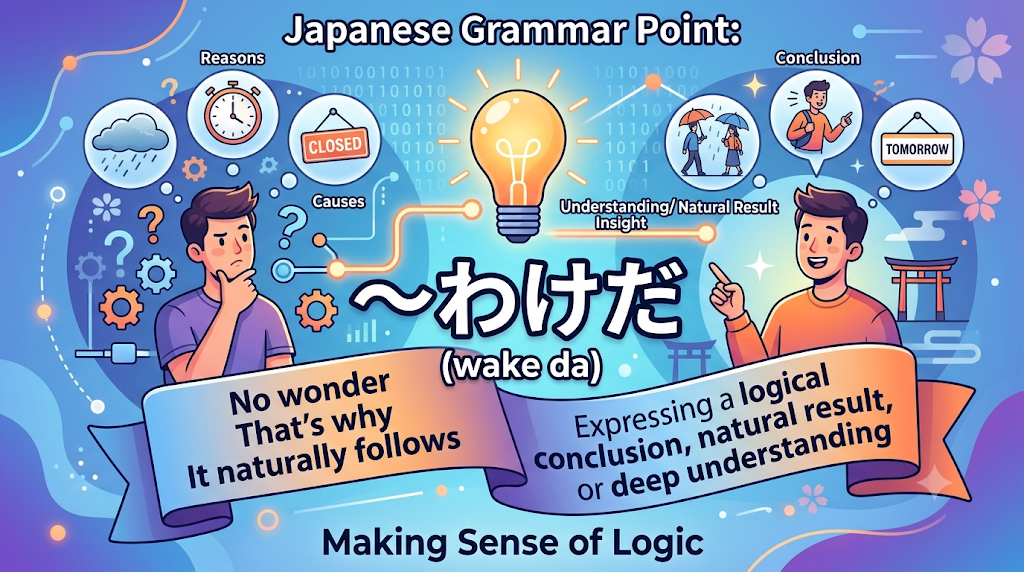
1. Core Meaning and Deep Nuance
At its core, ~わけだ translates to:
- “No wonder…”
- “That explains why…”
- “It stands to reason that…”
- “That means…”
The word わけ (理由/分解) historically refers to the reason, sense, or logical breakdown of a situation. When you attach だ (da), です (desu), or である (de aru) to it, you state that a specific conclusion naturally and logically follows from the facts presented.
The Psychology Behind ~わけだ
Unlike simple casual connectors like から (kara) or ので (node), which merely state a cause (“Because X, Y happens”), ~わけだ carries a reflective nuance.
- Conclusion First, Fact Second (or vice versa): You observe a fact (Fact A), hear a piece of background information (Fact B), and then connect them in your mind to draw a natural conclusion.
- The “Aha!” Moment: It signifies that something which was previously confusing or simply unstated now has a logical explanation.
Example Scenario:
- Observation: Tanaka-san is fluent in French.
- New Fact: You learn Tanaka-san lived in Paris for six years.
- Your Reaction using ~わけだ: 「なるほど、6年もパリに住んでいたわけだ!」 (Naruhodo, roku-nen mo Pari ni sunde ita wake da! / “Ah, no wonder he lived in Paris for six years!”)
2. Structural Breakdown and Conjugation Rules
To use ~わけだ correctly, attach it directly to the plain (informal) form of verbs, adjectives, and nouns. Watch out for な-adjectives and nouns, as they require specific connecting particles in the present affirmative tense.
| Part of Speech | Tense / Form | Connection Pattern | Example |
| Verbs | Plain Form | Verb (Plain) + わけだ | 食べる わけだ / 食べた わけだ |
| い-Adjectives | Plain Form | い-Adj + わけだ | 寒い わけだ / 寒かった わけだ |
| な-Adjectives | Present Affirmative | な-Adj + な + わけだ | 得意な わけだ |
| Past / Negative | Plain Form + わけだ | 得意だった わけだ | |
| Nouns | Present Affirmative | Noun + の / である + わけだ | 先生の わけだ / 先生である わけだ |
| Past / Negative | Plain Form + わけだ | 先生だった わけだ |
Pro Tip for JLPT Test Takers: Pay close attention to な-adjectives. Forgetting to keep な before わけだ in the present tense is one of the most common distractor choices on the JLPT N3 grammar section.
3. The 3 Main Functions of ~わけだ
To sound like a native speaker, you need to know when and where to use this pattern. ~わけだ broadly serves three main functions:
Function 1: Expressing “No Wonder” (Discovering a Reason)
Use this when you find out new information that explains a situation you already observed.
- 東京は物価が高いわけだ。Tokyō wa bukka ga takai wake da.(No wonder prices are high in Tokyo.)
- 外はマイナス5度か。寒いわけだ。Soto wa mainasu go-do ka. Samui wake da.(It’s -5 degrees outside? No wonder it’s so cold!)
Function 2: Expressing Logical Conclusions (“That Means…”)
Use this when summarizing a situation or restating a fact based on mathematical or logical deduction.
- 叔父の息子の子供だから、私にとっても親戚になるわけだ。Oji no musuko no kodomo dakara, watashi ni tottemo shinseki ni naru wake da.(Since he is my uncle’s son’s child, that means he is also my relative.)
- 時給1000円で8時間働いたから、今日は8000円稼いだわけだ。Jikyū sen-en de hachi-jikan hataraita kara, kyō wa hassan-en kaseida wake da.(I worked 8 hours at 1,000 yen per hour, which means I earned 8,000 yen today.)
Function 3: Summarizing or Paraphrasing a Conversation
In dialogue, you can use わけだ to confirm what the speaker just told you, effectively saying, “So what you’re saying is…”
- A: 昨日、終電を逃してしまって、家まで2時間歩いたんです。
- B: それで今日はそんなに疲れているわけですね。
- A: Kinō, shūden o nagoshite shimatte, ie made ni-jikan aruita n desu.
- B: Sore de kyō wa sonna ni tsukarete iru wake desu ne.
- (A: I missed the last train yesterday and walked 2 hours home. / B: So that’s why you look so tired today.)
4. Comparing ~わけだ with Similar Grammar Patterns
Understanding Japanese grammar requires distinguishing lookalike expressions. Let’s compare ~わけだ with related JLPT N3/N2 structures:
[ Observed Fact / Reality ] ──( Logical Connection )──> [ ~わけだ ]
1. ~わけだ vs. ~せいだ (Sei da)
- ~せいだ: Assigns blame for a negative outcome (“It’s because of X that Y happened”).
- ~わけだ: Neutral logical conclusion (“That explains why Y happened”).
- Example:
- 雨が降ったせいだ。(It’s the rain’s fault. – Blame)
- 雨が降っていたわけだ。(Ah, so it was raining. – Logical discovery)
2. ~わけだ vs. ~はずだ (Hazu da)
- ~はずだ: Expresses strong expectation based on logic or data (“It should be the case, though I might not have confirmed it yet”).
- ~わけだ: Expresses realized facts (“It is the case, and now I understand why”).
- Example:
- 彼は今日来るはずだ。(He should be coming today. – Expectation)
- 彼は今日来るわけだ。(So he is coming today after all. – Logical understanding)
To explore more nuances between わけ and はず, check out the detailed breakdown on Maggie Sensei’s Japanese Grammar Guides for real-world conversational native examples.
5. Daily Conversational Practice and Dialogue
To build muscle memory, read these natural conversational exchanges aloud:
Dialogue 1: At the Office
A: 佐藤さん、最近毎日残業しているらしいよ。
B: ああ、来週の大きなプロジェクトの準備をしているんだって。
A: なるほど、それで最近ずっと忙しいわけだ。
- Romaji:A: Satō-san, saikin mainichi zangyō shite iru rashii yo.B: Ā, raishū no ōkina purojekuto no junbi o shite iru n datte.A: Naruhodo, sore de saikin zutto isogashii wake da.
- English:A: I heard Sato-san has been working overtime every day recently.B: Yeah, apparently he’s preparing for next week’s big project.A: Ah, I see. No wonder he’s been so busy lately.
Dialogue 2: Studying for the JLPT
A: この問題、難しすぎるよ!
B: これ、N1レベルのテキストから出題されているんだよ。
A: どうりで難しいわけだ!まだ習っていない文法ばかりだもん。
- Romaji:A: Kono mondai, muzukashisugi ru yo!B: Kore, N1 reberu no tekisuto kara shutsudai sarete iru n da yo.A: Dōri de muzukashii wake da! Mada naratte inai bunpō bakari da mon.
- English:A: This problem is way too hard!B: That’s because it’s taken from an N1-level textbook.A: No wonder it’s hard! It’s full of grammar I haven’t learned yet.
If you are actively preparing for your test, you can review complete grammar listings and vocabulary syllabus breakdowns directly on the official JLPT Official Website.
6. Common Mistakes to Avoid
- Forgetting “な” or “の/である”
- Incorrect: 彼女は親切わけだ。
- Correct: 彼女は親切なわけだ。 (Kanojo wa shinsetsu na wake da.)
- Overusing it for Simple Direct Cause-and-Effect
- Do not use ~わけだ when simply explaining a basic action reason without any element of logical deduction or realization.
- Awkward: お腹が空いたわけだから、ラーメンを食べた。
- Natural: お腹が空いたから、ラーメンを食べた。 (Onaka ga suita kara, rāmen o tabeta.)
- Confusing with ~わけではない (Wake dewai nai)
- Adding ではない flips the meaning entirely to partial negation: “It doesn’t mean that…” or “It’s not necessarily true that…”
Summary Checklist for Master Path
- Use ~わけだ when you connect the dots to say “no wonder” or “that means.”
- Match plain forms of verbs/adjectives, but remember な for な-adjectives and の/である for nouns.
- Pair it with naturally occurring context words like なるほど (naruhodo – I see) or どうりで (dōri de – no wonder).