
If you’ve been studying Japanese for a few months, you’ve likely hit that classic milestone where grammar moves from simple subject-verb-object structures into nuance territory. You know how to say “I ate breakfast” or “I opened the window,” but how do you say “I slept with the lights on” or “I left the door open”?
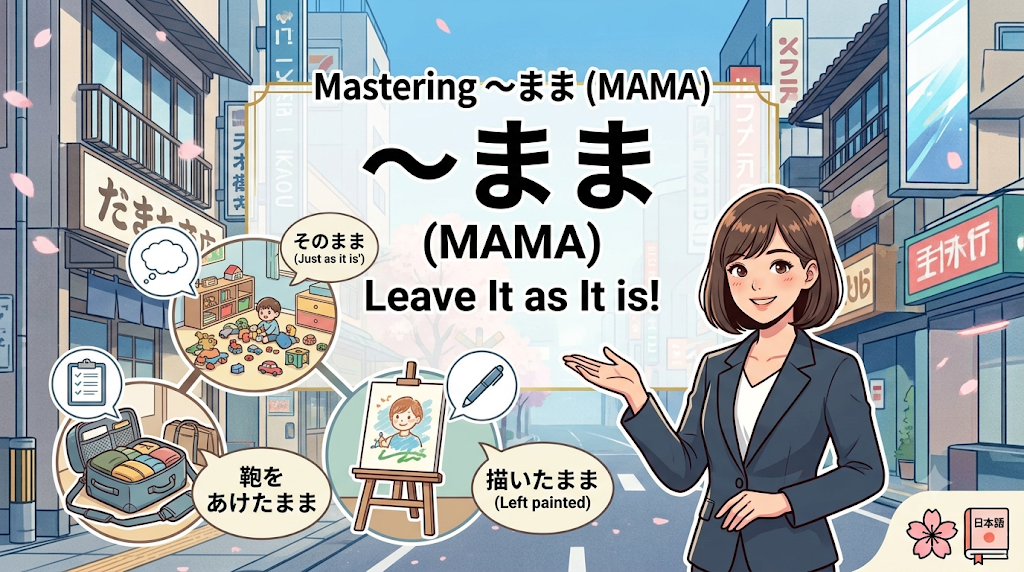
That’s where 〜まま (mama) comes in.
In this guide, we’re going to break down 〜まま step-by-step. Whether you are prepping for the JLPT N4 exam or just trying to sound more natural when chatting with Japanese friends, this post will give you the structural rules, deep contextual insights, and practical applications you need.
What Does 〜まま (mama) Actually Mean?
At its core, 〜まま (mama) expresses that a state or condition remains unchanged while another action occurs, or that something is left as-is.
In English, we translate this in a few different ways depending on the context:
- “As it is” or “in the state of…”
- “Leaving (something) as…”
- “With (something) still…” (e.g., with my shoes on, with the window open)
The main idea to lock in your mind is unbroken continuity. Action A created a state, and without resetting or changing that state, Action B happens.
Why Is 〜まま So Important for Natural Japanese?
English speakers often try to translate sentences like “I fell asleep with my glasses on” literally by using conjunctions like そして (soshite) or と (to).
If you say:
❌ メガネをかけて、寝ました。 (Megane o kakete, nemashita.)
Literally: I put on my glasses and slept.
While a native speaker will understand you, it sounds like putting on glasses was a deliberate part of your bedtime routine.
By using 〜まま:
⭕ メガネをかけたまま、寝てしまった。 (Megane o kaketa mama, nete shimatta.)
Meaning: I fell asleep with my glasses still on.
The grammar structure instantly communicates that an existing state (glasses on) was preserved passively during the main action (falling asleep).
To build a solid grounding in Japanese core structures alongside 〜まま, exploring comprehensive study guides on sites like JLPT Sensei’s N4 Grammar Master List can help you see how these conditional and state-based markers fit together.
How to Form 〜まま (Grammar Connections)
One reason 〜まま is so versatile is that it can attach to almost any part of speech: verbs, nouns, adjectives, and demonstratives.
Here is the quick reference rulebook:
| Part of Speech | Connection Rule | Example | Meaning |
| Verb (Past / Ta-form) | Verb (た) + まま | 開けたまま (aketa mama) | left open |
| Verb (Negative / Nai-form) | Verb (ない) + まま | 食べないまま (tabenai mama) | without eating |
| Noun | Noun + の + まま | 服のまま (fuku no mama) | with clothes on |
| i-Adjective | i-Adj + まま | 熱いまま (atsui mama) | while still hot |
| na-Adjective | na-Adj + な + まま | きれいなまま (kirei na mama) | remaining clean |
| Demonstratives | この / その / あの + まま | そのまま (sono mama) | just like that |
Deep Dive into Connections & Sentence Patterns
Let’s break down each connection type with detailed examples and realistic contexts.
1. Verbs (た-form & ない-form)
When connecting verbs, you will almost always use either the past tense (た-form) or the negative present tense (ない-form).
A. Verb (た-form) + まま
This pattern means an action was completed to create a condition, and that condition persists during another action.
- 窓を開けたまま、出かけてしまった。Mado o aketa mama, dekakete shimatta.I went out with the window left open.
- 靴を履いたまま、部屋に入らないでください。Kutsu o haita mama, heya ni hairanaide kudasai.Please don’t enter the room with your shoes on.
B. Verb (ない-form) + まま
This pattern means doing something without performing an expected prior step.
- 朝ごはんは食べないまま、会社に行きました。Asagohan wa tabenai mama, kaisha ni ikimashita.I went to work without eating breakfast.
- 何も言わないまま、彼は出て行った。Nani mo iwanai mama, kare wa dete itta.He walked out without saying anything.
2. Nouns + のまま
When combining nouns with まま, you must use the particle の (no). This pattern often describes someone’s posture, state of dress, or environmental conditions.
- パジャマのまま、コンビニに行ってしまった。Pajama no mama, konbini ni itte shimatta.I accidentally went to the convenience store in my pajamas.
- 昔のままの街並みが残っている。Mukashi no mama no machinami ga nokotte iru.The townscape remains just as it was in the past.
3. Adjectives + まま
Adjectives describe ongoing emotional or physical states.
A. i-Adjectives (Keep the 〜い)
- スープが熱いまま飲んだら、火傷した。Sūpu ga atsui mama nondara, yakedo shita.I drank the soup while it was still hot and burned myself.
B. na-Adjectives (Keep the 〜な)
- 部屋をきれいなままに保つのは難しい。Heya o kirei na mama ni tamatsu no wa murazukashii.Keeping a room clean (in a clean state) is difficult.
4. Demonstratives (そのまま / このまま / あのまま)
These set phrases appear constantly in casual and business conversation:
- このまま (kono mama): As it is right now (near the speaker)
- そのまま (sono mama): As it is (near the listener, or referring to an mentioned situation)
- あのまま (ano mama): As it was back then (referring to a distant past situation)
Real-world Shopping Scenario:
Clerk: 袋にお入れしますか? (Fukuro ni o-ire shimasu ka? — Shall I put this in a bag?)
You: いいえ、そのままください。 (Iie, sono mama kudasai. — No, I’ll take it as it is.)
Important Distinction: 〜まま (mama) vs. 〜っぱなし (ppanashi)
One of the trickiest parts of Japanese grammar for intermediate learners is telling 〜まま apart from 〜っぱなし. Both express an ongoing state, but their psychological nuance is completely different.
| Point of Comparison | 〜まま (mama) | 〜っぱなし (ppanashi) |
| Core Tone | Neutral, descriptive, or intentional | Negative, critical, or careless |
| Speaker’s Attitude | Just describing the state | Expressing annoyance/regret that something was left undone |
| Focus | The condition itself | The neglect of a required finishing action |
Comparing Examples:
- テレビをつけたまま寝た。 (Terebi o tsuketa mama neta.)Nuance: Neutral statement of fact. “I fell asleep with the TV on.”
- テレビをつけっぱなしで寝た! (Terebi o tsuke-ppanashi de neta!)Nuance: Frustration or self-criticism. “I fell asleep and left the TV running all night! What a waste of electricity!”
If you want to dive deeper into practical daily grammar nuances, practice drills, and vocabulary usage, checking resource sites like Tae Kim’s Guide to Learning Japanese is a fantastic way to supplement your structured textbook practice.
Subtle Nuance: 〜ままにする vs. 〜ままになる
How you end a 〜まま phrase changes whether you are taking an active role or describing passive preservation.
1. 〜ままにする (To leave something as it is)
This is an active choice to keep a state untouched.
- ドアを開けたままにしてください。Doa o aketa mama ni shite kudasai.Please leave the door open on purpose (for ventilation, etc.).
2. 〜ままになる (To remain / end up as it is)
This describes a result or state that happens naturally or by accident.
- 未開封のままになっている手紙。Mikaitō no mama ni natte iru tegami.A letter that has ended up sitting unopened.
Common JLPT N4 Traps & Mistakes to Avoid
Trap 1: Using Plain Present Tense Verbs
You cannot attach plain present (dictionary) form directly to まま.
- ❌ 窓を開けるまま、寝た。 (Mado o akeru mama, neta.)
- ⭕ 窓を開けたまま、寝た。 (Mado o aketa mama, neta.)
Reasoning: “Opening” is an action, but 〜まま requires a completed action that created a lingering state (hence the past/た-form).
Trap 2: Forgetting Particle の on Nouns
Nouns always need の before まま.
- ❌ 生まま食べる。 (Nama mama taberu.)
- ⭕ 生のまま食べる。 (Nama no mama taberu. — Eat it raw.)
Practical Native Expressions with 〜まま
To help you sound like a native speaker, here are a few fixed idiomatic phrases using 〜まま:
- 思うがままに (Omou ga mama ni)Meaning: As one pleases / As your heart desires.Example: 思うがままに人生を生きる。 (Live life as your heart desires.)
- 生まれつきのまま (Umaretuki no mama)Meaning: In its natural/original state since birth.
- 言われるがままに (Iwareru ga mama ni)Meaning: Doing exactly as told (without questioning).Example: 彼は言われるがままに作業を続けた。 (He kept working just as he was told.)
Summary Practice Checklist
Test your understanding with these quick scenarios:
- “I went to bed with my makeup on.”→ メイクをしたまま寝てしまった。 (Meiku o shita mama nete shimatta.)
- “Please leave the room as it is.”→ 部屋をそのままにしてください。 (Heya o sono mama ni shite kudasai.)
- “He left home without wearing a coat.”→ コートを着ないまま出かけた。 (Kōto o kinai mama dekaketa.)
Final Thoughts
Grammar structures like 〜まま represent the transition from basic translated Japanese to authentic, fluid communication. Once you get used to attaching it to verb past forms and nouns with の, you’ll find yourself using it in everyday conversation constantly.
Keep practicing by noticing where 〜まま shows up in Japanese dramas, manga, and daily conversations.


