
If you have ever left the TV running while sleeping, left the water tap dripping, or spent an entire morning standing on a packed Japanese train, you already know the real-world feeling of ~っぱなし (ppanashi).
In Japanese, grammar is more than just a set of mechanical rules—it reflects cultural attitudes toward order, responsibility, and mindfulness. The grammar pattern ~っぱなし (ppanashi) is one of the most vivid and expressive structures you will encounter at the JLPT N4/N3 level. It captures the exact idea of leaving something in an improper, unintended, or continuous state.
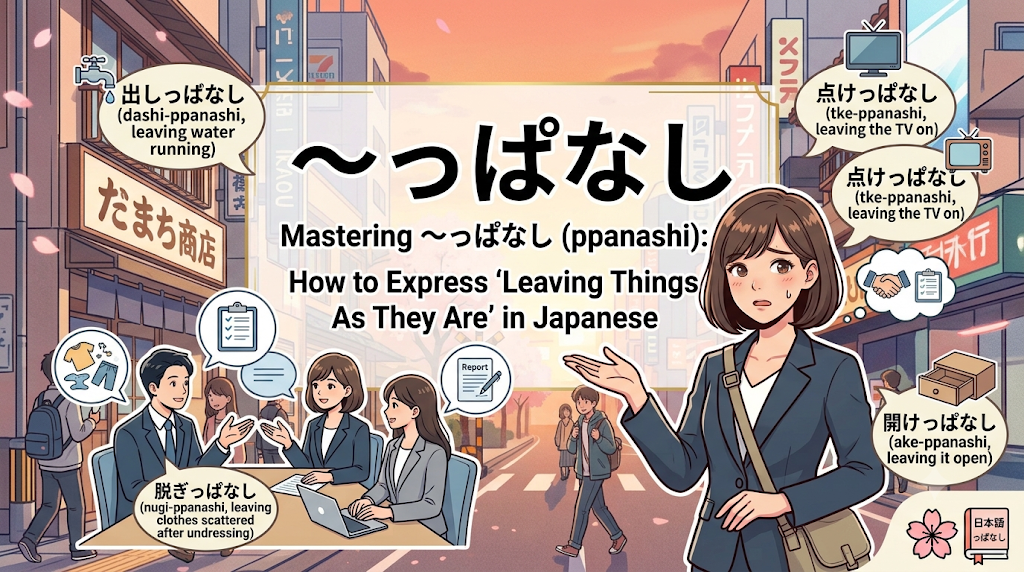
In this detailed guide, we will break down everything you need to know about ~っぱなし: how to construct it, its distinct emotional nuances, practical everyday applications, common pitfalls, and real-life conversational examples.
What Does ~っぱなし (ppanashi) Mean?
At its core, ~っぱなし (ppanashi) attaches to the stem of a verb to indicate that an action or state continues without being properly completed, cleaned up, or restored to its normal condition.
The Core Meaning
- Leaving something unattended or undone: Leaving an action in an unfinished state when social norms or common sense dictate that you should reset or clean it up (e.g., leaving the door open, leaving the light on).
- Continuous physical state or action: Performing an action or remaining in a single state uninterrupted for a long duration, often causing discomfort or fatigue (e.g., standing all day, wearing shoes all day).
The Linguistic Origin
The suffix っぱなし comes from the verb 放なし (放なし / はなし – hanashi), which stems from 放つ (hanatsu) meaning “to release,” “to let go,” or “to set free.” When combined with a verb stem, the original h sound changes to a hardened, emphatic p (っ解/っぱ) sound, creating the familiar sound of っぱなし.
Expressive Nuance: Why Is ~っぱなし So Important?
To sound like a native Japanese speaker, understanding the nuance behind grammar patterns is crucial. ~っぱなし carries specific emotional undertones depending on the context:
1. Frustration and Criticism (Negativity)
In most cases involving household chores, daily habits, or social manners, ~っぱなし carries a tone of annoyance, complaint, or self-deprecation. It implies that someone was careless, lazy, or irresponsible.
- ドアを開けっぱなしにしないで!(Doa o akeppanashi ni shinai de!) Don’t leave the door open! (Implies draftiness, lack of consideration, or letting bugs in.)
2. Physical Discomfort or Endurance
When applied to body posture or physical activities, it highlights the continuous nature of an action that causes physical strain.
- 一日中立ちっぱなしで足が痛い。(Ichinichijū tachippanashi de ashi ga itai.) My feet hurt from standing all day long without a break.
How to Form ~っぱなし (Grammar Rules)
Forming ~っぱなし is straightforward once you know verb stems.
Conjugation Rule
Take the Verb Stem (Masu-form without ます) and attach っぱなし.
$$\text{Verb Stem} + \text{っぱなし}$$
Quick Conjugation Examples:
| Verb (Dictionary) | Verb Stem (Masu-stem) | Formed with っぱなし | Meaning |
| 開ける (Akeru – to open) | 開け (Ake) | 開けっぱなし (Akeppanashi) | Leaving (it) open |
| つける (Tsukeru – to turn on) | つけ (Tsuke) | つけっぱなし (Tsukeppanashi) | Leaving (it) turned on |
| 出す (Dasu – to take out) | 出し (Dashi) | 出しっぱなし (Dashippanashi) | Leaving (things) lying out |
| 脱ぐ (Nugu – to take off clothes) | 脱ぎ (Nugi) | 脱ぎっぱなし (Nugippanashi) | Leaving clothes scattered |
| 立つ (Tatsu – to stand) | 立ち (Tachi) | 立ちっぱなし (Tachippanashi) | Remaining standing |
| 座る (Suwaru – to sit) | 座り (Suwari) | 座りっぱなし (Suwarippanashi) | Remaining seated |
| 敷く (Shiku – to lay out futon) | 敷き (Shiki) | 敷きっぱなし (Shikippanashi) | Leaving the futon laid out |
How to Use ~っぱなし in Sentences (Sentence Patterns)
Depending on how you want to use ~っぱなし in a sentence, it can function as a noun, an adverb, or a predicate.
1. Followed by だ / です (As a Predicate)
Used to state that something is currently in an unfinished or unattended state.
- テレビがつけっぱなしです。(Terebi ga tsukeppanashi desu.) The TV is left turned on.
- 本が開きっぱなしだ。(Hon ga hirakippanashi da.) The book is left lying open.
2. Followed by にする / になる (As an Action or Result)
- ~っぱなしにする: To deliberately or carelessly leave something in that state.
- ~っぱなしになる: To end up left in that state.
- 服を脱ぎっぱなしにしないでください。(Fuku o nugippanashi ni shinai de kudasai.) Please don’t leave your clothes scattered around after taking them off.
- 窓が開きっぱなしになっている。(Mado ga akippanashi ni natte iru.) The window has been left wide open.
3. Followed by で (To Describe the Circumstance of Another Action)
Used when doing another action while maintaining an ongoing physical state or condition.
- 昨夜は電気をつけっぱなしで寝てしまった。(Sakuya wa denki o tsukeppanashi de nete shimatta.) Last night I accidentally fell asleep with the lights turned on.
- 一日中座りっぱなしで作業した。(Ichinichijū suwarippanashi de sagyō shita.) I worked all day without getting up from my seat.
~っぱなし vs. ~ておく (Te Oku): Crucial Nuance Difference
Learners frequently confuse ~っぱなし (ppanashi) with ~ておく (te oku) because both deal with leaving a state intact. However, their intentions are complete opposites!
| Grammar Point | Intention / Tone | Example | Meaning |
| ~っぱなし | Unintentional, careless, negative outcome, or neglectful | 窓を開けっぱなしにした。 | I carelessly left the window open (and rain got in). |
| ~ておく | Intentional, purposeful, prepared for future use | 窓を開けておいた。 | I left the window open on purpose (to let fresh air in). |
- Pro Tip: If you did something on purpose for future convenience, always use ~ておく. If you forgot to clean up or left something in an improper state, use っぱなし.
To strengthen your overall knowledge of core grammar patterns, explore comprehensive list resources like Tae Kim’s Guide to Learning Japanese for intuitive explanations of essential grammar.
Common Real-World Expressions with ~っぱなし
Here are the most practical everyday expressions native speakers use all the time:
1. つけっぱなし (Tsukeppanashi) – Left turned on
Used for electronics, lights, air conditioners, heaters, and water faucets.
- エアコンをつけっぱなしで外出してしまった。(Eakon o tsukeppanashi de gaishutsu shite shimatta.) I went out while accidentally leaving the air conditioner running.
2. 出しっぱなし (Dashippanashi) – Left cluttering / lying out
Used when toys, tools, cosmetics, or cooking items aren’t put back in their proper storage spot.
- 使った工具を出しっぱなしにするな!(Tsukatta kōgu o dashippanashi ni suru na!) Don’t leave the tools you used lying around!
3. 立ちっぱなし / 座りっぱなし (Tachippanashi / Suwarippanashi)
Used for prolonged standing or sitting.
- デスクワークで座りっぱなしだと、腰が痛くなります。(Desuku wāku de suwarippanashi dato, koshi ga itaku narimasu.) If you stay seated all day doing desk work, your lower back starts to hurt.
4. 借りっぱなし (Karippanashi) – Borrowed and never returned
Used when you borrow books, money, or items and keep them for way too long.
- 友達から借りた漫画を一年間借りっぱなしにしている。(Tomodachi kara karita manga o ichinenkan karippanashi ni shite iru.) I’ve kept the manga I borrowed from my friend for a whole year without returning it.
Detailed Example Sentences with Japanese Script & Romaji
To build natural fluency, review these real-world example sentences:
- 水が出っぱなしですよ。早く止めてください。(Mizu ga deppanashi desu yo. Hayaku tomete kudasai.) The water is running continuously! Please turn it off quickly.
- 靴を脱ぎっぱなしにしないで、ちゃんと揃えなさい。(Kutsu o nugippanashi ni shinai de, chanto soroenasai.) Don’t just kick off your shoes and leave them scattered; line them up properly.
- 満員電車で二時間立ちっぱなしだったから、本当に疲れた。(Man’in densha de nijikan tachippanashi datta kara, hontō ni tsukareta.) I was standing for two hours straight on a packed train, so I’m completely exhausted.
- やりっぱなしの仕事がたくさんあって、休めない。(Yarippanashi no shigoto ga takusan atte, yasumenai.) I have so much unfinished work left hanging that I can’t take a break.
Culturally Grounded Insights: Japanese Etiquette & “Ppanashi”
Understanding ~っぱなし offers a great window into Japanese cultural values. In Japan, concepts like 後片付け (Atokatazuke – cleaning up after oneself) and 片付け (Katazuke – tidying up) are emphasized from early childhood in schools and homes.
Leaving something っぱなし implies a lack of consideration for the next person who will use the space (Meiwaku – 迷惑 / causing annoyance to others). When you master this grammar point, you don’t just gain vocabulary—you gain insight into how orderliness and social harmony are expressed through the language.
Summary Checklist for JLPT Prep
To prepare for your JLPT N4 or N3 exam, keep these rules in mind:
- Structure: Verb Stem + っぱなし
- Meaning 1: Left in an incomplete, messy, or improper state.
- Meaning 2: Doing a physical action continuously for a long time.
- Tone: Negativity, annoyance, or physical discomfort.
- Key Distinction: Opposite of ~ておく (which is intentional/prepared).
For additional official updates on JLPT test structure, scheduling, and exam levels, check the official website at JLPT Official Website. You can also test your reading and grammar proficiency interactively on Maggie Sensei to practice conversational Japanese contexts.
Practice Quiz: Test Your Understanding!
Try converting the following verbs into the ~っぱなし form and completing the sentences:
- 開ける (Akeru) $\rightarrow$ ドアを(____________)にしないでください。
- 座る (Suwaru) $\rightarrow$ 一日中(____________)で身体が痛い。
- 点ける (Tsukeru) $\rightarrow$ 明かりを(____________)で寝てしまった。
(Answers: 1. 開けっぱなし / 2. 座りっぱなし / 3. つけっぱなし)
Keep Practicing!
Language learning is all about consistency. Try creating 3 to 5 of your own personal sentences using ~っぱなし based on your daily routine. Did you leave your coffee mug out this morning? Did you sit at your computer for 5 hours? Use those real-life moments to lock this grammar point into your memory!


