
If you have been studying Japanese for a while, you already know that expressiveness in the language comes down to mastering contrast markers. In the early stages of your learning, words like でも (demo), けど (kedo), and けれど (keredo) do most of the heavy lifting when you want to say “but” or “although.”
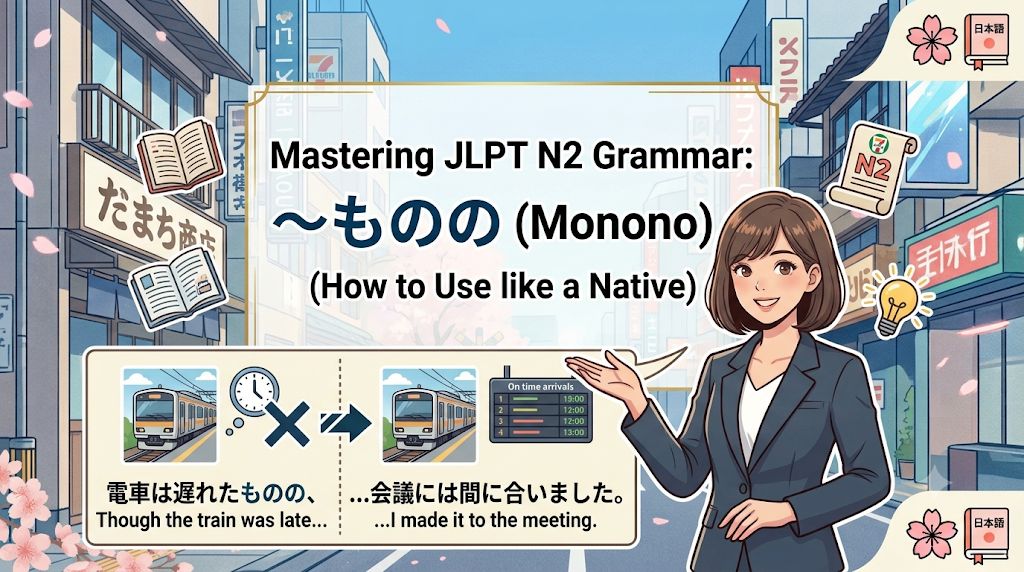
However, as you move into intermediate and advanced Japanese—specifically around the JLPT N2 level—you begin encountering grammar patterns that carry subtle tone shifts, formality levels, and emotional nuances. One of the most important and frequently tested patterns in this category is 〜ものの (monono).
In this guide, we will break down 〜ものの completely. We will look at what it means, how to construct it grammatically, how it differs from similar contrast patterns, real-world native examples, and common traps to avoid on exam day.
1. What Does 〜ものの (Monono) Mean?
At its core, 〜ものの translates to:
- “Although…”
- “Even though…”
- “Despite the fact that…”
It is used to connect two clauses where Clause B presents a result, situation, or state that contrasts with the expectation set by Clause A.
The Key Nuance: Acknowledging Reality vs. Unmet Expectations
Unlike casual contrast markers, 〜ものの carries a specific internal logic:
- Clause A states a objective fact or reality (“I bought the book,” “Summer has arrived,” “I apologized”).
- Clause B reveals a secondary fact that goes against what normally or logically should follow from Clause A (“…but I haven’t read it,” “…but it’s still cold,” “…but they are still angry”).
Tone and Register
〜ものの is a formal and written-style grammar pattern. You will see it frequently in:
- Japanese newspaper articles and essays
- Formal business correspondence and reports
- Novel prose and literary narration
- JLPT N2 and N1 reading comprehension passages
While native speakers occasionally use it in spoken Japanese during formal meetings, presentations, or speeches, using it in casual everyday conversation with friends will sound overly stiff.
2. How to Form 〜ものの (Grammar & Structure)
Connecting 〜ものの to different parts of speech is straightforward, but you must pay close attention to the plain forms and correct conjunctions.
| Part of Speech | Connection Formula | Example |
| Verbs | Plain Form (Present/Past) + ものの | 買った ものの (Katta monono) |
| i-Adjectives | Dictionary Form + ものの | 暖かい ものの (Atatakai monono) |
| na-Adjectives | Stem + な + ものの (or である + ものの) | 得意な ものの (Tokui na monono) |
| Nouns | Noun + である + ものの | 学生である ものの (Gakusei de aru monono) |
Crucial Rule to Remember: Nouns cannot connect directly to 〜ものの using な (na) or の (no). They must take である (de aru). For instance, “Although he is a doctor…” becomes 医師であるものの (Ishi de aru monono).
3. Clear Sentence Examples with Breakdown
To build intuition for this pattern, let’s explore real-world examples categorized by context.
A. Personal Actions & Experiences
This is the most common practical application: stating that you completed an action, but the expected outcome did not materialize.
- 日本語の辞書を買ったものの、一度も使っていない。
- Romaji: Nihongo no jisho o katta monono, ichido mo tsukatte inai.
- Translation: Although I bought a Japanese dictionary, I haven’t used it even once.
- Nuance: The action (buying) is done, but the logical next step (using it) failed to happen.
- 手術は成功したものの、完全な回復にはまだ時間がかかりそうだ。
- Romaji: Shujutsu wa seikou shita monono, kanzen na kaifuku ni wa mada jikan ga kakarisou da.
- Translation: Even though the surgery was successful, it seems full recovery will still take time.
B. Weather and Environmental Conditions
In descriptive writing, 〜ものの is frequently used to highlight seasonal or environmental contradictions.
- 暦の上では秋とはいうものの、まだまだ暑い日が続いている。
- Romaji: Koyomi no ue de wa aki to wa iu monono, madamada atsui hi ga tsuzuku.
- Translation: Although according to the calendar it is autumn, hot days are still continuing.
- 雨は上がったものの、風が強くて外に出られない。
- Romaji: Ame wa agatta monono, kaze ga tsuyokute soto ni derarenai.
- Translation: Even though the rain has stopped, the wind is so strong that I cannot go outside.
C. Professional and Social Situations
- 給料は多少上がったものの、物価の昇騰に追いつかない。
- Romaji: Kyuuryou wa tashou agatta monono, bukka no shoutou ni oitsukanai.
- Translation: Although my salary went up a little, it cannot keep up with rising prices.
4. 〜ものの vs. Similar Contrast Patterns
Grammar confusion is the biggest obstacle on the JLPT. Let’s clear up how 〜ものの stacks up against its closest relatives.
Contrast Grammar Hierarchy (Formality & Nuance)

[ Casual / Spoken ]  ----------------------------------->  [ Formal / Written ]
   けど / けれど          〜のに            〜ものの          〜にもかかわらず
 (Simple Contrast)   (Frustration)    (Fact Contradiction)  (Strong Defiance)
1. 〜ものの vs. 〜のに (Noni)
- 〜のに (Noni): Expresses strong emotional reactions like frustration, surprise, anger, or regret (“Even though I prepared so hard, I failed!”). It is heavily used in speech.
- 〜ものの (Monono): Focuses on objective facts rather than venting emotions. It neutrally reports that Fact A occurred, but Fact B stands in contrast.
2. 〜ものの vs. 〜けれども (Keredomo)
- 〜けれども (Keredomo): Highly versatile and neutral. Can be used in both speech and writing.
- 〜ものの (Monono): Sounds distinctly more formal, literary, and deliberate.
3. 〜ものの vs. 〜もののの (Mononono)
- While they sound nearly identical, 〜ものの is standard standard Japanese. 〜もののの is a colloquial repetition occasionally heard in casual dialectal speech, but it is grammatically incorrect in written Japanese and on exams. Stick strictly to 〜ものの.
For a complete look at intermediate contrast grammar, check out the comprehensive JLPT Grammar Master List on JLPT Sensei for breakdown charts and audio guides.
5. Common Mistakes to Avoid
Mistake #1: Using Volitional Forms before 〜ものの
〜ものの requires a completed action, established state, or factual occurrence in Clause A. You cannot use intentional, volitional, or future conjecture forms directly before it.
- ❌ 勉強しようものの、集中できない。 (Incorrect)
- ⭕ 勉強を始めたものの、集中できない。 (Correct: “Although I started studying, I can’t concentrate.”)
Mistake #2: Incorrect Noun Connection
Forgetting である with nouns is a classic test trap.
- ❌ 初心者ものの、頑張ります。 (Incorrect)
- ⭕ 初心者であるものの、頑張ります。 (Correct: “Although I am a beginner, I will do my best.”)
6. Practical Exam Tip for the JLPT N2
In the JLPT N2 Reading Section (読解), when you spot 〜ものの, pay immediate attention to the clause that follows it. Japanese authors frequently use 〜ものの to state a widely accepted fact or premise first, only to deliver their actual core argument or main thesis right after it in Clause B.
If you are preparing for upcoming Japanese language proficiency tests, you can register and check test center details at the official JLPT Official Website. You can also practice your reading strategies using authentic materials hosted on Tofugu’s Japanese Learning Resources.
Summary Cheat Sheet
- Meaning: Although / Even though / Despite the fact that…
- Register: Formal / Written Japanese (JLPT N2 level)
- Structure: Verb (Plain) + ものの | Noun + である + ものの
- Key Point: States a clear fact in Clause A, followed by an unexpected reality in Clause B without overly emotional venting.


