
If you have been studying Japanese past the beginner level, you have likely realized that transition words and practical grammatical conjunctions are what turn choppy, robotic phrases into fluid, natural Japanese. One of the most essential, high-frequency grammar structures you will encounter in everyday conversation, business settings, and on the JLPT (specifically at the N3 and N2 levels) is ~代わりに (kawari ni).
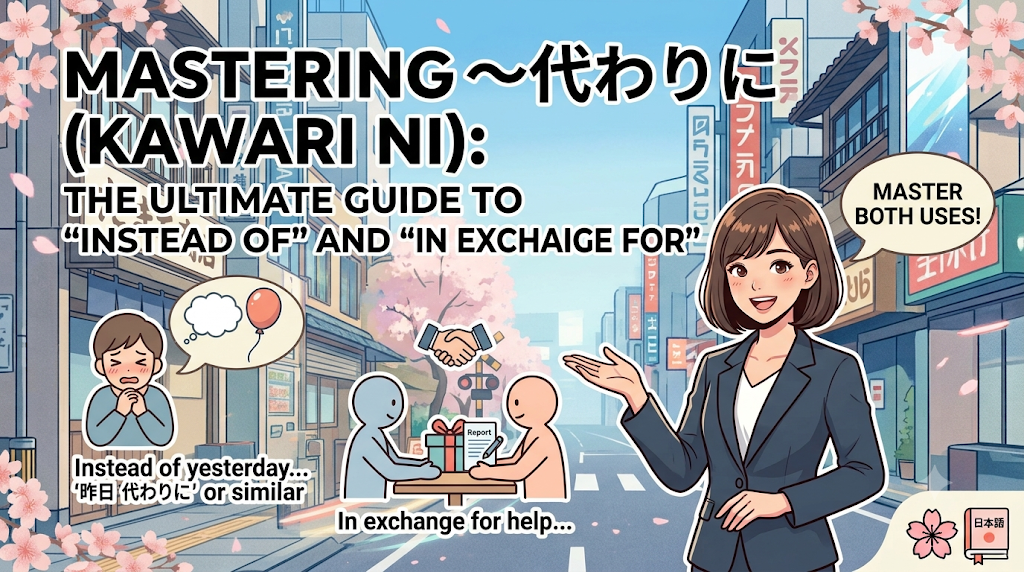
At a glance, standard textbooks tell you that ~代わりに translates simply to “instead of” or “in place of.” While that is accurate for basic sentences, relying solely on a single English translation often causes non-native speakers to misuse it. In reality, ~代わりに carries two distinct functional roles:
- Substitution: Doing one thing instead of another, or using item A in place of item B.
- Compensation / Trade-off: Doing or accepting something in exchange for, on the condition of, or as a balancing act for something else.
In this comprehensive guide, we will break down the mechanics, nuance, real-world conversational dynamics, and common pitfalls of ~代わりに so you can use it with total confidence.
1. Grammatical Formations: How to Attach ~代わりに
Before diving into the nuanced contexts, let us look at the structural mechanics. Because 代わり (kawari) is fundamentally a noun meaning “substitute,” “replacement,” or “proxy,” the way it connects to surrounding words follows standard Japanese noun-modification rules.
Here is the master connection formula:
| Part of Speech | Connection Pattern | Example Structure |
|---|---|---|
| Nouns | Noun + の + 代わりに | 私の代わりに (watashi no kawari ni) |
| Verbs (Dictionary Form) | Verb (Plain Non-Past) + 代わりに | 映画を見に行く代わりに (eiga o mii ni iku kawari ni) |
| Verbs (Past Form) | Verb (Plain Past ~た) + 代わりに | 買い物をした代わりに (kaimono o shita kawari ni) |
| Adjectives (い-adj) | Adjective (Plain) + 代わりに | 忙しい代わりに (isogashii kawari ni) |
| Adjectives (な-adj) | Adjective + な + 代わりに | 静かな代わりに (shizuka na kawari ni) |
Pro Tip for Pronunciation and Writing:
In casual written Japanese or spoken communication, the particle に (ni) is occasionally dropped, leaving just ~代わり (kawari), though keeping に is always standard and grammatically safe for JLPT examinations and formal settings.
2. Usage Pattern A: Pure Substitution (“Instead of…”)
The first major function of ~代わりに is straightforward replacement. You use this when an action, person, or object is step-in for another that would normally be expected.
Key Nuance
When using pattern A, there is always an explicit or implied alternative that was skipped, canceled, or replaced.
Real-Life Examples
- Nouns:
- 課長の代わりに、私が会議に出席します。Kachō no kawari ni, watashi ga kaigi ni shusseki shimasu.(I will attend the meeting in place of / on behalf of the section manager.)
- Verbs:
- 車で行く代わりに、歩いて会社に行きました。Kuruma de iku kawari ni, aruite kaisha ni ikimashita.(I walked to work instead of going by car.)
- コーヒーを飲む代わりに、白湯を飲むようにしています。Kōhī o nomu kawari ni, sayu o nomu yō ni shite imasu.(I make it a point to drink plain hot water instead of drinking coffee.)
Notice how in each scenario, action A (driving, drinking coffee, section manager attending) was expected or typical, but action B took its place.
3. Usage Pattern B: Compensation & Trade-offs (“In Exchange For…”)
This is where many native English speakers stumble because standard dictionaries do not highlight it enough. ~代わりに can also express a balance, compromise, or direct trade-off between two contrasting elements.
Key Nuance
Here, the phrase means “in return for,” “on the condition that,” or “to make up for.” It often balances a positive feature with a negative trade-off, or vice versa.
Real-Life Examples
- Exchanging Favors:
- 日本語を教えてもらう代わりに、英語を教えてあげます。Nihongo o oshiete morau kawari ni, Eigo o oshiete agemasu.(I will teach you English in exchange for you teaching me Japanese.)
- Balancing Advantages and Disadvantages:
- このアパートは家賃が安い代わりに、駅から遠いです。Kono apāto wa yachin ga yasui kawari ni, eki kara tōi desu.(This apartment is far from the station, but on the flip side / in exchange for that, the rent is cheap.)
- 私の部屋は狭い代わりに、日当たりがいい。Watashi no heya wa semai kawari ni, hiatari ga ii.(My room is small, but to make up for it, it gets great natural light.)
When preparing for exams like the N3 or N2, pay close attention to context. If you see two contrasting properties (like cheap rent vs. far station), ~代わりに is acting as a balancing scale, not a literal replacement.
For comprehensive breakdown lists of grammar rules across levels, you can review structured study guides on JLPTSensei or explore test structures directly through the Official JLPT Website.
4. Compare and Contrast: ~代わりに vs. Similar Grammar Points
To reach true fluency, you must learn how ~代わりに differs from other grammar structures that express contrast or substitution.
1. ~代わりに vs. ~のではなく (no de wa naku)
- ~のではなく strictly negatives sentence component A and replaces it with B (“Not A, but B”). It is used purely to correct a fact or statement.
- ~代わりに highlights the choice, replacement, or trade-off involved.
- Example:
- 彼は学生ではなく、社会人です。 (He is not a student, but a working adult. — Fact correction)
- バスで行く代わりに電車に乗った。 (I took the train instead of taking the bus. — Action substitution)
2. ~代わりに vs. ~に反して (ni hanshite)
- ~に反して means “contrary to” or “against expectations” (e.g., “Contrary to expectations, the test was easy”).
- ~代わりに does not imply that an expectation was violated; it simply sets up a balanced exchange or substitution.
3. ~代わりに vs. ~反面 (hanmen)
- ~反面 translates to “on one hand… on the other hand.” It looks at two opposing sides of a single scenario objectively.
- ~代わりに implies a sense of compensation—that one side balances out the other.
5. Conversational Insights & Cultural Nuance
In natural Japanese society, maintaining harmony (wa) and mutual benefit is essential. Understanding how ~代わりに fits into daily culture can elevate your spoken communication:
- Making Requests Smoothly: When asking someone for a favor, offering something in return using ~代わりに softens the obligation and makes the request polite and natural.
- Example: 「今日、代わりにシフトに入ってくれない?その代わり、来週の土曜日は私が交代するから!」 (Kyō, kawari ni shifuto ni itte kurenai? Sono kawari, raishū no doyōbi wa watashi ga kōtai suru kara! / “Could you cover my shift today instead? In return, I’ll switch with you next Saturday!”)
- Evaluating Choices objectively: Japanese professionals frequently use this phrase when weighing pros and cons during business discussions, product evaluations, or vendor choices.
To keep expanding your vocabulary and listening skills naturally, consider diving into reading materials and practical lessons available on Tofugu.
6. Practice Quiz: Test Your Understanding
Try translating these sentences or filling in the correct form to check your grasp of ~代わりに.
- Fill in the blank: 山田先生の( )、鈴木先生が授業を行います。Yamada-sensei no ( _____ ), Suzuki-sensei ga jugyō o okonaimasu.(Mr. Suzuki will conduct the class in place of Mr. Yamada.)
- Translate to Japanese: “This computer is heavy, but in exchange, its performance is great.”
- Choose the correct nuance: What does 「日曜日働いた代わりに、月曜日に休みを取った」 mean?a) I worked on Sunday instead of Monday.b) I took Monday off in exchange for having worked on Sunday.
(Answers: 1. 代わりに | 2. このパソコンは重い代わりに、性能がいいです。 | 3. b)
Summary Checklist for JLPT Prep
When reviewing ~代わりに for your upcoming JLPT test:
- Remember to attach の when connecting directly to nouns.
- Remember to attach な when connecting to な-adjectives.
- Check if the context implies substitution (Pattern A) or compensation/trade-off (Pattern B).
- Look out for その代わりに (sono kawari ni) used at the beginning of a sentence to mean “In exchange for that…” or “On the other hand…”


