
If you have ever prepared for the Japanese Language Proficiency Test (JLPT)—specifically intermediate and upper-intermediate levels like N3 and N2—you have likely encountered sentences that describe unexpected contrasts. In English, we express this using words like “despite,” “in spite of,” or “even though.”
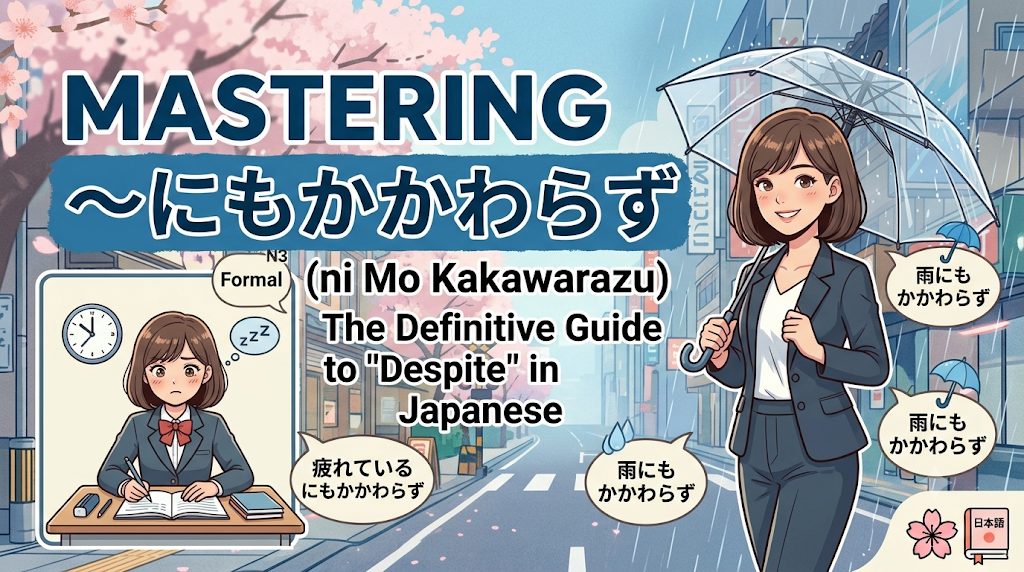
In Japanese, one of the most natural, formal, and expressive ways to convey this concept is through the grammar pattern ~にもかかわらず (ni mo kakawarazu).
While standard textbook definitions simply translate it as “despite,” using this grammar pattern naturally requires an understanding of tone, sentence register, and subtle nuance. In this guide, we will break down the mechanics of ~にもかかわらず, explore how to connect it with various parts of speech, compare it with similar grammar points like ~のに (noni) and ~くせに (kuseni), and examine real-world examples.
1. What Does ~にもかかわらず Mean?
At its core, ~にもかかわらず (ni mo kakawarazu) expresses that an outcome occurred contrary to what would logically be expected given a specific circumstance or obstacle.
Breakdown of the Structure
Understanding the breakdown of the phrase makes it much easier to remember:
- に (ni): Target/Direction particle.
- も (mo): “Even” or “also.”
- かかわらず (kakawarazu): The negative conjunctive form of the verb 拘る (kakawaru), which means “to be concerned with,” “to stick to,” or “to be affected by.”
Literally translated, the phrase means “without being bound or affected by [X].” In natural English, we translate this as:
- Despite…
- In spite of…
- Even though…
- Regardless of…
2. Kanji and Spelling Variations
In everyday Japanese writing, you will encounter this expression in two primary formats:
- Hiragana Only: 〜にもかかわらず (Most Common)
- With Kanji: 〜にも拘わらず (Used in formal or literary contexts)
pro tip: On the JLPT and in standard corporate correspondence, writing this pattern entirely in hiragana (〜にもかかわらず) is standard practice.
3. How to Form Sentences: Connection Rules
To use ~にもかかわらず correctly, you must pair it with the appropriate forms of verbs, adjectives, and nouns.
| Part of Speech | Connection Pattern | Example Construction |
| Nouns | Noun + にもかかわらず | 大雨 (Oaame) + にもかかわらず |
| Verbs | Short Form (Plain Form) + にもかかわらず | 練習した (Renshū shita) + にもかかわらず |
| i-Adjectives | Dictionary Form + にもかかわらず | 忙しい (Isogashii) + にもかかわらず |
| na-Adjectives | Stem + である + にもかかわらず | 静かである (Shizuka de aru) + にもかかわらず |
Important Distinction for Nouns and Na-Adjectives
Unlike casual contrast markers, you do not add の (no) or な (na) between a noun or na-adjective and にもかかわらず.
- Correct: 大雨にもかかわらず (Oaame ni mo kakawarazu)
- Incorrect: 大雨のにもかかわらず
- Correct: 有名であるにもかかわらず (Yūmei de aru ni mo kakawarazu) OR 有名にもかかわらず
- Incorrect: 有名なにもかかわらず
4. Deep Dive: Sentence Examples across Contexts
Let’s explore how this pattern functions across different scenarios.
Example 1: Nouns (Weather, Health, Circumstances)
- 日本語: 悪天候にもかかわらず、多くの参加者がイベントに集まった。
- Rōmaji: Akutenkō ni mo kakawarazu, ōku no sankasha ga ibento ni atsumatta.
- English: Despite the bad weather, many participants gathered for the event.
Notice how direct the noun connection is. You do not need any intervening particle after 悪天候 (akutenkō – bad weather).
Example 2: Verbs (Past Actions and Continuous States)
- 日本語: 徹夜で勉強したにもかかわらず、試験で良い点が取れなかった。
- Rōmaji: Tetsuya de benkyō shita ni mo kakawarazu, shiken de yoi ten ga torenakatta.
- English: In spite of studying all night, I couldn’t get a good score on the exam.
Here, the expectation was that studying all night would lead to a high score. The actual result directly contradicted that assumption.
Example 3: i-Adjectives (Physical States or Conditions)
- 日本語: 体調が悪いにもかかわらず、彼は休もうとしない。
- Rōmaji: Taichō ga warui ni mo kakawarazu, kare wa yasumō to shinai.
- English: Despite feeling unwell, he refuses to take a rest.
Example 4: na-Adjectives (Qualities or Settings)
- 日本語: 彼は新人であるにもかかわらず、ベテランのように落ち着いている。
- Rōmaji: Kare wa shinjin de aru ni mo kakawarazu, beteran no yō ni ochitsuite iru.
- English: Despite being a newcomer, he is as calm and collected as a veteran.
5. Nuance and Tone: When Should You Use It?
Understanding when to use a grammar point is just as critical as knowing how to conjugate it.
Formal vs. Casual Register
~にもかかわらず belongs to a relatively formal and objective register. You will commonly find it in:
- Written news reports and journalistic writing
- Business emails and official presentations
- Academic essays and JLPT reading comprehension passages
- Formal speeches
While you can use it in spoken Japanese, doing so adds a serious, formal tone. For everyday casual conversations with friends, speakers usually rely on 〜のに (noni) or 〜けれど (keredo) instead.
6. Comparison: ~にもかかわらず vs. Similar Grammar Points
Japanese has several ways to express “although” or “despite.” Selecting the wrong one can change the tone or emotional weight of your sentence.
+-----------------------------------------------------------------------+
|                         CONTRAST GRAMMAR MAP                          |
|                                                                       |
|   Formal / Objective  <=========================>  Casual / Emotional |
|                                                                       |
|   ~にかかわらず        ~にもかかわらず       ~のに       ~くせに  |
|   (Regardless of)       (Despite X, Y)     (Even though)  (Despite/ |
|                                                         Blaming)      |
+-----------------------------------------------------------------------+
1. ~にもかかわらず vs. ~のに (Noni)
- ~のに (noni): Highly emotional, personal, and frequently carries feelings of annoyance, disappointment, or surprise.
- Example: 勉強したのに、不合格だった。(I studied, yet I failed… [Expresses personal frustration] )
- ~にもかかわらず (ni mo kakawarazu): Objective, measured, and matter-of-fact. It highlights the factual contradiction rather than the speaker’s emotional state.
- Example: 勉強したにもかかわらず、不合格だった。(Despite having studied, the result was a fail. [States the factual contrast] )
2. ~にもかかわらず vs. ~くせに (Kuseni)
- ~くせに (kuseni): Used exclusively when criticizing or expressing contempt toward someone else (never yourself).
- Example: 知らないくせに、知っているふりをするな。(Don’t pretend to know when you actually don’t! [Accusatory] )
- ~にもかかわらず (ni mo kakawarazu): Completely neutral. It contains no inherent judgment or hostility toward the subject.
3. ~にもかかわらず vs. ~にかかわらず (Ni Kakawarazu – Without “Mo”)
Dropping the particle も (mo) changes the meaning entirely:
- ~にもかかわらず (With も): Means “Despite [X]” (X is a specific past or present reality that occurred).
- ~にかかわらず (Without も): Means “Regardless of [X]” (X represents a variable condition like age, weather, or gender).
Compare these two sentences:
- 雨にもかかわらず、試合は行われた。(Despite the rain [which was actively falling], the match was held.)
- 雨にかかわらず、試合は行われる。(Regardless of rain [whether it rains or not], the match will be held.)
For additional practice with intermediate Japanese grammar patterns and JLPT level structures, you can explore detailed study guides on the JLPT Sensei Grammar Index to see how this fits into the broader N2 curriculum.
7. Practical Application: Real-World Scenarios
To help solidify this pattern in your memory, consider these real-world contexts:
Scenario A: Business and Workplace Communications
When writing formal status reports or client updates, ~にもかかわらず helps you present setbacks or surprising achievements professionally:
厳しい予算制約があったにもかかわらず、プロジェクトは予定通りに完了しました。
(Kibishii yosan seiyaku ga atta ni mo kakawarazu, purojekuto wa yotei dōri ni kanryō shimashita.)
Translation: Despite strict budget constraints, the project was completed on schedule.
Scenario B: Reading Japanese News Articles
News outlets like NHK frequently use this pattern to highlight contrast without adding subjective commentary:
高齢化が進んでいるにもかかわらず、労働力人口は増加傾向を見せている。
(Kōreika ga susunde iru ni mo kakawarazu, rōdōryoku jinkō wa zōka keikō o misete iru.)
Translation: Despite the advancing aging population, the labor force population is showing an upward trend.
To read authentic examples of this grammar structure used in daily news broadcasts, visit NHK World EASY Japanese News, which provides accessible Japanese news resources for language learners.
8. Common Mistakes to Avoid
Even advanced learners occasionally stumble on this structure. Here are three common errors to guard against:
❌ Mistake 1: Adding の (no) after a noun
- Incorrect: 暴風雨のにもかかわらず、外出をした。
- Correct: 暴風雨にもかかわらず、外出をした。 (Despite the rainstorm, I went outside.)
❌ Mistake 2: Confusing “Regardless of” with “In spite of”
- Incorrect: 性別にもかかわらず、誰でも応募できます。(Using “despite” when you mean “regardless of”)
- Correct: 性別にかかわらず、誰でも応募できます。 (Regardless of gender, anyone can apply.)
❌ Mistake 3: Forgetting である with Na-Adjectives
- Incorrect: 交通が不便なにもかかわらず、その店は繁盛している。
- Correct: 交通が不便であるにもかかわらず、その店は繁盛している。 (Despite inconvenient transportation, that shop is thriving.)
9. Summary Check: Key Takeaways
To review what we have covered:
- Meaning: Expresses “despite” or “in spite of” an obstacle or unexpected factor.
- Formality: Formal and objective—ideal for written reports, official speeches, and the JLPT N2 exam.
- Noun Rule: Connect nouns directly without adding の or な.
- Distinction: Do not confuse it with ~にかかわらず (which means “regardless of”).
By mastering these rules, you can elevate your written and spoken Japanese, making your expression clear, natural, and professional.
10. Test Your Knowledge: Practice Quiz
Try translating the following sentences into Japanese using ~にもかかわらず:
- Despite being busy, my friend helped me move.
- In spite of the doctor’s warning, he continues to smoke.
- Despite working late every day, she always looks energetic.
(Answers: 1. 忙しいにもかかわらず、友達は私の引っ越しを手伝ってくれた。 2. 医師の警告にもかかわらず、彼はたばこを吸い続けている。 3. 毎日遅くまで働いているにもかかわらず、彼女はいつも元気に見える。)


