If you’ve been studying Japanese for a while, you’ve likely encountered the grammar point 〜ながら (nagara) early on in your journey. You probably learned it as a way to express simultaneous actions—like listening to music while studying (ongaku o kikanagara benkyou suru).
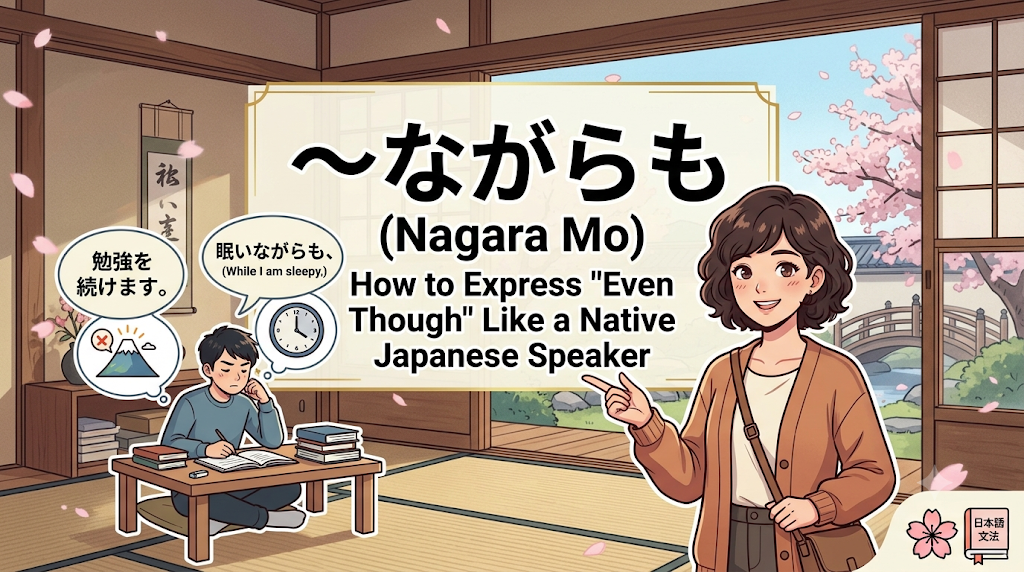
However, as you transition into intermediate Japanese (around the JLPT N3 and N2 levels), you start meeting grammar points that look familiar on the surface but carry completely different functional nuances. Enter 〜ながらも (nagara mo).
Despite sharing its root with the simultaneous action marker, 〜ながらも has nothing to do with doing two things at the exact same time. Instead, it serves as a sophisticated, expressive conjunction that translates to “although,” “even while,” “despite,” or “even though.”
In this comprehensive guide, we will unpack everything you need to know about 〜しながらも—from structural rules to core emotional nuances, real-world examples, and comparisons with similar contrastive expressions.
What Does 〜ながらも (Nagara Mo) Mean?
At its core, 〜ながらも is used to connect two clauses where Clause B occurs in spite of the state or action in Clause A.
- Core Meaning: “Although…”, “Even while…”, “Despite…”, “Even though…”
- Core Function: It expresses a strong contrast, unexpected outcome, or lingering state between two facts.
- JLPT Level: Primarily N3, but frequently tested on N2 reading comprehension exams.
When you add も (mo) to ながら (nagara), you shift the grammar from an objective temporal marker (“while doing X, doing Y”) into an emotional, contrastive particle (“even though X is true, Y remains the case”).
How to Form 〜ながらも (Grammar Conjugation Rules)
One reason students love 〜ながらも is its flexibility. It connects with verbs, adjectives, and nouns, though each word class attaches slightly differently.
| Word Class | Conjugation Rule | Example Word | Conjugated Form |
| Verbs (Masu-stem) | Verb [Masu-stem] + ながらも | 知る (shiru) | 知りながらも (shirinagara mo) |
| i-Adjectives | i-Adj + ながらも | 狭い (semai) | 狭いながらも (semainagara mo) |
| na-Adjectives | na-Adj + (であり)ながらも | 残念 (zannen) | 残念ながらも / 残念でありながらも |
| Nouns | Noun + (であり)ながらも | 子供 (kodomo) | 子供ながらも / 子供でありながらも |
Conjugation Notes to Keep in Mind
- Verb Stem Connection: Remove the final 〜masu from the verb, just as you would with standard nagara.
- Tabemasu $\rightarrow$ Tabe $\rightarrow$ Tabenagara mo
- Na-Adjectives & Nouns: You can attach nagara mo directly to a noun or na-adjective (e.g., kodomo-nagara mo), or insert de ari for a more formal or written tone (e.g., kodomo de ari nagara mo).
The Core Nuance: What Makes 〜ながらも Unique?
To speak natural Japanese, you must understand the subtle human emotion embedded inside this pattern. It isn’t just a clinical logical operator; it communicates specific psychological contexts:
1. The Conflict Between Knowing and Doing
We often use ~nagara mo when someone fully realizes something, yet acts contrary to that knowledge or feelings.
- Bad example context: Knowing smoking is bad, but continuing anyway.
- Japanese: 身体に悪いと分かっていながらも、甘いものをやめられない。(Even though I know it’s bad for my body, I can’t stop eating sweets.)
2. Limitations Overcome by Results
It highlights an impressive outcome despite a clear constraint or limitation (such as young age, lack of experience, or small space).
- Example: 狭いながらも楽しい我が家。(Though small, it’s our happy home.)
Detailed Example Sentences by Category
To build true intuition, examine how this pattern functions across different real-world contexts.
Context A: Expressing Regret or Inner Struggle (Verbs)
- 彼はお酒が害になると知っていながらも、飲むのをやめなかった。
- Rōmaji: Kare wa osake ga gai ni naru to shitte inagara mo, nomu no o yamenakata.
- English: Even though he knew alcohol was harmful, he didn’t stop drinking.
- 残念な結果に終わりながらも、全力を尽くしたことに後悔はない。
- Rōmaji: Zannen na kekka ni owarinagara mo, zenryoku o tsukushita koto ni koukai wa nai.
- English: Although it ended in a disappointing result, I have no regrets because I gave it my all.
Context B: Impressive Feats Despite Constraints (Nouns & Adjectives)
- 彼は子供ながらも、家族を支えるために一生懸命働いた。
- Rōmaji: Kare wa kodomo nagara mo, kazoku o sasaeru tame ni isshoukenmei hataraita.
- English: Even though he was just a child, he worked tirelessly to support his family.
- 初心者の指導員でありながらも、彼は非常に落ち着いて指導していた。
- Rōmaji: Shoshinsha no shidouin de arinagara mo, kare wa hijou ni ochitsukete shidou shite ita.
- English: Despite being a beginner instructor, he taught with great composure.
〜ながらも vs. Other Conjunctions: How to Choose?
Japanese is famous for having dozens of ways to say “but” or “although.” Understanding where ~nagara mo fits relative to its peers prevents unnatural phrasing.
1. 〜ながらも vs. 〜のに (Noni)
- 〜のに (Noni): Expresses personal frustration, complaint, surprise, or unexpectedness. It is emotionally subjective.
- 〜ながらも (Nagara mo): More objective, reflective, and composed. It observes a continuous contradiction without sounding accusatory.
2. 〜ながらも vs. 〜けれども (Keredomo) / 〜が (Ga)
- 〜けれども / 〜が: General-purpose “although/but.” Works anywhere.
- 〜ながらも: Requires the subject in both clauses to generally be the same, and emphasizes a sustained condition or mindset throughout the action.
Common Mistakes to Avoid
- Changing Subjects Mid-Sentence:
- Incorrect: 彼は頑張りながらも、私は諦めた。
- Correct: 彼は限界を感じながらも、最後まで走りぬいた。(He pushed through to the end, despite feeling at his limit.)
- Rule: The subject performing the action or state in Clause A must be the same subject in Clause B.
- Confusing Simultaneous Action with Contrast:
- Incorrect: 音楽を聞きながらも、勉強する。(Makes no sense if intended as “while listening”).
- Correct: 音楽を聞きながら勉強する。(Standard nagara for simultaneous action).
Further Japanese Learning Resources
To continue deepening your mastery of intermediate and advanced Japanese grammar, check out these excellent external reference tools and study platforms:
- Test your grammar knowledge and prepare for certification using official practice items at the JLPT Official Website Practice Test Section.
- Explore detailed vocabulary breakdowns, stroke orders, and real-time sentence contexts using the free Jisho Japanese-English Online Dictionary.
- Dive deeper into nuanced grammar discussions and native speaker usage debates on Stack Exchange Japanese Language Community.
Wrap-Up Exercise
Try translating these three sentences into Japanese using 〜ながらも:
- Although she felt tired, she finished her report.
- Despite being an amateur, his painting was wonderful.
- Even though I knew the truth, I kept quiet.
Mastering patterns like 〜ながらも bridges the gap between mechanical textbook translations and smooth, natural Japanese communication. Keep practicing, and don’t be afraid to experiment with these structures in your everyday speech and writing!