
If you have ever been surprised by a outcome that contradicted what you reasonably expected, you already understand the emotional heart of わりに(は) (wari ni wa).
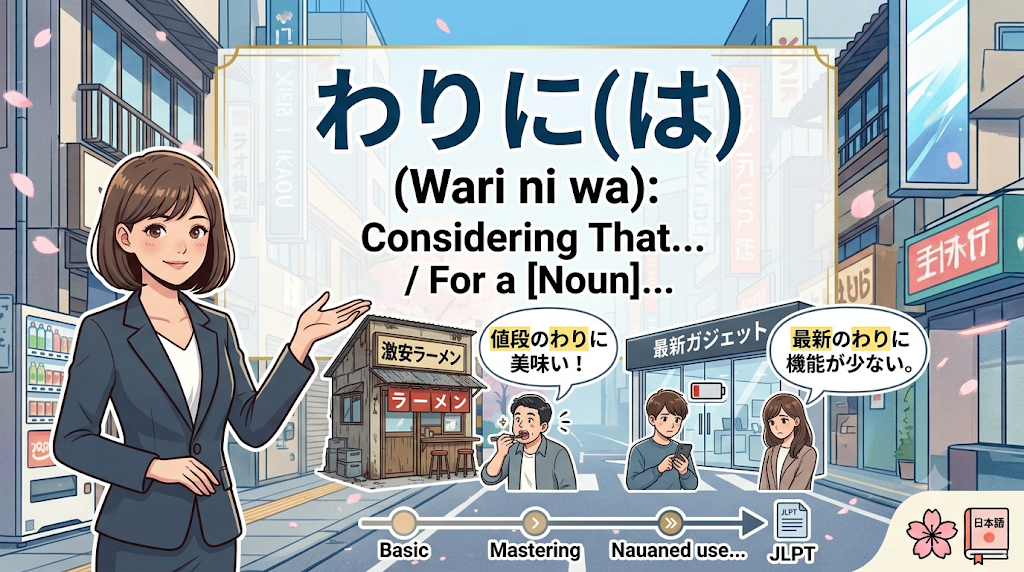
Whether you are studying for the JLPT N2 exam, reading contemporary Japanese literature, or chatting with Japanese friends over coffee, encountering this grammar point is inevitable. It gives your Japanese a natural, nuanced flair by allowing you to express an unexpected evaluation: “For a cheap restaurant, the food is surprisingly good,” or “Considering he studied for only three days, he got a remarkably high score.”
In this comprehensive guide, we will unpack everything you need to know about わりに(は)—from its core mechanics and accurate sentence structures to subtle native nuances, contrast comparisons with similar grammar, and real-world conversation examples.
1. What Does わりに(は) Mean?
At its core, わりに(は) translates to:
- “Considering that…”
- “For a [category/state], …”
- “Surprisingly, given that…”
- “In proportion to…”
The Core Concept: Expectation vs. Reality
In Japanese, わりに stems from the kanji 割 (wari), which relates to proportions, ratios, or shares (as seen in words like waribiki [discount] or percentage counts like ichi-wari [10%]).
When you attach わりに(は) to a clause or noun, you set up a baseline ratio or expectation based on standard common sense, and then state a reality that deviates from that expected proportion.
$$\text{Baseline Expectation (Cause/State)} + \text{わりに(は)} \rightarrow \text{Unexpected Result/Evaluation}$$
- Mental Model: Standard standard ratio says X should happen, but surprisingly Y is true instead.
2. How to Form Sentences with わりに(は)
To use this grammar point cleanly, you must connect it to the plain non-past or past forms of verbs and adjectives, or directly to nouns using the possessive particle の (no).
Grammar Connection Rule Table
| Part of Speech | Formation Rule | Example Connection | Meaning |
| Nouns | Noun + の + わりに(は) | 年 (の) わりに | Considering (their) age |
| i-Adjectives | i-Adj (Plain) + わりに(は) | 安い わりに | For being cheap |
| na-Adjectives | na-Adj + な + わりに(は) | 元気 な わりに | Considering (they) are energetic |
| Verbs | Verb (Plain/Past) + わりに(は) | 食べた わりに | Considering how much was eaten |
The Role of は (wa) in Bracketed (は)
Notice that は is optional.
- わりに: Objective, slightly more neutral tone.
- わりには: Adding は accentuates contrast and topical emphasis. In spoken Japanese, わりには is far more common because speakers usually want to highlight the stark contrast between their expectation and the result.
3. Clear Examples with Breakdown
Let’s look at how わりに(は) operates across different contexts and sentence structures.
Example 1: Noun Connection
- この店は、値段のわりに料理がとても美味しい。Kono mise wa, nedan no wari ni ryōri ga totemo oishii.Translation: Considering the price, this restaurant’s food is very delicious.
- Nuance: Cheap price usually implies average quality, but this meal exceeds expectations.
Example 2: Verb Connection
- 彼はたくさん食べたわりには、ぜんぜん体重が増えない。Kare wa takusan tabeta wari ni wa, zenzen taijū ga fuenai.Translation: Considering how much he ate, he hasn’t gained any weight at all.
- Nuance: High calorie intake normally yields weight gain, making this result surprisingly counter-intuitive.
Example 3: i-Adjective Connection
- 彼女は若いわりに、とても落ち着いている。Kanojo wa wakai wari ni, totemo ochitsuite iru.Translation: For being so young, she is remarkably calm and composed.
- Nuance: Youth is commonly associated with rashness or inexperience, but her behavior deviates positively.
Example 4: na-Adjective Connection
- 試験は大変だったわりに、みんな笑顔で会場から出てきた。Shiken wa taihen datta wari ni, minna egao de kaijō kara detekita.Translation: Considering the exam was tough, everyone came out of the venue smiling.
4. Native Nuances & Critical Rules to Avoid Mistakes
While わりに(は) is straightforward grammatically, several usage restrictions trip up JLPT examinees and intermediate learners.
Rule A: The Standard/Baseline Must Have Range
The phrase before わりに(は) must represent a scale, range, or broad state where varying degrees of quality or quantity are expected.
- ⭕ 年齢のわりに (nenrei no wari ni – Considering age [age has a wide spectrum])
- ❌ 70歳のわりに (70-sai no wari ni – Incorrect: Specific numeric milestones pair better with にしては)
Rule B: Subject Consistency & Expressing Personal Judgments
The clause following わりに(は) almost always reflects an evaluation, judgment, or subjective opinion by the speaker. Avoid using absolute imperative commands (like do this!) immediately following a わりに(は) clause.
Rule C: Double Negatives
You can pair わりに(は) with negative forms to express a double-contrast:
- あまり練習しなかったわりに、上手く弾けた。Amari renshū shinakata wari ni, umaku hiketa.Translation: Considering I didn’t practice much, I played surprisingly well.
5. Grammar Comparison: わりに(は) vs. にしては vs. のに
Japanese features multiple structures for expressing contrast or unmet expectations. Three frequent points often cause confusion: わりに(は), にしては, and のに.
| Grammar Point | Core Function | Best Used For | Key Distinction |
| わりに(は) | Proportional contrast based on general expectations. | Relative categories, general concepts (price, age, effort). | Focuses on a ratio or degree of outcome relative to baseline. |
| にしては | Contrast against a specific, concrete standard or fact. | Specific names, exact numbers, concrete individuals. | Used when evaluating a known, specific fact (e.g., 70 years old, Tokyo). |
| のに | Stronger emotional frustration, complaint, or surprise (“Even though…”). | Unmet expectations caused by an external situation. | Carries higher subjective feeling or discontent than neutral evaluation. |
Comparative Examples
- わりに(は) [Relative standard]:
- この靴は安いのわりに丈夫だ。This shoe is durable considering it’s cheap. (General baseline of cheap shoes)
- にしては [Specific standard]:
- この靴は100円にしては丈夫だ。For a 100-yen shoe, this is durable. (100 yen is an exact, concrete figure)
- のに [Frustration / Emotional complaint]:
- 高かったのに、すぐに壊れた!Even though it was expensive, it broke right away! (Expresses active annoyance)
If you are preparing for the JLPT exam, reviewing authentic curriculum lists can help keep these structural boundaries clear. You can cross-reference grammar patterns on the official JLPT Japanese-Language Proficiency Test portal, or explore comprehensive study guides on Maggie Sensei to see hundreds of native context sentences.
6. Practical Real-World Dialogues
Seeing grammar inside authentic conversations builds long-term retention faster than isolated drills.
Scenario A: Talking About a Restaurant
- Aさん: 昨日オープンしたラーメン屋、行った?(Kinō ōpun shita rāmen-ya, itta?)“Did you go to the ramen shop that opened yesterday?”
- Bさん: うん、行ったよ!値段が安かったわりに、スープにコクがあって美味しかったよ。(Un, itta yo! Nedan ga yasukatta wari ni, sūpu ni koku ga atte oishikatta yo.)“Yeah, I went! Considering how cheap it was, the broth was rich and surprisingly good.”
Scenario B: Discussing Work or Study
- Aさん: 鈴木さん、今日のプレゼンすごかったね。(Suzuki-san, kyō no purezen sugokatta ne.)“Suzuki-san’s presentation today was amazing, wasn’t it?”
- Bさん: 本当にね。準備期間が短かったわりには、完璧な内容だったよ。(Hontō ni ne. Junbi kikan ga mijikakatta wari ni wa, kanpeki na naiyō datta yo.)“Rely. Considering the short preparation period, the content was flawless.”
7. Common Mistakes to Avoid on the JLPT
When taking the JLPT N2 exam, watch out for these common pitfalls:
- Forgetting Particle の on Nouns:
- ❌ 年わりに (Nen wari ni)
- ⭕ 年のわりに (Nen no wari ni)
- Using な-Adjectives without な:
- ❌ 有名わりに (Yūmei wari ni)
- ⭕ 有名なわりに (Yūmei na wari ni)
- Mixing up わりに with にしては for concrete numbers:
- ❌ 彼、80歳わりに若く見えるね。
- ⭕ 彼、80歳にしては若く見えるね。
For structured grammar drills and detailed explanations across all proficiency tiers, the lessons on Tofugu offer clear, illustrated guides to lock in these nuances.
Summary Checklist for わりに(は)
To quickly audit your usage of わりに(は), verify three points:
- Is your connection clean? (Noun + の, na-Adj + な, i-Adj + plain form, Verb + plain/past)?
- Does your first clause set up a general baseline ratio, category, or effort?
- Does your second clause state a subjective outcome or evaluation that deviates from that baseline expectation?


