If you have been studying Japanese for any length of time, you have almost certainly encountered 〜くらい (kurai) and 〜ぐらい (gurai). On the surface, textbooks usually translate this grammar point as “about,” “approximately,” or “to the extent of.” While those translations are technically correct, relying on them too heavily can leave you confused when you hear Japanese speakers use it in everyday conversation.
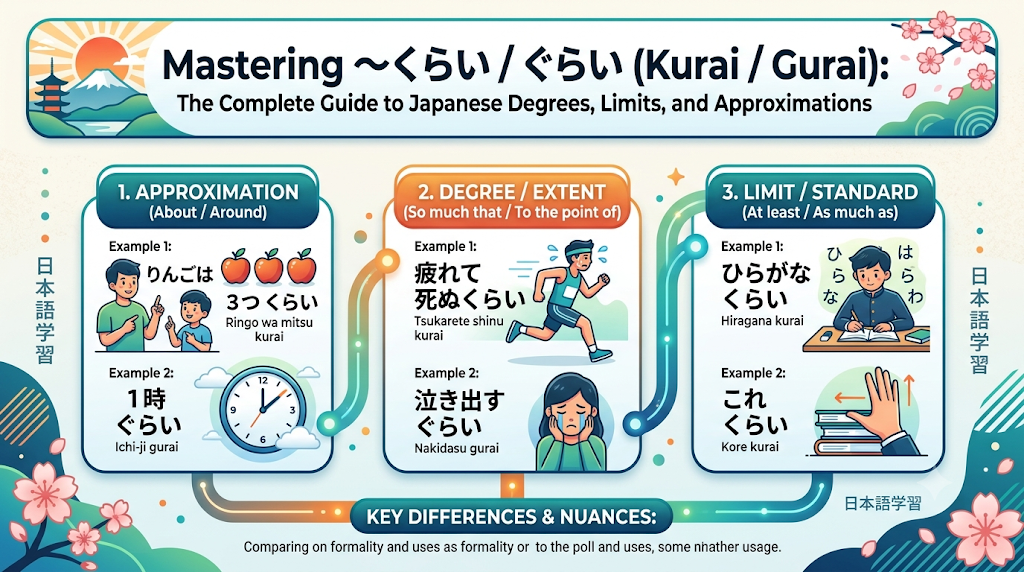
Have you ever wondered why a speaker uses kurai when talking about feeling so tired they could sleep for three days? Or why someone uses it when saying, “At least clean your room”?
In this comprehensive guide, we are going to break down 〜くらい / ぐらい completely. We will look at its three primary functional uses, analyze the subtle difference between kurai and gurai, explore real-world conversational nuances, and point out common pitfalls that trip up even intermediate learners.
1. What Is 〜くらい / ぐらい?
At its core, 〜くらい / ぐらい is a postpositional particle (or grammar pattern) used to indicate a degree, level, quantity, or limit. Depending on the context, it translates into English in a few different ways:
- Approximate Quantity/Time: About, approximately, around
- Degree or Extent: To the extent that, so much that, as much as
- Minimum Level or Disparagement: At least, just, only
Before diving into each of these meanings, let’s address the most common question learners ask: What is the difference between kurai and gurai?
Kurai vs. Gurai: Is There a Difference?
The short answer is no, there is no structural difference in meaning. Both express the exact same concepts. However, there are subtle phonetic and contextual tendencies you should keep in mind:
- くらい (Kurai): This is the unvoiced, original form. It tends to sound slightly more formal, precise, or written. You will often see it in literature, formal speeches, and official test materials like the JLPT Official Website.
- ぐらい (Gurai): This is the voiced version (using dakuten). It flows easier in rapid speech and is the preferred choice in casual, everyday spoken Japanese.
Pro Tip: In spoken Japanese, feel free to use ぐらい (gurai) as your default—it sounds natural and effortless. When writing essays or taking formal exams, leaning toward くらい (kurai) is standard practice.
2. Structural Breakdown: How to Attach 〜くらい / ぐらい
One reason this grammar point is so common is its versatile connectivity. You can attach 〜くらい / ぐらい to nouns, verbs, and adjectives.
Here is how you connect it across different parts of speech:
| Part of Speech | Connection Pattern | Example |
| Nouns | Noun + くらい/ぐらい | 3時間くらい (about 3 hours) |
| Verbs (Plain Form) | Verb (Dictionary / Past / Negative) + くらい/ぐらい | 泣くくらい (to the extent of crying) |
| i-Adjectives | i-Adj + くらい/ぐらい | 高いくらい (so expensive that…) |
| na-Adjectives | na-Adj + な + くらい/ぐらい | 有名なくらい (so famous that…) |
| Demonstratives | これ / それ / あれ + くらい/ぐらい | これくらい (about this much) |
Now let’s explore the three distinct core usages in detail.
3. Usage 1: Expressing Approximations (About / Around)
This is usually the first meaning taught in beginner courses (JLPT N5/N4 level). When attached to numbers, counters, or time expressions, 〜くらい / ぐらい indicates an approximate amount rather than an exact figure.
Key Nuance
Unlike English where we put “about” before the number (“about three hours”), Japanese places くらい / ぐらい directly after the number or counter.
Example Sentences
- ここから駅まで徒歩で10分ぐらいかかります。Koko kara eki made toho de juppun gurai kakarimasu.It takes about 10 minutes on foot from here to the station.
- 昨日は8時間くらい寝ました。Kinō wa hachijikan kurai nemashita.I slept for around 8 hours yesterday.
- パーティーに人が50人ぐらい来ました。Pātī ni hito ga gojū-nin gurai kimashita.Approximately 50 people came to the party.
Nuance Comparison: くらい (Kurai) vs. ごろ (Goro)
A very common mistake for Japanese learners is mixing up くらい/ぐらい with ごろ (goro).
- くらい / ぐらい: Used for duration, quantities, or spans of time (e.g., 3 hours, 5 miles, 20 people).
- ごろ: Used for a specific point in time (e.g., 3 o’clock, middle of May, next Tuesday).
Incorrect: 3時くらいに会いましょう。 (Though heard casually, it literally means “Let’s meet for a duration of 3 hours.”)
Correct: 3時ごろに会いましょう。 (Let’s meet around 3 o’clock.)
Correct: 3時間ぐらい話し合いました。 (We talked for about 3 hours.)
To test your overall understanding of Japanese grammar structures, you can check out comprehensive learning materials on Maggie Sensei, a fantastic resource for natural conversational examples.
4. Usage 2: Expressing Extent or Degree (So Much That…)
As you move into intermediate Japanese (JLPT N3), you will find 〜くらい / ぐらい used to convey the intensity of a situation by comparing it to an extreme state or hypothetical example.
In English, we often express this as:
- “So… that…”
- “To the point where…”
- “Enough to…”
Real-World Mechanics
When using this form, the clause coming before くらい sets the hypothetical or literal benchmark, while the clause coming after describes the result or state.
Example Sentences
- お腹が空いて、馬を一頭食べてしまいたいくらいです。Onaka ga sukite, uma o ittō tabete shimaitai kurai desu.I am so hungry that I could eat a horse.
- 昨日のライブは声が出なくなるくらい叫びました。Kinō no raibu wa koe ga denaku naru kurai sakebimashita.At yesterday’s concert, I screamed to the point that I lost my voice.
- 涙が出るくらい感動的な映画だった。Namida ga deru kurai kandōteki na eiga datta.It was a movie so moving that it made me cry.
Figurative vs. Literal Extent
Notice how this structure can be used both hyperbolically (exaggerating for effect) and literally:
- Hyperbolic (Metaphorical):死ぬほど忙しい / 死ぬくらい忙しい (I’m so busy I could die.)You aren’t actually going to die, but it emphasizes extreme stress.
- Literal:立っていられないくらい足が痛い (My leg hurts so much I can’t stand.)This directly describes physical limitations based on pain.
5. Usage 3: Indicating Minimum Level or Belittling (At Least / Just)
This is perhaps the most nuanced and culturally rich usage of 〜くらい / ぐらい. It appears frequently in natural conversations, anime, and everyday interactions.
Depending on the speaker’s tone, it can convey two related ideas:
- Setting a minimum baseline: “At the very least, you should do X.”
- Downplaying/Belittling something: “It’s just X, no big deal.”
A. Setting a Minimum Requirement (“At Least”)
When you want to say that something is so basic or simple that failing to do it is unreasonable, you pair a noun or action with くらい / ぐらい.
- 自分の服くらい自分で洗濯しなさい。Jibun no fuku kurai jibun de sentaku shinasai.Wash your own clothes at least.
- 挨拶くらいしても損はないでしょう。Aisatsu kurai shitemo son wa nai deshō.It wouldn’t hurt to at least say hello.
B. Expressing Low Evaluation or Ease (“It’s Only…”, “Just…”)
Here, くらい / ぐらい minimizes the value, difficulty, or severity of something. It shows that the speaker views the object or action as minor or simple.
- ひらがなぐらいは子供でも読める。Hiragana gurai wa kodomo demo yomeru.Even a child can read something as basic as Hiragana.
- これくらいの傷で騒ぐな。Kore kurai no kizu de sawaguna.Don’t make a fuss over such a minor scratch.
6. Advanced Patterns featuring 〜くらい / ぐらい
Once you feel comfortable with the core usages, you can start recognizing these common fixed structures combining くらい / ぐらい with other grammar particles.
1. 〜くらいなら (Kurai nara) — “If it comes to X, I’d rather…”
This structure is used to show a strong preference by comparing two undesirable situations. The action before kurai nara is something you strongly dislike, while the action that follows is your preferred alternative.
- あいつに頭を下げるくらいなら、会社を辞める。Aitsu ni atama o sage ru kurai nara, kaisha o yameru.If I have to bow down to that guy, I’d rather quit the company.
2. 〜くらい〜はない (Kurai… wa nai) — “There is no one/nothing as… as…”
This pattern creates a superlative statement. It claims that nothing else reaches the level of the subject being discussed.
- 彼女くらい親切な人はいない。Kanojo kurai shinsetsu na hito wa nai.There is nobody as kind as her.
3. 〜くらいのものだ (Kurai no mono da) — “Only X can…” / “X is about the only…”
Used when expressing that a particular condition applies only to a very narrow, specific subject or scenario.
- こんな時間まで開いている店は、コンビニくらいのものだ。Konna jikan made aite iru mise wa, kombini kurai no mono da.Convenience stores are about the only places open at this hour.
For learners preparing for standardized exams, referencing comprehensive grammar indexes like Tae Kim’s Guide to Learning Japanese is a helpful way to see how these advanced forms connect across levels.
7. Common Pitfalls and How to Avoid Them
Even advanced students make subtle mistakes with 〜くらい / ぐらい. Here are three key pitfalls to watch out for in your studies:
Mistake 1: Stacking “About” Words
In English, we often combine words like “around about 3 hours.” In Japanese, combining 約 (yaku) with くらい / ぐらい can sound redundant if overused, though it does appear in formal contexts.
- Awkward: 約3時間くらいかかります。
- Natural: 3時間くらいかかります。
- Natural (Formal): 約3時間かかります。
Mistake 2: Confusing くらい (Kurai) with ほど (Hodo)
Both くらい and ほど (hodo) express degree and approximations. However, ほど (hodo) is significantly more formal and carries a stronger sense of high intensity.
- 日常会話 (Casual): 驚くくらいきれいだった。 (It was surprisingly pretty.)
- 硬い表現 (Formal/Literary): 息をのむほど美しかった。 (It was so breathtakingly beautiful.)
Mistake 3: Dropping Particles Incorrectly
When くらい / ぐらい is attached to a noun with topic or direction markers like に (ni), で (de), or へ (he), the ordering matters. Generally, くらい / ぐらい replaces simple object markers like が (ga) and を (o), but follows directional particles.
- Correct: 10分くらいで終わります。 (It will finish in about 10 minutes.)
- Correct: 友だちの家へくらい… → Better: 友だちの家にくらいは行きなさい。 (At least go to your friend’s house.)
8. Summary Cheat Sheet
To keep everything crystal clear, here is a quick reference table summarizing how to use 〜くらい / ぐらい:
| Usage Type | English Equivalent | Quick Example |
| Approximation | About / Around | 1時間くらい待った (Waited about 1 hour) |
| Extent / Degree | So much that… | 倒れるくらい疲れた (Tired to the point of collapsing) |
| Minimum Limit | At least… | 自分の部屋くらい掃除しなさい (At least clean your room) |
| Belittling / Ease | Just / Minor | これくらいのことで泣くな (Don’t cry over such a small thing) |
Final Thoughts
Mastering 〜くらい / ぐらい is one of those crucial milestones in Japanese language acquisition. Moving beyond simple numeric approximations and using it to express emotional degree, minimum expectations, and subtle comparisons will make your spoken Japanese sound markedly more fluid and natural.
Have you ever wondered why a speaker uses kurai when talking about feeling so tired they could sleep for three days? Or why someone uses it when saying, “At least clean your room”?
In this comprehensive guide, we are going to break down 〜くらい / ぐらい completely. We will look at its three primary functional uses, analyze the subtle difference between kurai and gurai, explore real-world conversational nuances, and point out common pitfalls that trip up even intermediate learners.
1. What Is 〜くらい / ぐらい?
At its core, 〜くらい / ぐらい is a postpositional particle (or grammar pattern) used to indicate a degree, level, quantity, or limit. Depending on the context, it translates into English in a few different ways:
- Approximate Quantity/Time: About, approximately, around
- Degree or Extent: To the extent that, so much that, as much as
- Minimum Level or Disparagement: At least, just, only
Before diving into each of these meanings, let’s address the most common question learners ask: What is the difference between kurai and gurai?
Kurai vs. Gurai: Is There a Difference?
The short answer is no, there is no structural difference in meaning. Both express the exact same concepts. However, there are subtle phonetic and contextual tendencies you should keep in mind:
- くらい (Kurai): This is the unvoiced, original form. It tends to sound slightly more formal, precise, or written. You will often see it in literature, formal speeches, and official test materials like the JLPT Official Website.
- ぐらい (Gurai): This is the voiced version (using dakuten). It flows easier in rapid speech and is the preferred choice in casual, everyday spoken Japanese.
Pro Tip: In spoken Japanese, feel free to use ぐらい (gurai) as your default—it sounds natural and effortless. When writing essays or taking formal exams, leaning toward くらい (kurai) is standard practice.
2. Structural Breakdown: How to Attach 〜くらい / ぐらい
One reason this grammar point is so common is its versatile connectivity. You can attach 〜くらい / ぐらい to nouns, verbs, and adjectives.
Here is how you connect it across different parts of speech:
| Part of Speech | Connection Pattern | Example |
| Nouns | Noun + くらい/ぐらい | 3時間くらい (about 3 hours) |
| Verbs (Plain Form) | Verb (Dictionary / Past / Negative) + くらい/ぐらい | 泣くくらい (to the extent of crying) |
| i-Adjectives | i-Adj + くらい/ぐらい | 高いくらい (so expensive that…) |
| na-Adjectives | na-Adj + な + くらい/ぐらい | 有名なくらい (so famous that…) |
| Demonstratives | これ / それ / あれ + くらい/ぐらい | これくらい (about this much) |
Now let’s explore the three distinct core usages in detail.
3. Usage 1: Expressing Approximations (About / Around)
This is usually the first meaning taught in beginner courses (JLPT N5/N4 level). When attached to numbers, counters, or time expressions, 〜くらい / ぐらい indicates an approximate amount rather than an exact figure.
Key Nuance
Unlike English where we put “about” before the number (“about three hours”), Japanese places くらい / ぐらい directly after the number or counter.
Example Sentences
- ここから駅まで徒歩で10分ぐらいかかります。Koko kara eki made toho de juppun gurai kakarimasu.It takes about 10 minutes on foot from here to the station.
- 昨日は8時間くらい寝ました。Kinō wa hachijikan kurai nemashita.I slept for around 8 hours yesterday.
- パーティーに人が50人ぐらい来ました。Pātī ni hito ga gojū-nin gurai kimashita.Approximately 50 people came to the party.
Nuance Comparison: くらい (Kurai) vs. ごろ (Goro)
A very common mistake for Japanese learners is mixing up くらい/ぐらい with ごろ (goro).
- くらい / ぐらい: Used for duration, quantities, or spans of time (e.g., 3 hours, 5 miles, 20 people).
- ごろ: Used for a specific point in time (e.g., 3 o’clock, middle of May, next Tuesday).
Incorrect: 3時くらいに会いましょう。 (Though heard casually, it literally means “Let’s meet for a duration of 3 hours.”)
Correct: 3時ごろに会いましょう。 (Let’s meet around 3 o’clock.)
Correct: 3時間ぐらい話し合いました。 (We talked for about 3 hours.)
To test your overall understanding of Japanese grammar structures, you can check out comprehensive learning materials on Maggie Sensei, a fantastic resource for natural conversational examples.
4. Usage 2: Expressing Extent or Degree (So Much That…)
As you move into intermediate Japanese (JLPT N3), you will find 〜くらい / ぐらい used to convey the intensity of a situation by comparing it to an extreme state or hypothetical example.
In English, we often express this as:
- “So… that…”
- “To the point where…”
- “Enough to…”
Real-World Mechanics
When using this form, the clause coming before くらい sets the hypothetical or literal benchmark, while the clause coming after describes the result or state.
Example Sentences
- お腹が空いて、馬を一頭食べてしまいたいくらいです。Onaka ga sukite, uma o ittō tabete shimaitai kurai desu.I am so hungry that I could eat a horse.
- 昨日のライブは声が出なくなるくらい叫びました。Kinō no raibu wa koe ga denaku naru kurai sakebimashita.At yesterday’s concert, I screamed to the point that I lost my voice.
- 涙が出るくらい感動的な映画だった。Namida ga deru kurai kandōteki na eiga datta.It was a movie so moving that it made me cry.
Figurative vs. Literal Extent
Notice how this structure can be used both hyperbolically (exaggerating for effect) and literally:
- Hyperbolic (Metaphorical):死ぬほど忙しい / 死ぬくらい忙しい (I’m so busy I could die.)You aren’t actually going to die, but it emphasizes extreme stress.
- Literal:立っていられないくらい足が痛い (My leg hurts so much I can’t stand.)This directly describes physical limitations based on pain.
5. Usage 3: Indicating Minimum Level or Belittling (At Least / Just)
This is perhaps the most nuanced and culturally rich usage of 〜くらい / ぐらい. It appears frequently in natural conversations, anime, and everyday interactions.
Depending on the speaker’s tone, it can convey two related ideas:
- Setting a minimum baseline: “At the very least, you should do X.”
- Downplaying/Belittling something: “It’s just X, no big deal.”
A. Setting a Minimum Requirement (“At Least”)
When you want to say that something is so basic or simple that failing to do it is unreasonable, you pair a noun or action with くらい / ぐらい.
- 自分の服くらい自分で洗濯しなさい。Jibun no fuku kurai jibun de sentaku shinasai.Wash your own clothes at least.
- 挨拶くらいしても損はないでしょう。Aisatsu kurai shitemo son wa nai deshō.It wouldn’t hurt to at least say hello.
B. Expressing Low Evaluation or Ease (“It’s Only…”, “Just…”)
Here, くらい / ぐらい minimizes the value, difficulty, or severity of something. It shows that the speaker views the object or action as minor or simple.
- ひらがなぐらいは子供でも読める。Hiragana gurai wa kodomo demo yomeru.Even a child can read something as basic as Hiragana.
- これくらいの傷で騒ぐな。Kore kurai no kizu de sawaguna.Don’t make a fuss over such a minor scratch.
6. Advanced Patterns featuring 〜くらい / ぐらい
Once you feel comfortable with the core usages, you can start recognizing these common fixed structures combining くらい / ぐらい with other grammar particles.
1. 〜くらいなら (Kurai nara) — “If it comes to X, I’d rather…”
This structure is used to show a strong preference by comparing two undesirable situations. The action before kurai nara is something you strongly dislike, while the action that follows is your preferred alternative.
- あいつに頭を下げるくらいなら、会社を辞める。Aitsu ni atama o sage ru kurai nara, kaisha o yameru.If I have to bow down to that guy, I’d rather quit the company.
2. 〜くらい〜はない (Kurai… wa nai) — “There is no one/nothing as… as…”
This pattern creates a superlative statement. It claims that nothing else reaches the level of the subject being discussed.
- 彼女くらい親切な人はいない。Kanojo kurai shinsetsu na hito wa nai.There is nobody as kind as her.
3. 〜くらいのものだ (Kurai no mono da) — “Only X can…” / “X is about the only…”
Used when expressing that a particular condition applies only to a very narrow, specific subject or scenario.
- こんな時間まで開いている店は、コンビニくらいのものだ。Konna jikan made aite iru mise wa, kombini kurai no mono da.Convenience stores are about the only places open at this hour.
For learners preparing for standardized exams, referencing comprehensive grammar indexes like Tae Kim’s Guide to Learning Japanese is a helpful way to see how these advanced forms connect across levels.
7. Common Pitfalls and How to Avoid Them
Even advanced students make subtle mistakes with 〜くらい / ぐらい. Here are three key pitfalls to watch out for in your studies:
Mistake 1: Stacking “About” Words
In English, we often combine words like “around about 3 hours.” In Japanese, combining 約 (yaku) with くらい / ぐらい can sound redundant if overused, though it does appear in formal contexts.
- Awkward: 約3時間くらいかかります。
- Natural: 3時間くらいかかります。
- Natural (Formal): 約3時間かかります。
Mistake 2: Confusing くらい (Kurai) with ほど (Hodo)
Both くらい and ほど (hodo) express degree and approximations. However, ほど (hodo) is significantly more formal and carries a stronger sense of high intensity.
- 日常会話 (Casual): 驚くくらいきれいだった。 (It was surprisingly pretty.)
- 硬い表現 (Formal/Literary): 息をのむほど美しかった。 (It was so breathtakingly beautiful.)
Mistake 3: Dropping Particles Incorrectly
When くらい / ぐらい is attached to a noun with topic or direction markers like に (ni), で (de), or へ (he), the ordering matters. Generally, くらい / ぐらい replaces simple object markers like が (ga) and を (o), but follows directional particles.
- Correct: 10分くらいで終わります。 (It will finish in about 10 minutes.)
- Correct: 友だちの家へくらい… → Better: 友だちの家にくらいは行きなさい。 (At least go to your friend’s house.)
8. Summary Cheat Sheet
To keep everything crystal clear, here is a quick reference table summarizing how to use 〜くらい / ぐらい:
| Usage Type | English Equivalent | Quick Example |
| Approximation | About / Around | 1時間くらい待った (Waited about 1 hour) |
| Extent / Degree | So much that… | 倒れるくらい疲れた (Tired to the point of collapsing) |
| Minimum Limit | At least… | 自分の部屋くらい掃除しなさい (At least clean your room) |
| Belittling / Ease | Just / Minor | これくらいのことで泣くな (Don’t cry over such a small thing) |
Final Thoughts
Mastering 〜くらい / ぐらい is one of those crucial milestones in Japanese language acquisition. Moving beyond simple numeric approximations and using it to express emotional degree, minimum expectations, and subtle comparisons will make your spoken Japanese sound markedly more fluid and natural.If you have been studying Japanese for any length of time, you have almost certainly encountered 〜くらい (kurai) and 〜ぐらい (gurai). On the surface, textbooks usually translate this grammar point as “about,” “approximately,” or “to the extent of.” While those translations are technically correct, relying on them too heavily can leave you confused when you hear Japanese speakers use it in everyday conversation.
Have you ever wondered why a speaker uses kurai when talking about feeling so tired they could sleep for three days? Or why someone uses it when saying, “At least clean your room”?
In this comprehensive guide, we are going to break down 〜くらい / ぐらい completely. We will look at its three primary functional uses, analyze the subtle difference between kurai and gurai, explore real-world conversational nuances, and point out common pitfalls that trip up even intermediate learners.
1. What Is 〜くらい / ぐらい?
At its core, 〜くらい / ぐらい is a postpositional particle (or grammar pattern) used to indicate a degree, level, quantity, or limit. Depending on the context, it translates into English in a few different ways:
- Approximate Quantity/Time: About, approximately, around
- Degree or Extent: To the extent that, so much that, as much as
- Minimum Level or Disparagement: At least, just, only
Before diving into each of these meanings, let’s address the most common question learners ask: What is the difference between kurai and gurai?
Kurai vs. Gurai: Is There a Difference?
The short answer is no, there is no structural difference in meaning. Both express the exact same concepts. However, there are subtle phonetic and contextual tendencies you should keep in mind:
- くらい (Kurai): This is the unvoiced, original form. It tends to sound slightly more formal, precise, or written. You will often see it in literature, formal speeches, and official test materials like the JLPT Official Website.
- ぐらい (Gurai): This is the voiced version (using dakuten). It flows easier in rapid speech and is the preferred choice in casual, everyday spoken Japanese.
Pro Tip: In spoken Japanese, feel free to use ぐらい (gurai) as your default—it sounds natural and effortless. When writing essays or taking formal exams, leaning toward くらい (kurai) is standard practice.
2. Structural Breakdown: How to Attach 〜くらい / ぐらい
One reason this grammar point is so common is its versatile connectivity. You can attach 〜くらい / ぐらい to nouns, verbs, and adjectives.
Here is how you connect it across different parts of speech:
| Part of Speech | Connection Pattern | Example |
| Nouns | Noun + くらい/ぐらい | 3時間くらい (about 3 hours) |
| Verbs (Plain Form) | Verb (Dictionary / Past / Negative) + くらい/ぐらい | 泣くくらい (to the extent of crying) |
| i-Adjectives | i-Adj + くらい/ぐらい | 高いくらい (so expensive that…) |
| na-Adjectives | na-Adj + な + くらい/ぐらい | 有名なくらい (so famous that…) |
| Demonstratives | これ / それ / あれ + くらい/ぐらい | これくらい (about this much) |
Now let’s explore the three distinct core usages in detail.
3. Usage 1: Expressing Approximations (About / Around)
This is usually the first meaning taught in beginner courses (JLPT N5/N4 level). When attached to numbers, counters, or time expressions, 〜くらい / ぐらい indicates an approximate amount rather than an exact figure.
Key Nuance
Unlike English where we put “about” before the number (“about three hours”), Japanese places くらい / ぐらい directly after the number or counter.
Example Sentences
- ここから駅まで徒歩で10分ぐらいかかります。Koko kara eki made toho de juppun gurai kakarimasu.It takes about 10 minutes on foot from here to the station.
- 昨日は8時間くらい寝ました。Kinō wa hachijikan kurai nemashita.I slept for around 8 hours yesterday.
- パーティーに人が50人ぐらい来ました。Pātī ni hito ga gojū-nin gurai kimashita.Approximately 50 people came to the party.
Nuance Comparison: くらい (Kurai) vs. ごろ (Goro)
A very common mistake for Japanese learners is mixing up くらい/ぐらい with ごろ (goro).
- くらい / ぐらい: Used for duration, quantities, or spans of time (e.g., 3 hours, 5 miles, 20 people).
- ごろ: Used for a specific point in time (e.g., 3 o’clock, middle of May, next Tuesday).
Incorrect: 3時くらいに会いましょう。 (Though heard casually, it literally means “Let’s meet for a duration of 3 hours.”)
Correct: 3時ごろに会いましょう。 (Let’s meet around 3 o’clock.)
Correct: 3時間ぐらい話し合いました。 (We talked for about 3 hours.)
To test your overall understanding of Japanese grammar structures, you can check out comprehensive learning materials on Maggie Sensei, a fantastic resource for natural conversational examples.
4. Usage 2: Expressing Extent or Degree (So Much That…)
As you move into intermediate Japanese (JLPT N3), you will find 〜くらい / ぐらい used to convey the intensity of a situation by comparing it to an extreme state or hypothetical example.
In English, we often express this as:
- “So… that…”
- “To the point where…”
- “Enough to…”
Real-World Mechanics
When using this form, the clause coming before くらい sets the hypothetical or literal benchmark, while the clause coming after describes the result or state.
Example Sentences
- お腹が空いて、馬を一頭食べてしまいたいくらいです。Onaka ga sukite, uma o ittō tabete shimaitai kurai desu.I am so hungry that I could eat a horse.
- 昨日のライブは声が出なくなるくらい叫びました。Kinō no raibu wa koe ga denaku naru kurai sakebimashita.At yesterday’s concert, I screamed to the point that I lost my voice.
- 涙が出るくらい感動的な映画だった。Namida ga deru kurai kandōteki na eiga datta.It was a movie so moving that it made me cry.
Figurative vs. Literal Extent
Notice how this structure can be used both hyperbolically (exaggerating for effect) and literally:
- Hyperbolic (Metaphorical):死ぬほど忙しい / 死ぬくらい忙しい (I’m so busy I could die.)You aren’t actually going to die, but it emphasizes extreme stress.
- Literal:立っていられないくらい足が痛い (My leg hurts so much I can’t stand.)This directly describes physical limitations based on pain.
5. Usage 3: Indicating Minimum Level or Belittling (At Least / Just)
This is perhaps the most nuanced and culturally rich usage of 〜くらい / ぐらい. It appears frequently in natural conversations, anime, and everyday interactions.
Depending on the speaker’s tone, it can convey two related ideas:
- Setting a minimum baseline: “At the very least, you should do X.”
- Downplaying/Belittling something: “It’s just X, no big deal.”
A. Setting a Minimum Requirement (“At Least”)
When you want to say that something is so basic or simple that failing to do it is unreasonable, you pair a noun or action with くらい / ぐらい.
- 自分の服くらい自分で洗濯しなさい。Jibun no fuku kurai jibun de sentaku shinasai.Wash your own clothes at least.
- 挨拶くらいしても損はないでしょう。Aisatsu kurai shitemo son wa nai deshō.It wouldn’t hurt to at least say hello.
B. Expressing Low Evaluation or Ease (“It’s Only…”, “Just…”)
Here, くらい / ぐらい minimizes the value, difficulty, or severity of something. It shows that the speaker views the object or action as minor or simple.
- ひらがなぐらいは子供でも読める。Hiragana gurai wa kodomo demo yomeru.Even a child can read something as basic as Hiragana.
- これくらいの傷で騒ぐな。Kore kurai no kizu de sawaguna.Don’t make a fuss over such a minor scratch.
6. Advanced Patterns featuring 〜くらい / ぐらい
Once you feel comfortable with the core usages, you can start recognizing these common fixed structures combining くらい / ぐらい with other grammar particles.
1. 〜くらいなら (Kurai nara) — “If it comes to X, I’d rather…”
This structure is used to show a strong preference by comparing two undesirable situations. The action before kurai nara is something you strongly dislike, while the action that follows is your preferred alternative.
- あいつに頭を下げるくらいなら、会社を辞める。Aitsu ni atama o sage ru kurai nara, kaisha o yameru.If I have to bow down to that guy, I’d rather quit the company.
2. 〜くらい〜はない (Kurai… wa nai) — “There is no one/nothing as… as…”
This pattern creates a superlative statement. It claims that nothing else reaches the level of the subject being discussed.
- 彼女くらい親切な人はいない。Kanojo kurai shinsetsu na hito wa nai.There is nobody as kind as her.
3. 〜くらいのものだ (Kurai no mono da) — “Only X can…” / “X is about the only…”
Used when expressing that a particular condition applies only to a very narrow, specific subject or scenario.
- こんな時間まで開いている店は、コンビニくらいのものだ。Konna jikan made aite iru mise wa, kombini kurai no mono da.Convenience stores are about the only places open at this hour.
For learners preparing for standardized exams, referencing comprehensive grammar indexes like Tae Kim’s Guide to Learning Japanese is a helpful way to see how these advanced forms connect across levels.
7. Common Pitfalls and How to Avoid Them
Even advanced students make subtle mistakes with 〜くらい / ぐらい. Here are three key pitfalls to watch out for in your studies:
Mistake 1: Stacking “About” Words
In English, we often combine words like “around about 3 hours.” In Japanese, combining 約 (yaku) with くらい / ぐらい can sound redundant if overused, though it does appear in formal contexts.
- Awkward: 約3時間くらいかかります。
- Natural: 3時間くらいかかります。
- Natural (Formal): 約3時間かかります。
Mistake 2: Confusing くらい (Kurai) with ほど (Hodo)
Both くらい and ほど (hodo) express degree and approximations. However, ほど (hodo) is significantly more formal and carries a stronger sense of high intensity.
- 日常会話 (Casual): 驚くくらいきれいだった。 (It was surprisingly pretty.)
- 硬い表現 (Formal/Literary): 息をのむほど美しかった。 (It was so breathtakingly beautiful.)
Mistake 3: Dropping Particles Incorrectly
When くらい / ぐらい is attached to a noun with topic or direction markers like に (ni), で (de), or へ (he), the ordering matters. Generally, くらい / ぐらい replaces simple object markers like が (ga) and を (o), but follows directional particles.
- Correct: 10分くらいで終わります。 (It will finish in about 10 minutes.)
- Correct: 友だちの家へくらい… → Better: 友だちの家にくらいは行きなさい。 (At least go to your friend’s house.)
8. Summary Cheat Sheet
To keep everything crystal clear, here is a quick reference table summarizing how to use 〜くらい / ぐらい:
| Usage Type | English Equivalent | Quick Example |
| Approximation | About / Around | 1時間くらい待った (Waited about 1 hour) |
| Extent / Degree | So much that… | 倒れるくらい疲れた (Tired to the point of collapsing) |
| Minimum Limit | At least… | 自分の部屋くらい掃除しなさい (At least clean your room) |
| Belittling / Ease | Just / Minor | これくらいのことで泣くな (Don’t cry over such a small thing) |
Final Thoughts
Mastering 〜くらい / ぐらい is one of those crucial milestones in Japanese language acquisition. Moving beyond simple numeric approximations and using it to express emotional degree, minimum expectations, and subtle comparisons will make your spoken Japanese sound markedly more fluid and natural.
Have you ever wondered why a speaker uses kurai when talking about feeling so tired they could sleep for three days? Or why someone uses it when saying, “At least clean your room”?
In this comprehensive guide, we are going to break down 〜くらい / ぐらい completely. We will look at its three primary functional uses, analyze the subtle difference between kurai and gurai, explore real-world conversational nuances, and point out common pitfalls that trip up even intermediate learners.
1. What Is 〜くらい / ぐらい?
At its core, 〜くらい / ぐらい is a postpositional particle (or grammar pattern) used to indicate a degree, level, quantity, or limit. Depending on the context, it translates into English in a few different ways:
- Approximate Quantity/Time: About, approximately, around
- Degree or Extent: To the extent that, so much that, as much as
- Minimum Level or Disparagement: At least, just, only
Before diving into each of these meanings, let’s address the most common question learners ask: What is the difference between kurai and gurai?
Kurai vs. Gurai: Is There a Difference?
The short answer is no, there is no structural difference in meaning. Both express the exact same concepts. However, there are subtle phonetic and contextual tendencies you should keep in mind:
- くらい (Kurai): This is the unvoiced, original form. It tends to sound slightly more formal, precise, or written. You will often see it in literature, formal speeches, and official test materials like the JLPT Official Website.
- ぐらい (Gurai): This is the voiced version (using dakuten). It flows easier in rapid speech and is the preferred choice in casual, everyday spoken Japanese.
Pro Tip: In spoken Japanese, feel free to use ぐらい (gurai) as your default—it sounds natural and effortless. When writing essays or taking formal exams, leaning toward くらい (kurai) is standard practice.
2. Structural Breakdown: How to Attach 〜くらい / ぐらい
One reason this grammar point is so common is its versatile connectivity. You can attach 〜くらい / ぐらい to nouns, verbs, and adjectives.
Here is how you connect it across different parts of speech:
| Part of Speech | Connection Pattern | Example |
| Nouns | Noun + くらい/ぐらい | 3時間くらい (about 3 hours) |
| Verbs (Plain Form) | Verb (Dictionary / Past / Negative) + くらい/ぐらい | 泣くくらい (to the extent of crying) |
| i-Adjectives | i-Adj + くらい/ぐらい | 高いくらい (so expensive that…) |
| na-Adjectives | na-Adj + な + くらい/ぐらい | 有名なくらい (so famous that…) |
| Demonstratives | これ / それ / あれ + くらい/ぐらい | これくらい (about this much) |
Now let’s explore the three distinct core usages in detail.
3. Usage 1: Expressing Approximations (About / Around)
This is usually the first meaning taught in beginner courses (JLPT N5/N4 level). When attached to numbers, counters, or time expressions, 〜くらい / ぐらい indicates an approximate amount rather than an exact figure.
Key Nuance
Unlike English where we put “about” before the number (“about three hours”), Japanese places くらい / ぐらい directly after the number or counter.
Example Sentences
- ここから駅まで徒歩で10分ぐらいかかります。Koko kara eki made toho de juppun gurai kakarimasu.It takes about 10 minutes on foot from here to the station.
- 昨日は8時間くらい寝ました。Kinō wa hachijikan kurai nemashita.I slept for around 8 hours yesterday.
- パーティーに人が50人ぐらい来ました。Pātī ni hito ga gojū-nin gurai kimashita.Approximately 50 people came to the party.
Nuance Comparison: くらい (Kurai) vs. ごろ (Goro)
A very common mistake for Japanese learners is mixing up くらい/ぐらい with ごろ (goro).
- くらい / ぐらい: Used for duration, quantities, or spans of time (e.g., 3 hours, 5 miles, 20 people).
- ごろ: Used for a specific point in time (e.g., 3 o’clock, middle of May, next Tuesday).
Incorrect: 3時くらいに会いましょう。 (Though heard casually, it literally means “Let’s meet for a duration of 3 hours.”)
Correct: 3時ごろに会いましょう。 (Let’s meet around 3 o’clock.)
Correct: 3時間ぐらい話し合いました。 (We talked for about 3 hours.)
To test your overall understanding of Japanese grammar structures, you can check out comprehensive learning materials on Maggie Sensei, a fantastic resource for natural conversational examples.
4. Usage 2: Expressing Extent or Degree (So Much That…)
As you move into intermediate Japanese (JLPT N3), you will find 〜くらい / ぐらい used to convey the intensity of a situation by comparing it to an extreme state or hypothetical example.
In English, we often express this as:
- “So… that…”
- “To the point where…”
- “Enough to…”
Real-World Mechanics
When using this form, the clause coming before くらい sets the hypothetical or literal benchmark, while the clause coming after describes the result or state.
Example Sentences
- お腹が空いて、馬を一頭食べてしまいたいくらいです。Onaka ga sukite, uma o ittō tabete shimaitai kurai desu.I am so hungry that I could eat a horse.
- 昨日のライブは声が出なくなるくらい叫びました。Kinō no raibu wa koe ga denaku naru kurai sakebimashita.At yesterday’s concert, I screamed to the point that I lost my voice.
- 涙が出るくらい感動的な映画だった。Namida ga deru kurai kandōteki na eiga datta.It was a movie so moving that it made me cry.
Figurative vs. Literal Extent
Notice how this structure can be used both hyperbolically (exaggerating for effect) and literally:
- Hyperbolic (Metaphorical):死ぬほど忙しい / 死ぬくらい忙しい (I’m so busy I could die.)You aren’t actually going to die, but it emphasizes extreme stress.
- Literal:立っていられないくらい足が痛い (My leg hurts so much I can’t stand.)This directly describes physical limitations based on pain.
5. Usage 3: Indicating Minimum Level or Belittling (At Least / Just)
This is perhaps the most nuanced and culturally rich usage of 〜くらい / ぐらい. It appears frequently in natural conversations, anime, and everyday interactions.
Depending on the speaker’s tone, it can convey two related ideas:
- Setting a minimum baseline: “At the very least, you should do X.”
- Downplaying/Belittling something: “It’s just X, no big deal.”
A. Setting a Minimum Requirement (“At Least”)
When you want to say that something is so basic or simple that failing to do it is unreasonable, you pair a noun or action with くらい / ぐらい.
- 自分の服くらい自分で洗濯しなさい。Jibun no fuku kurai jibun de sentaku shinasai.Wash your own clothes at least.
- 挨拶くらいしても損はないでしょう。Aisatsu kurai shitemo son wa nai deshō.It wouldn’t hurt to at least say hello.
B. Expressing Low Evaluation or Ease (“It’s Only…”, “Just…”)
Here, くらい / ぐらい minimizes the value, difficulty, or severity of something. It shows that the speaker views the object or action as minor or simple.
- ひらがなぐらいは子供でも読める。Hiragana gurai wa kodomo demo yomeru.Even a child can read something as basic as Hiragana.
- これくらいの傷で騒ぐな。Kore kurai no kizu de sawaguna.Don’t make a fuss over such a minor scratch.
6. Advanced Patterns featuring 〜くらい / ぐらい
Once you feel comfortable with the core usages, you can start recognizing these common fixed structures combining くらい / ぐらい with other grammar particles.
1. 〜くらいなら (Kurai nara) — “If it comes to X, I’d rather…”
This structure is used to show a strong preference by comparing two undesirable situations. The action before kurai nara is something you strongly dislike, while the action that follows is your preferred alternative.
- あいつに頭を下げるくらいなら、会社を辞める。Aitsu ni atama o sage ru kurai nara, kaisha o yameru.If I have to bow down to that guy, I’d rather quit the company.
2. 〜くらい〜はない (Kurai… wa nai) — “There is no one/nothing as… as…”
This pattern creates a superlative statement. It claims that nothing else reaches the level of the subject being discussed.
- 彼女くらい親切な人はいない。Kanojo kurai shinsetsu na hito wa nai.There is nobody as kind as her.
3. 〜くらいのものだ (Kurai no mono da) — “Only X can…” / “X is about the only…”
Used when expressing that a particular condition applies only to a very narrow, specific subject or scenario.
- こんな時間まで開いている店は、コンビニくらいのものだ。Konna jikan made aite iru mise wa, kombini kurai no mono da.Convenience stores are about the only places open at this hour.
For learners preparing for standardized exams, referencing comprehensive grammar indexes like Tae Kim’s Guide to Learning Japanese is a helpful way to see how these advanced forms connect across levels.
7. Common Pitfalls and How to Avoid Them
Even advanced students make subtle mistakes with 〜くらい / ぐらい. Here are three key pitfalls to watch out for in your studies:
Mistake 1: Stacking “About” Words
In English, we often combine words like “around about 3 hours.” In Japanese, combining 約 (yaku) with くらい / ぐらい can sound redundant if overused, though it does appear in formal contexts.
- Awkward: 約3時間くらいかかります。
- Natural: 3時間くらいかかります。
- Natural (Formal): 約3時間かかります。
Mistake 2: Confusing くらい (Kurai) with ほど (Hodo)
Both くらい and ほど (hodo) express degree and approximations. However, ほど (hodo) is significantly more formal and carries a stronger sense of high intensity.
- 日常会話 (Casual): 驚くくらいきれいだった。 (It was surprisingly pretty.)
- 硬い表現 (Formal/Literary): 息をのむほど美しかった。 (It was so breathtakingly beautiful.)
Mistake 3: Dropping Particles Incorrectly
When くらい / ぐらい is attached to a noun with topic or direction markers like に (ni), で (de), or へ (he), the ordering matters. Generally, くらい / ぐらい replaces simple object markers like が (ga) and を (o), but follows directional particles.
- Correct: 10分くらいで終わります。 (It will finish in about 10 minutes.)
- Correct: 友だちの家へくらい… → Better: 友だちの家にくらいは行きなさい。 (At least go to your friend’s house.)
8. Summary Cheat Sheet
To keep everything crystal clear, here is a quick reference table summarizing how to use 〜くらい / ぐらい:
| Usage Type | English Equivalent | Quick Example |
| Approximation | About / Around | 1時間くらい待った (Waited about 1 hour) |
| Extent / Degree | So much that… | 倒れるくらい疲れた (Tired to the point of collapsing) |
| Minimum Limit | At least… | 自分の部屋くらい掃除しなさい (At least clean your room) |
| Belittling / Ease | Just / Minor | これくらいのことで泣くな (Don’t cry over such a small thing) |
Final Thoughts
Mastering 〜くらい / ぐらい is one of those crucial milestones in Japanese language acquisition. Moving beyond simple numeric approximations and using it to express emotional degree, minimum expectations, and subtle comparisons will make your spoken Japanese sound markedly more fluid and natural.