
If you have been studying Japanese for a while, you have likely run into grammar patterns that seem to wear multiple hats depending on how they show up in a sentence. One pattern that fits this description is 〜ほど (hodo).
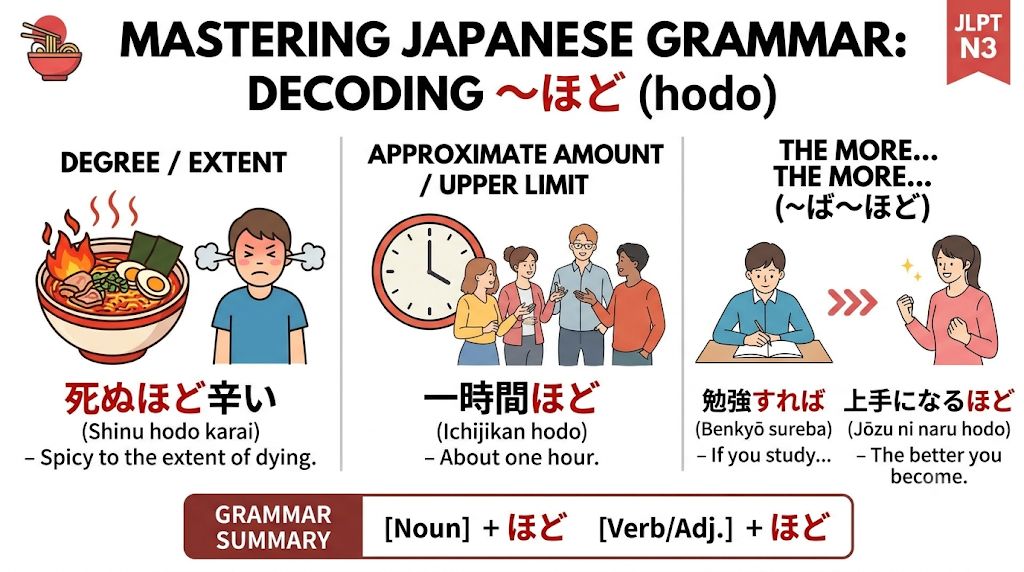
Sometimes it means “to the point where…” Other times it transforms into “the more you do something, the more…” And in other contexts, it acts as a soft estimate for time or quantity.
If you are preparing for the JLPT (specifically levels N3 and N2), understanding the nuances of 〜ほど isn’t just helpful—it’s essential for passing the reading comprehension and grammar sections. In this deep dive, we will break down how 〜ほど works, explore its primary patterns with clear formula breakdowns, analyze real-world usage, and cover the common traps test-takers fall into.
What Does 〜ほど (hodo) Actually Mean?
At its core, the kanji for hodo is 程, which carries the core concept of degree, extent, limit, or bound.
When attached to verbs, adjectives, or nouns, 〜ほど acts as a ruler. It measures the intensity of an action, state, or feeling by comparing it to an extreme example or illustrating a proportional change.
To build a solid intuition, think of 〜ほど through three main frameworks:
- Extreme Extent / Degree: Doing something to the extent that something dramatic happens.
- Proportional Change: The more X happens, the more Y changes.
- Comparative Limit: Stating that something is not as X as Y (when paired with negative endings).
Pattern 1: Extreme Degree (“To the Extent That…”)
This usage expresses that a situation or feeling is so intense that it reaches a remarkable or extreme state. The clause preceding ほど describes the extreme metaphor or result, while the clause following it describes the action or feeling itself.
Structural Formulas
- Verb (Plain Form) + ほど
- Noun + ほど
- い-Adjective + ほど
- な-Adjective + な + ほど
Example Breakdown
- ほっぺたが落ちるほどおいしい。
- Literal: It is delicious to the point that one’s cheeks fall off.
- Natural English: It’s so delicious my face is melting / It’s unbelievably delicious.
- 涙が出るほど嬉しかった。
- Literal: I was happy to the extent that tears came out.
- Natural English: I was so happy I cried.
- 死ぬほど疲れた。
- Literal: I am tired to the extent of dying.
- Natural English: I’m exhausted to death / I’m dead tired.
Practical Nuance Note
Native speakers frequently use this pattern in casual conversation for hyperbole. Just as English speakers say “I’m starving to death” when they are simply very hungry, Japanese speakers use 死ぬほど腹が減っている (shinu hodo hara ga hette iru) to exaggerate everyday feelings.
Pattern 2: Proportional Change (“The More… The More…”)
When you want to express that two variables move together—that as condition A increases, outcome B increases or decreases in response—you use the combined form 〜ば〜ほど (ba… hodo).
Structural Formulas
- Verbs: Verb (conditional 〜ば form) + Verb (dictionary form) + ほど
- い-Adjectives: Drop 〜い $\rightarrow$ 〜ければ + Adjective (dictionary form) + ほど
- な-Adjectives: な-Adjective + なら(ば) + な-Adjective + な + ほど
- Nouns: Noun + であれば + Noun + であるほど (Less common in casual speech, frequent in written Japanese)
Step-by-Step Sentence Construction
Let’s take the verb 食べる (taberu – to eat):
- Convert to conditional: 食べれば (tabereba)
- Add plain form + ほど: 食べるほど (taberu hodo)
- Combine: 食べれば食べるほど太る。 (Tabereba taberu hodo futoru.)
- Translation: The more I eat, the more weight I gain.
Now let’s take the い-Adjective 早い (hayai – fast/early):
- Convert to conditional: 早ければ (hayakereba)
- Add plain form + ほど: 早いほど (hayai hodo)
- Combine: 早ければ早いほどいい。 (Hayakereba hayai hodo ii.)
- Translation: The earlier/faster, the better.
Shortened Casual Variation
In spoken Japanese, the first conditional clause is often dropped entirely if the context is obvious:
- 日本語は使えば使うほど上手になる。 (Full form: The more you use Japanese, the better you get.)
- 日本語は使うほど上手になる。 (Shortened form: Japanese gets better the more you use it.)
Both are natural, but you will see the full conditional construction far more often in grammar sections on standardized exams like the JLPT. If you are building out your exam study plan, reviewing structured practice drills on sites like JLPT Sensei can help reinforce how these conditional variations appear in reading passages.
Pattern 3: Negative Comparison (“Not as… as…”)
When combined with a negative verb or adjective ending (like 〜ない), 〜ほど establishes a threshold that the subject fails to reach.
Structural Formula
- Noun A + は + Noun B + ほど + Negative Predicate
Example Breakdown
- 今日の暑さは、昨日ほどではない。
- Translation: Today’s heat is not as intense as yesterday’s.
- 僕の日本語は田中さんほど上手ではありません。
- Translation: My Japanese is not as good as Tanaka-san’s.
Strategic Distinction: ほど vs. より
It helps to look at how comparisons flip depending on whether you use より (yori) or ほど (hodo):
- 田中さんは僕より日本語が上手だ。(Tanaka-san is better at Japanese than I am.) $\rightarrow$ Focuses on Tanaka’s higher skill level.
- 僕は田中さんほど日本語が上手ではない。(I am not as good at Japanese as Tanaka-san.) $\rightarrow$ Focuses on my lower skill level relative to Tanaka.
Advanced JLPT N2 Variations Involving ほど
Once you move into intermediate and upper-intermediate Japanese, 〜ほど begins pairing with other grammar markers to express more specialized ideas.
1. 〜ほど〜はない (There is nothing as… as…)
This pattern is used to express strong personal conviction or superlative statements.
- Formula: Noun + ほど + [Adjective/Verb] + Noun + はない
- Example:家族と過ごす時間ほど大切なものはない。
- Translation: There is nothing more precious than time spent with family.
2. 〜ほどではない (It’s not to the point where…)
Used to downplay a situation or clarify that while something is present, it hasn’t reached an extreme state.
- Example:風邪を引いたが、病院に行くほどではない。
- Translation: I caught a cold, but it’s not so bad that I need to go to the hospital.
3. 〜に応じた / 〜ほどの (Proportional phrasing)
When modifies a noun directly, it acts as an adjective describing degree.
- Example:彼ほどの人物でも失敗することがある。
- Translation: Even a person of his stature makes mistakes sometimes.
ほど vs. くらい (Kurai/Gurai): Knowing the Difference
One of the most common points of confusion for learners is choosing between ほど (hodo) and くらい / ぐらい (kurai / gurai). While they overlap when estimating numbers or time, their register and underlying nuances differ.
| Feature | ほど (hodo) | くらい / ぐらい (kurai / gurai) |
| Tone / Register | Formal, polite, literary, academic | Casual, spoken, conversational |
| Estimating Quantities | 10分ほどかかります (More formal) | 10分くらいかかります (More casual) |
| Proportional Change (ば…ほど) | Fully natural and common | Incorrect or unnatural in standard grammar |
| Extreme Metaphors | Emphasizes high degree/intensity | Emphasizes low degree/insignificance |
When taking written tests or speaking in professional business settings (Keigo), lean toward ほど. For daily chit-chat with friends, くらい / ぐらい is usually the default choice.
Key Takeaways for Practical Application
To lock this grammar point into your working memory, try these practical exercises when writing or speaking:
- Build hyperbole sentences: Combine everyday actions with vivid consequences using Pattern 1 (“I slept so much my head hurts”, “I laughed so much my stomach aches”).
- Practice optimization loops: Use Pattern 2 (ば…ほど) to describe skills or habits (“The more you read, the faster you get”).
- Refine humble responses: Practice Pattern 3 to give polite, humble responses when complimented (“I’m not as knowledgeable as my mentor”).
Mastering these subtle grammar markers takes time, but breaking them down into clear patterns makes them far easier to parse when reading or listening to native content.


