So, you’re considering taking the JLPT N2. That’s huge! It’s a monumental step in any Japanese learner’s journey, often seen as the gateway to professional opportunities and true functional fluency in Japan.
But then the question hits you: “What does JLPT N2 actually equate to?” You’ve probably heard it’s “business level” or roughly “B2” on that European scale you keep seeing. But what does that mean? Is it enough to work in a Japanese office? Can you watch anime without subtitles? How does it stack up against an English proficiency test like IELTS?
As someone who has both taken and prepared students for the JLPT for years, I’m here to demystify this for you. We’ll go beyond the simple charts and into the real-world meaning of the JLPT N2, how it fits into the CEFR framework, and why understanding this comparison is crucial for your goals.
First, Let’s Demystify the Two Standards
Before we compare, we need to understand what each test and framework is designed to do. They come from completely different philosophies.
What is the JLPT (Japanese-Language Proficiency Test)?
The JLPT is a standardized test to evaluate and certify the Japanese language proficiency of non-native speakers. Its primary focus is on “Receptive” skills – that is, what you can understand.
- Tested Skills: Language Knowledge (Vocabulary/Grammar), Reading, and Listening.
- Not Tested: Speaking and Writing. This is the most critical point to remember! The JLPT does not assess your ability to produce the language spontaneously.
- Goal: It measures your ability to comprehend Japanese in various contexts, from academic articles to everyday conversations.
What is the CEFR (Common European Framework of Reference for Languages)?
The CEFR isn’t a test itself. It’s a comprehensive framework used to describe achievements of learners of foreign languages across Europe and increasingly, the world. Its focus is much broader.
- Tested Skills: All four core skills are considered equally: Reading, Listening, Speaking, and Writing (Production and Interaction).
- Goal: To provide a holistic view of a learner’s ability to function in a language. It describes what a learner can do in real-world situations, from writing a simple postcard (A1) to arguing a complex case in a debate (C2).
This fundamental difference – comprehension vs. production – is why a direct, perfect equivalence is impossible. But we can make a very educated comparison.
The Official Stance: JLPT N2 and CEFR B2 (Mostly)
The Japan Foundation, the body that administers the JLPT, has conducted studies to align their test with the CEFR. Their official mapping suggests:
- JLPT N1 is approximately equivalent to CEFR C1
- JLPT N2 is approximately equivalent to CEFR B2
- JLPT N3 is approximately equivalent to the boundary of CEFR B1/B2
- JLPT N4 is approximately equivalent to CEFR A2
- JLPT N5 is approximately equivalent to CEFR A1
So, officially, JLPT N2 is considered a CEFR B2 level. But let’s breathe life into those letters. What does a B2 level actually represent?
What “B2” or “Upper-Intermediate” Really Means
According to the CEFR, a B2 user:
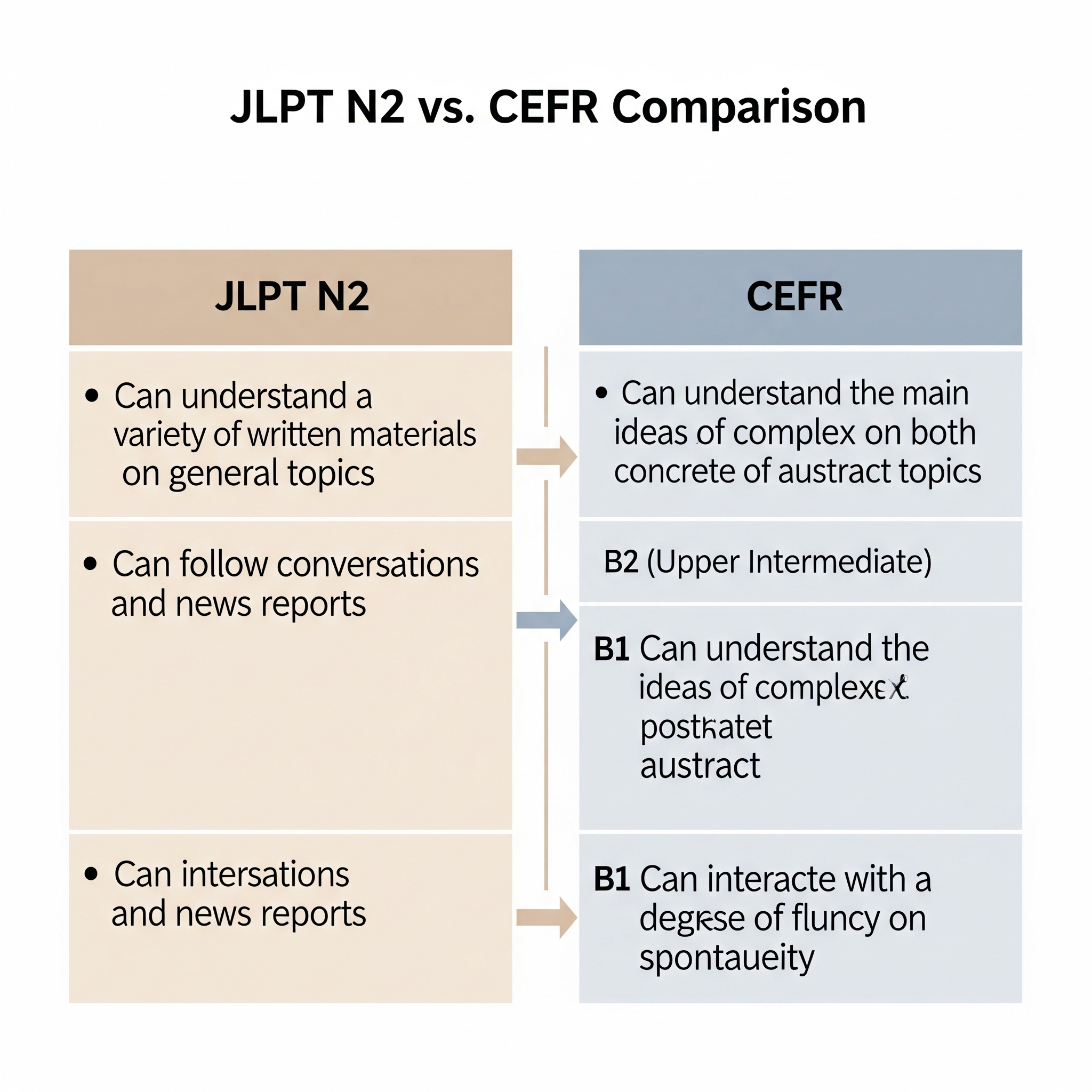
- Can understand the main ideas of complex text on both concrete and abstract topics.
- Can interact with a degree of fluency and spontaneity that makes regular interaction with native speakers quite possible without strain for either party.
- Can produce clear, detailed text on a wide range of subjects and explain a viewpoint on a topical issue giving the advantages and disadvantages of various options.
Sounds impressive, right? Now, let’s filter this through the lens of the JLPT N2.
The Reality Check: What JLPT N2 Actually Measures
Here’s the insider perspective you won’t get from a simple conversion chart. While your comprehension might be solidly at a B2 level, your productive skills (speaking/writing) are untested. This creates a common phenomenon among JLPT takers.
The JLPT N2 certifies that you have a strong passive understanding of Japanese. You can likely:
- Read and understand newspapers and magazine articles on a wide range of topics.
- Follow the plot of a TV drama or news broadcast without too much struggle.
- Grasp the general meaning even if you don’t know every single word, thanks to strong contextual guessing skills.
- Understand everyday conversations spoken at near-native speed.
However, passing the JLPT N2 does not automatically mean you can speak or write at a B2 level. I’ve met countless students who aced the N2 but froze when trying to express a complex opinion in a meeting. The exam simply doesn’t push that skill.
So, a more accurate description might be: Your reading and listening comprehension is at a CEFR B2 level, but your speaking and writing could be anywhere from B1 to B2, depending on how you’ve practiced separately.
How Does JLPT N2 Compare to Other Major Tests?
To give you even more context, let’s see how it loosely compares to other well-known proficiency tests. Remember, these are approximations because each test has a different format and focus.
| Your Level | JLPT | CEFR | IELTS (English) | Real-World Japanese Ability |
|---|---|---|---|---|
| Advanced | N1 | C1 | 7.0 – 8.0 | Professional, academic fluency. |
| Upper-Intermediate | N2 | B2 | 5.5 – 6.5 | Functional fluency. Can work in a Japanese environment. |
| Intermediate | N3 | B1 | 4.0 – 5.0 | Handles most everyday situations. |
| Elementary | N4 | A2 | ~3.0 | Basic survival Japanese. |
| Beginner | N5 | A1 | – | Understands basic phrases. |
Comparison is illustrative. IELTS is used as a familiar benchmark.
Seeing it next to an IELTS score of 5.5-6.5 can be a lightbulb moment for many. It represents a competent, functional level of language, not yet fully fluent but far beyond simple tourist phrases.
The Practical Application: What Can You Do with an N2?
This is the most important part. Why do you want the N2? Here’s what it unlocks in the real world:
- Employment in Japan: This is the biggest one. Many Japanese companies require at least N2 from foreign hires for white-collar jobs. It’s a benchmark that says, “I can read documents, understand meetings, and communicate effectively in a workplace.” It won’t get you every job, but it opens the door. For some fields, especially tech, check out our guide on How to Use Your JLPT N2 to Land a Job in Japan.
- University Admission: While top universities often require the N1 for full-degree programs, many technical schools (専門学校 senmon gakkō) and some university programs will accept N2 as proof of sufficient language ability to undertake studies.
- A Massive Confidence Boost: The jump from N3 to N2 is significant. It represents a move from “learning the language” to “starting to use the language as a real tool.” The amount of media that becomes accessible to you expands exponentially.
- A Stepping Stone to N1: The N2 is the essential foundation for the beast that is the N1. The grammar and vocabulary you master for N2 are used constantly in daily life, while N1 often delves into more formal, literary, and specific academic jargon.
Beyond the Test: How to “Humanize” Your N2 Level
Passing the N2 is an incredible achievement, but don’t let it be the end of your journey. To truly become a B2-level user of Japanese, you need to bridge the gap between comprehension and production.
- For Speaking: Find a language exchange partner or a tutor on iTalki. explicitly tell them, “I passed JLPT N2, but I need to practice speaking more naturally.” Discuss articles you’ve read, summarize a TV show you watched, or debate a topic. The goal is to activate the passive knowledge in your head.
- For Writing: Start a journal in Japanese. Write summaries of your day. Try to use those N2 grammar patterns in your own sentences. Join LangCorrect or a similar community where natives can correct your writing.
- For Listening & Reading: Don’t just consume media; engage with it. After watching a news segment, try to explain the topic out loud in your own words. Read an opinion piece and then write a short paragraph agreeing or disagreeing with it.
If you’re struggling with the listening section specifically, we have a dedicated post full of strategies: Conquering the JLPT Listening Section: From N5 to N1.
Final Verdict: So, What’s the JLPT N2 CEFR Equivalent?
The JLPT N2 is officially and roughly equivalent to a CEFR B2 level in reading and listening comprehension.
However, the key takeaway is this: The JLPT N2 is a powerful certificate of your understanding of Japanese. It’s a testament to your hard work and a key that unlocks doors in Japan. To truly claim that B2 level, you must actively work on your speaking and writing skills outside of the exam format.
It’s not just about passing a test; it’s about building a ability to connect with people and culture. Keep studying, keep practicing, and 頑張ってください (ganbatte kudasai) – you’ve got this!
Ready to start your N2 journey? Plan your study strategy with our ultimate JLPT Study Plan Guide.
Passing Score for JLPT N2: Grading System Explained
JLPT N2 Duration & Exam Time: What to Expect