JLPT Required for Japanese Work Visa (Explained Clearly)
If you have ever dreamed of moving to Tokyo, Osaka, or anywhere else in Japan for work, you have almost certainly bumped into those four letters: JLPT (Japanese-Language Proficiency Test).
When you start browsing job boards or immigration forums, you will quickly encounter conflicting claims. One person swears you cannot get a work visa without passing N2. Another claims they landed an IT engineering job in Tokyo with zero Japanese language ability. Someone else mentions a new rule about language requirements for business managers.
Who is actually right?
As a Japanese language teacher and immigration roadmap specialist who has coached hundreds of foreign professionals through this process, I am here to clear up the confusion.
The honest truth? Japan’s Immigration Services Agency rarely requires a JLPT certificate by strict administrative law. However, Japanese employers and immigration points systems almost always do in practice.
Let’s unpack how the JLPT for work visa Japan equation actually functions across different visa categories, what levels matter, and how to strategically use your language skills to get your visa approved smoothly.
1. The Big Misconception: Legal Requirement vs. Market Reality
Before diving into specific visa categories, we must distinguish between two very different gatekeepers:
- The Immigration Services Agency of Japan (MOJ): The government body that issues your Certificate of Eligibility (COE) and approves your visa.
- Your Sponsoring Employer: The Japanese company, school, or organization that hires you and files documents on your behalf.
For most standard white-collar work visas, the Japanese government does not legally mandate a JLPT certificate. The immigration law asks for relevant educational qualifications (like a bachelor’s degree) or verified work experience in your field.
However, unless you are an engineer or software developer joining an all-English tech startup in Shibuya, 90% of Japanese companies will require JLPT N2 or N1 before giving you a job offer. Without a job offer, you cannot get a visa sponsor—meaning that while the government might not ask for your JLPT certificate, your future employer definitely will.
To understand where you fit in, check out our comprehensive master resource on [JLPT for Immigration to Japan: Visa, PR & Work Permit Guide], which covers the full landscape of residency statuses.
2. Visa-by-Visa Breakdown: Do You Need the JLPT?
Let’s examine how language requirements apply across Japan’s primary work visa classifications.
       JLPT & Japanese Work Visas: At a Glance
+------------------------------------+--------------------------+
| Visa Category                      | Legal JLPT Requirement?  |
+------------------------------------+--------------------------+
| Engineer / Specialist in Humanities| NO (Employer preferred)  |
| Specified Skilled Worker (SSW 1)   | YES (JLPT N4 or JFT-Basic)|
| Highly Skilled Professional (HSP)  | NO (Gives 10-15 Points)  |
| Business Manager Visa              | YES (CEFR B2 / N2 Level) |
| Medical Services / Caregiver       | YES (JLPT N2 or higher)  |
+------------------------------------+--------------------------+
Category A: Engineer / Specialist in Humanities / International Services
This is the most common work visa category for foreign professionals in Japan. It covers roles such as:
- Software engineers, IT architects, systems analysts
- Marketing specialists, accountants, HR personnel
- Translators, interpreters, foreign language teachers in private language schools
Is JLPT legally required?
No. Under standard immigration guidelines, there is no statutory requirement to hold a JLPT certificate for this visa.
What is required in practice?
- IT / Software Engineering: Many international firms hire developers with N5 or zero Japanese, provided their technical skills are top-tier.
- Specialist in Humanities / Marketing / HR: Japanese companies almost uniformly demand JLPT N2 or N1. You will be communicating with Japanese colleagues, reading internal documents, and dealing with clients.
- Translators & Interpreters: JLPT N1 is usually non-negotiable.
For a deeper dive into whether you can bypass language tests altogether for white-collar jobs, read our guide on [Japanese Visa Language Requirements: Do You Really Need JLPT?].
Category B: Specified Skilled Worker (SSW / Tokutei Ginou)
Created to address acute labor shortages in designated industries, the Specified Skilled Worker (SSW) visa operates under entirely different rules.
Is JLPT legally required?
Yes. To qualify for an SSW Type 1 visa, you must prove basic Japanese language proficiency.
What level do you need?
- You must pass JLPT N4 or higher.
- Alternatively, you can pass the Japan Foundation Test for Basic Japanese (JFT-Basic).
- Special Exception: If you are applying for the Nursing Care (Kaigo) field under SSW, you must pass JLPT N4 plus the specialized Nursing Care Japanese Language Evaluation Test.
You can verify official examination schedules and industry criteria directly on the official Japanese Ministry of Foreign Affairs SSW portal.
If you are torn between taking the JLPT or the computer-based JFT-Basic for an SSW visa, take a moment to read [JLPT vs JFT: Which Test Is Better for Visa Applications?] to see which test aligns with your timeline.
Category C: Highly Skilled Professional (HSP) Visa
Japan’s Highly Skilled Professional (HSP) visa uses a point-based preferential system designed to attract top international talent in research, advanced technology, and business management.
Is JLPT legally required?
No. You do not need the JLPT to apply for an HSP visa if you already meet the minimum 70-point threshold through your academic degrees, salary, age, and professional achievements.
How the JLPT helps your point score:
While not mandatory, passing higher levels of the JLPT gives your application a massive boost under the points matrix:
- JLPT N1: Yields 15 extra points.
- JLPT N2: Yields 10 extra points.
- University Degree in Japanese Major: Yields 15 extra points.
In many cases, having an N2 or N1 certificate is the exact tipping point that pushes an applicant over the 70-point mark (for visa approval) or the 80-point mark (for fast-tracked Permanent Residence in just 1 year).
To calculate your exact points breakdown, explore our detailed guide on [How JLPT Points Work for Japanese Immigration]. You can also reference official point calculation rules published by the Immigration Services Agency of Japan.
Category D: Business Manager Visa
The Business Manager visa allows foreign entrepreneurs to establish or manage a business in Japan.
Is JLPT legally required?
Yes. Under updated operational regulations, either the applicant or a full-time employee at the company must demonstrate sufficient Japanese language proficiency (typically CEFR B2 or JLPT N2 level).
Because business management requires interacting with local tax offices, corporate registries, and banking institutions, immigration authorities now closely evaluate whether the company can operate autonomously in Japanese.
3. Beyond the Work Visa: Permanent Residence & Naturalization
While securing your initial work visa gets your foot in the door, long-term stability in Japan usually leads to two goals: Permanent Residence (PR) or Japanese Citizenship (Naturalization).
                   Long-Term Career Pathway
+------------------+     +--------------------+     +------------------+
| Initial Work Visa| --> | JLPT N2 / N1 Study | --> | PR / Naturalize  |
|  (SSW / Engineer)|     | (Earn Immi Points) |     |  (Fast-Tracked)  |
+------------------+     +--------------------+     +------------------+
Permanent Residence (PR)
Under current statutory rules, there is no formal requirement to submit a JLPT certificate when applying for standard Permanent Residence.
However, immigration officers evaluate your integration into Japanese society. Holding JLPT N2 or N1 demonstrates long-term commitment and stability. Furthermore, if you apply via the HSP points route, holding N1 or N2 drastically slashes your waiting period from 10 years down to 1–3 years.
For a complete breakdown of long-term language strategies, check out [JLPT for Permanent Residence in Japan: Full Guide].
Naturalization (Japanese Citizenship)
If you choose to naturalize as a Japanese citizen, the Legal Affairs Bureau will conduct an in-person interview and administer a basic written exam. While they do not explicitly ask for a JLPT certificate, your spoken and written language skills must be at an N3 to N2 level to pass the evaluation.
To review official policy statements on how language qualifications support long-term residence status, visit the official JLPT site advantages guide.
4. Practical Expert Roadmap: Which Level Should You Aim For?
As someone who has helped learners navigate Japanese from basic greetings to corporate boardrooms, here is my honest advice on how to target your study efforts:
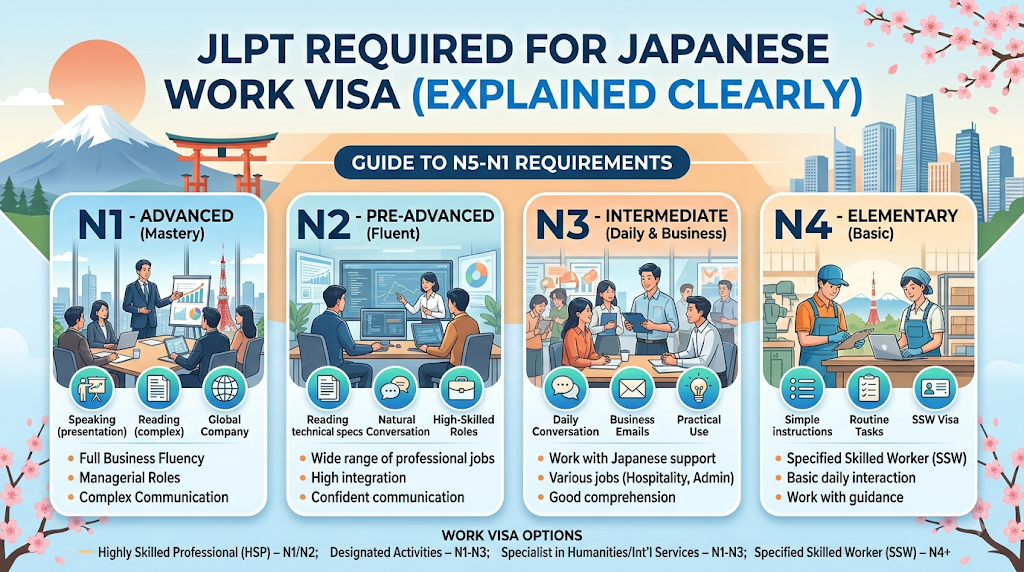
If you are targeting JLPT N5 / N4:
- Target Roles: Entry-level Specified Skilled Worker (SSW) jobs, technical intern transitions, or English teaching positions in small conversation schools.
- Value: Good for daily survival, reading basic signs, and meeting minimum SSW legal requirements.
- Reality Check: N4 is rarely enough for corporate roles or internal team communications in domestic Japanese companies.
If you are targeting JLPT N3:
- Target Roles: Hospitality, customer support with English focus, IT support desks, and junior engineering roles.
- Value: Demonstrates serious effort. N3 bridges the gap between basic textbooks and real-world conversation.
- Reality Check: While helpful on a resume, N3 does not confer bonus points on the HSP immigration scale.
If you are targeting JLPT N2:
- Target Roles: Mainstream corporate positions, marketing, international sales, project management, and nursing care roles.
- Value: The Gold Standard. N2 opens the door to roughly 80% of Japanese corporate jobs. It earns you 10 points toward the HSP visa and shows employers you can work without a translator.
If you are targeting JLPT N1:
- Target Roles: Executive management, legal/compliance, translation/interpretation, university teaching, and client-facing consulting.
- Value: Near-native fluency recognition. Earns 15 points toward HSP and makes your resume stand out in any industry.
5. Summary & Action Steps for Applicants
To recap the relation between JLPT for work visa Japan applications:
- For SSW Visas: JLPT N4 or JFT-Basic is legally mandatory.
- For General Work Visas (Engineer / Humanities): JLPT is not legally required by immigration, but N2/N1 is heavily preferred by employers.
- For Highly Skilled Professional (HSP) Visas: JLPT N2 (10 points) or N1 (15 points) speeds up your path to long-term residence.
- For Business Manager Visas: Japanese communication ability (N2 equivalent) is required to ensure smooth business operations.
Focus your energy on building practical communication skills alongside your test preparation. Passing the test gets your resume read; speaking confidently in your interview gets you the job offer—and the visa sponsor—you need.