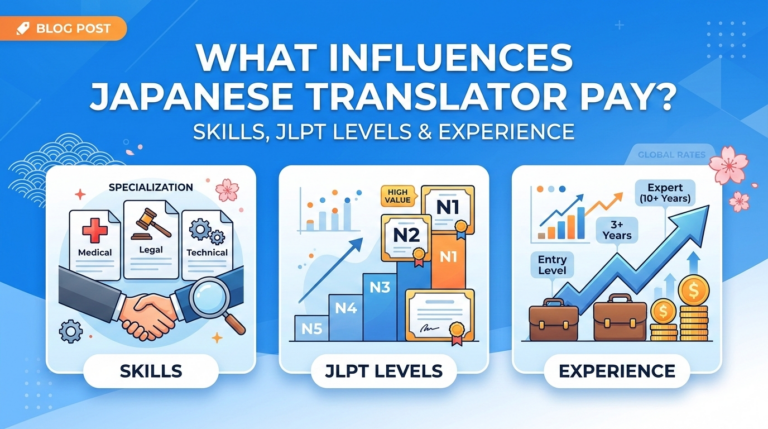
Scholarships in Japan That Accept JLPT Scores: The Ultimate Funding Guide
Studying in Japan is one of the most rewarding academic and cultural decisions you can make, but financing your education abroad often feels daunting. Tuition fees, living costs in cities like Tokyo or Osaka, and textbook expenses add up quickly.
Japanese fluency is not just a tool for navigating daily life—it is real financial currency.
While many international students rely solely on English-medium programs or general savings, thousands of scholarships in Japan reward students who demonstrate Japanese language proficiency. Achieving a passing score on the Japanese Language Proficiency Test (JLPT) significantly increases your eligibility for government grants, private foundation stipends, and university tuition reductions.
Whether you are aiming for our primary guide on [Study in Japan with JLPT: Universities, Admission & Requirements] or looking for immediate funding to cover your monthly rent, understanding which scholarships value your JLPT level is the key to studying in Japan tuition-free.
How JLPT Scores Directly Unlock Financial Aid in Japan
When Japanese foundations and government bodies allocate financial aid, they want assurance that international recipients can adapt to Japanese society, succeed academically, and potentially contribute to the local workforce after graduation.
Your JLPT score serves as standardized proof of that capability.
                    JLPT Proficiency & Funding Thresholds

  JLPT Level       Scholarship Opportunities                 Average Monthly Value
  ──────────────────────────────────────────────────────────────────────────────────
     N1          Full Government/Private Fellowships         ¥120,000 – ¥242,000
     N2          Major Private Foundations & University-Wide  ¥50,000 – ¥150,000
                 Tuition Reductions (50%–100%)
     N3          JASSO Honors & Regional Foundations         ¥30,000 – ¥48,000
     N4 / N5     Language School Grants & Entry Waivers      Partial Fee Waiver
While tests like the Examination for Japanese University Admission for International Students (EJU) measure general academic knowledge alongside language skills, the JLPT remains the universal benchmark recognized by non-university private foundations, local government funds, and vocational schools.
To understand how these certification levels fit into your overall academic journey, refer to our detailed breakdown on the [JLPT Level Needed to Study in Japan (N5–N1 Explained)].
Major Scholarships in Japan Accepting JLPT Scores
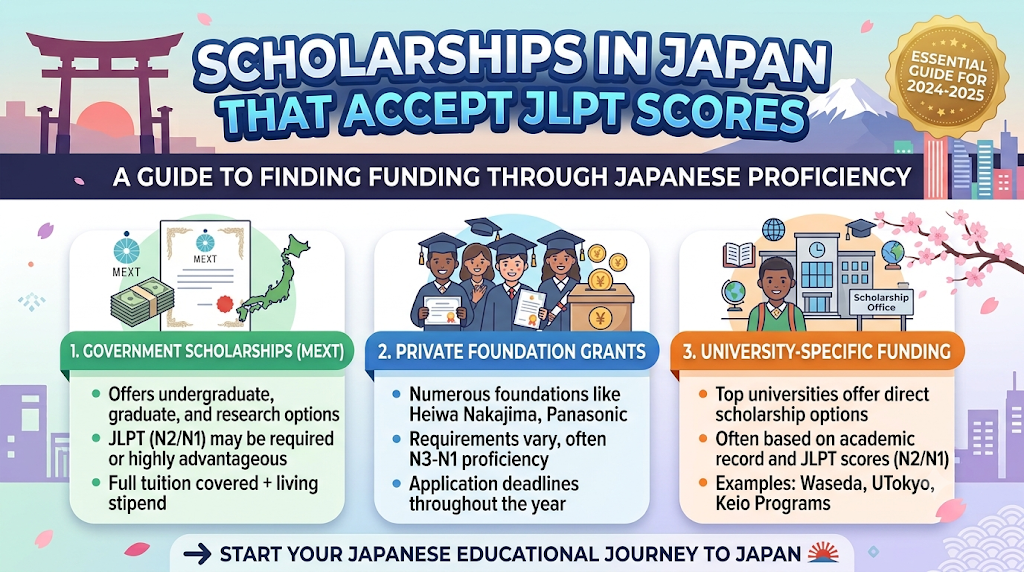
Scholarships in Japan generally fall into four categories: Government (MEXT), Independent Administrative Institutions (JASSO), Local Government/Private Foundations, and University-Specific Grants.
1. MEXT (Monbukagakusho) Scholarships
The Ministry of Education, Culture, Sports, Science and Technology (MEXT) scholarship is the gold standard of financial aid in Japan. It covers 100% of tuition, provides round-trip airfare, and gives a monthly living stipend ranging from ¥117,000 to ¥145,000 depending on your degree level.
- Does MEXT require JLPT? Not strictly for all tracks, but Japanese proficiency provides a massive advantage. For undergraduate humanities, training college, and research student tracks, a strong showing on the official Japanese exam (or holding an N2/N1 certificate) often exempts you from mandatory preparatory language training and secures direct university placement.
- Target JLPT Level: JLPT N2 or N1.
For a comprehensive breakdown of MEXT eligibility rules, application paths, and language waivers, see our dedicated guide on [JLPT for MEXT Scholarship: Eligibility Guide].
2. JASSO Monbukagakusho Honors Scholarship
The Japan Student Services Organization (JASSO) offers the “Monbukagakusho Honors Scholarship for Privately-Financed International Students.” This scholarship provides a monthly stipend of ¥48,000 for university/graduate students or ¥30,000 for language school students.
- Eligibility Criteria: Applicants must demonstrate financial need, maintain high academic marks, and meet language criteria—either a JLPT score of N2 or higher, an EJU Japanese score of 200+, or proven English proficiency for English-track programs.
- Pre-Arrival Reservation Program: You can reserve this scholarship before arriving in Japan if you score high on the EJU or possess strong JLPT credentials during university applications.
You can verify application guidelines directly on the official JASSO Scholarships Information Portal.
3. Rotary Yoneyama Memorial Foundation Scholarship
As one of Japan’s largest private scholarship organizations, the Rotary Yoneyama Foundation supports international students enrolled in Japanese universities or graduate schools.
- Value: ¥100,000/month (Undergraduate), ¥140,000/month (Master’s), or ¥140,000/month (Doctoral).
- JLPT Requirement: N2 or N1 is practically essential. Because Rotary scholars represent their home countries at local Rotary Club monthly meetings in Japan, strong spoken Japanese and deep cultural comprehension are mandatory during the interview phase.
4. Sato Yo International Scholarship Foundation
This private foundation funds students from Asian countries studying at designated Japanese universities.
- Value: Up to ¥180,000/month plus tuition support.
- JLPT Requirement: JLPT N2 or higher at the time of application. Interviews are conducted entirely in Japanese.
5. JEES (Japan Educational Exchanges and Services) Scholarships
JEES sponsors several specialized scholarships in cooperation with private donors (such as the Mitsubishi Corporation International Student Scholarship or the JLPT Scholarship program itself).
- Value: ¥50,000 to ¥150,000/month.
- JLPT Requirement: Many JEES awards specifically target top-scoring candidates from the JLPT. In fact, JEES directly funds scholarships reserved for students who scored exceptionally high on the JLPT N1 or N2 exams held worldwide.
To explore the wider array of official public and private grant programs, you can consult the official government platform Study in Japan Financial Aid Gateway maintained by JASSO.
Level-by-Level Scholarship Breakdown (N5 to N1)
Your current JLPT level dictates which funding doors are open to you right now, and which will open as your language skills grow.
       JLPT Level & Scholarship Access Funnel

       [ N1 ] ──► Full MEXT, Elite Foundations, Research Grants
       [ N2 ] ──► JASSO Honors, Rotary Yoneyama, University Tuition Waivers
       [ N3 ] ──► Regional Foundations, Vocational Grants, Partial Waivers
     [ N4-N5 ] ──► Language School Grants, Visa Entry Waivers
JLPT N5 and N4: Foundation & Entry Level
At N5 and N4, full academic scholarships for universities are rare because university lectures require higher comprehension. However, N4 and N5 are critical for securing your initial entry into Japan.
- What it covers: Language school tuition discounts (ranging from ¥50,000 to ¥100,000 off entrance fees) and entry-level regional study grants.
- Strategic Value: Meeting basic language requirements is crucial for visa processing. Read more about these baseline parameters in our guide on [Student Visa Language Requirements for Japan].
JLPT N3: Intermediate Opportunities
N3 is the bridge level. While top national universities usually require N2 or N1, many specialized training colleges (senmon gakko), regional private universities, and smaller foundation grants accept N3 certificates.
- Key Scholarships: Local municipal scholarships (e.g., prefectural international association grants) and partial tuition reduction waivers (20%–30%) offered directly by private universities.
- Real-World Insight: Having N3 shows selection committees that you have moved beyond basic survival Japanese and are actively working toward full fluency.
JLPT N2: The Sweet Spot for Funding
JLPT N2 is the single most valuable milestone for international students seeking financial aid in Japan. It proves you can understand normal speed Japanese used in everyday situations and basic academic contexts.
- Key Scholarships: JASSO Monbukagakusho Honors Scholarship, Rotary Yoneyama, Sato Yo, Heiwa Nakajima Foundation, and 30% to 100% University Tuition Reduction Schemes.
- Academic Impact: Most private universities and many public universities consider N2 the minimum benchmark for enrolling in standard undergraduate degree programs taught in Japanese. Check out our thorough analysis on [JLPT Required for Japanese University Admission].
JLPT N1: Full Ride & Prestigious Fellowships
Holding an N1 certificate removes almost all language barriers to scholarship applications in Japan.
- Key Scholarships: Direct MEXT University Recommendation scholarships, elite corporate grants (Mori Seki, Mitsubishi, Toyota Foundation grants), and high-value research fellowships.
- Competitive Edge: When two international students have identical academic transcripts, the candidate holding a high JLPT N1 score will almost always win the scholarship nomination.
Direct University Tuition Reduction Schemes
Beyond third-party foundations, Japanese universities offer their own internal scholarships and tuition exemption programs linked directly to JLPT scores.
                  University Tuition Reduction Framework

  University Type        JLPT Threshold      Typical Tuition Benefit
  ────────────────────────────────────────────────────────────────────────
  Private Universities      JLPT N2         30% to 50% Tuition Waiver
  Private Universities      JLPT N1         50% to 100% Tuition Waiver
  National Universities     JLPT N2/N1      Full or Half Tuition Exemption
                                            (Based on financial need + N2/N1)
- Ritsumeikan Asia Pacific University (APU): Offers Tuition Reduction Scholarships of 30%, 50%, 65%, 80%, or 100% to international students upon admission. Language test scores (JLPT or English equivalent) play a massive role in determining your percentage bracket.
- Waseda & Keio University: Provide numerous internal donor-funded scholarships ranging from ¥400,000 to ¥1,000,000 per year, prioritizing students with documented N2/N1 proficiency.
- National Universities (e.g., Tokyo, Kyoto, Osaka University): National universities offer a 50% or 100% Tuition Exemption Program for high-achieving international students facing financial hardship. Demonstrating academic excellence alongside JLPT N1 credentials guarantees top priority.
Action Plan: How to Win JLPT-Based Scholarships
Applying for scholarships in Japan is competitive, but structured preparation drastically increases your success rate.
                       Scholarship Application Timeline

  [ 12-18 Months Prior ] ──► Take JLPT Exam (July or Dec Session)
  [  8-12 Months Prior ] ──► Research Deadlines & Prepare Documents
  [  4-6 Months Prior  ] ──► Submit University & Scholarship Applications
  [  1-3 Months Prior  ] ──► Attend Japanese Interview & Await Results
Step 1: Time Your JLPT Exam Wisely
JLPT exams take place only twice a year—in July and December. Results take approximately two months to be officially issued. If your scholarship application deadline is in April, you must pass the December test at the very latest (July is even safer).
Step 2: Write a Compelling “Reason for Study” (志望理由書)
Scholarship boards in Japan do not evaluate test scores in isolation. They look closely at your Shibou Riyuushou (Statement of Purpose).
- Write this document in natural, polite Japanese (Desu/Masu form for undergraduates, Da/Dewa Aru for graduate research depending on guidelines).
- Clearly connect your study plan in Japan to your long-term career goals and how you plan to bridge Japan and your home country.
Step 3: Master the Japanese Scholarship Interview
If a scholarship requires JLPT N2 or N1, expect the interview to be conducted entirely in Japanese.
- Practice Self-Introduction (Jikoshoukai): Keep it concise (1–2 minutes), highlighting your academic background, your passion for your field, and why you selected Japan.
- Anticipate Common Questions: Be prepared to explain why you chose this specific scholarship, how you handle financial budgeting, and what challenges you faced while learning Japanese.
- Maintain Formal Etiquette (Keigo): Using basic business Japanese etiquette and polite language during the interview leaves a lasting impression on Japanese committee members.
Frequently Asked Questions
Can I get a scholarship in Japan if I only have JLPT N5 or N4?
Yes, but choices are primarily limited to language school tuition discounts, basic entry grants, and specific regional exchange programs. To access monthly living stipends (like JASSO) or university tuition waivers, aim to pass JLPT N3 or N2 as quickly as possible.
Does the JLPT certificate expire when applying for scholarships?
Unlike TOEFL or IELTS, official JLPT certificates never expire. However, individual scholarship boards or universities may request a test score taken within the last 2 years to ensure your current language ability matches your certificate.
Are English-taught degree programs eligible for JLPT-based scholarships?
Absolutely! If you are enrolled in an English-medium degree program (e.g., Global 30 or English track courses), holding a JLPT N3, N2, or N1 certificate makes your application stand out significantly for internal university grants and private foundation stipends like Rotary or JASSO.
Final Thoughts
Your JLPT score is far more than a certificate on your wall—it is one of the most effective tools to reduce the cost of studying in Japan. By moving from N5 up through N2 and N1, you steadily unlock access to government grants, private foundation stipends, and full university tuition waivers.
Plan your exam schedule early, align your target JLPT score with your preferred scholarship program, and take full advantage of the financial aid available to dedicated Japanese language learners!