JLPT N1 & N2 Preparation Guide for Advanced Learners
Crossing the boundary from intermediate to advanced Japanese is where most language learners hit a wall. While passing N3 proves you can navigate daily life in Japan, tackling N2 and N1 requires a fundamental shift in how you process the language. You are no longer just memorizing vocabulary and grammar rules; you are training your brain to comprehend abstract logic, subtle nuance, speed-read formal prose, and grasp implicit meaning under strict time constraints.
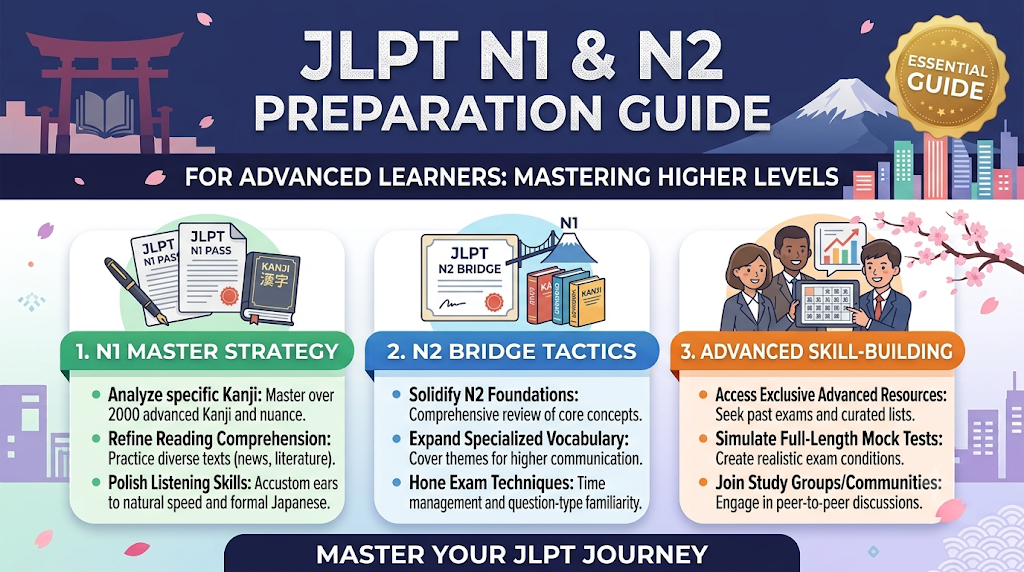
Whether your goal is securing a high-paying job in Tokyo, translating technical documents, or achieving true mastery, this ultimate JLPT N1 N2 preparation guide provides the exact roadmap, practical techniques, and strategic mindset required to pass both exams.
Decoding N2 vs. N1: The Leap from Competence to Mastery
To build an effective prep strategy, you must first understand the structural and cognitive gap between these two advanced tiers. Many test-takers assume N1 is simply “N2 with more kanji.” That assumption is the primary reason the N1 pass rate hovers around 30% worldwide.
N3 (Intermediate)  --->  N2 (Upper-Intermediate)  --->  N1 (Advanced/Native-level Logic)
Daily Conversation       Business & News Media           Abstract, Specialized & Literary
The Metric Shift: Quantifying the Difference
| Dimension | JLPT N2 | JLPT N1 | What Changes? |
| Kanji Count | ~1,000–1,200 | ~2,000–2,136+ | Complete mastery of Joyo Kanji |
| Vocabulary Size | ~6,000 words | ~10,000–15,000+ words | Shift from everyday terms to formal, archaic & domain-specific terms |
| Reading Material | Newspaper articles, clear essays, workplace notices | Philosophical commentary, editorial critiques, complex legal/business prose | |
| Listening Speed | Near-native speed with clear enunciation | Native conversational speed with background noise, interruptions, and implied meaning | |
| Pass Rate (Global Avg) | ~40% – 45% | ~30% – 34% | N1 requires deep contextual deduction, not just rote recall |
Understanding these differences is crucial when planning your timeline and salary expectations in Japan. For a detailed breakdown of how these levels impact job placement and earnings, read our guide on JLPT N2 vs N1: Difficulty, Salary & Career Comparison.
Tactical Prep Framework for JLPT N2
Passing N2 proves you can handle real-world Japanese in professional and academic settings. The challenge here is stamina and processing speed.
1. Vocabulary & Kanji: Move Beyond Flashcard Isolation
At the N2 level, learning single kanji meanings is insufficient. You must master compound words (熟語 – Jukugo), transitive/intransitive pairs, and nuance-heavy verbs.
- Ditch isolated word lists: Study vocabulary within context sentences. Use spaced repetition systems (Anki) configured for context-first recall (Japanese sentence on front, target word definition on back).
- Focus on functional prefixes and suffixes: N2 heavily tests compounds using prefixes like 未 (mi – not yet), 再 (sai – re-), or 無 (mu – without) and suffixes like 感 (kan – feeling) or 性 (sei – nature/property).
- Textbook Benchmark: Complete Shin Kanzen Master Vocabulary N2 or 日本語総まとめ (Nihongo Sou Matome) N2.
2. Grammar: Dissecting Subtle Differences
N2 grammar introduces structures that express fine distinctions in emotion, condition, and cause. Instead of memorizing raw definitions, map grammar points into usage buckets:
- Conditions & Timing: ~に際して (On the occasion of) vs. ~に当たって (In light of / Prior to)
- Unavoidable Actions: ~ざるを得ない (Cannot help but / Forced to) vs. ~ないではいられない (Can’t help but feel)
- Proportions & Scales: ~にともなって (Accompanying / As X changes, Y changes)
Pro Tip: When studying N2 grammar, never translate directly to English. Write example sentences that reflect real workplace scenarios (e.g., announcing a business launch or issuing a policy change).
3. Reading Comprehension (読解 – Dokkai): The Time Trap
The N2 reading section trips up learners not because the text is impossible, but because they run out of time.
- Read the questions FIRST: Before touching the passage, read the question stems (not the choices) to identify what information you are searching for.
- Identify logical connectors: Train your eyes to spot turnaround words like しかし (however), したがって (therefore), むしろ (rather), and とはいえ (be that as it may). The author’s true point almost always follows these transitions.
- Daily Practice: Read short opinion pieces on NHK News Web or editorial columns in Japanese daily newspapers.
If you are balancing full-time technical work while preparing for N2, tailored scheduling is essential. Check out our specialized guide: JLPT N2 Study Plan for Engineers & IT Professionals.
The Ultimate JLPT N1 Mastery Roadmap
N1 is a different beast entirely. Where N2 tests whether you understand what is written, N1 tests whether you understand why the author wrote it, what is implied between the lines, and how subtle tone shifts alter meaning.
N1 Study Pyramid:
      ▲
     / \     [Layer 4: Speed & Exam Tactics] -> Mock tests under strict time
    /   \    [Layer 3: Abstract Reading] -> Philosophy, editorials, essays
   /     \   [Layer 2: Advanced Collocations] -> Formal idioms, 4-kanji compounds
  /_______\  [Layer 1: Native Immersion] -> Podcasts, business reports, news
Why Standard Textbook Studying Fails at N1
If you rely solely on prep books for N1, you will likely fail the reading and listening sections. The test designers explicitly pull passages from published novels, academic journals, corporate white papers, and philosophical essays.
To understand why so many advanced students plateau at this stage, read our in-depth analysis: Why JLPT N1 Is Hard (And How to Actually Pass It).
Core Pillars of N1 Preparation
Pillar A: High-Density Reading & Speed Optimization
You have approximately 110 minutes to complete the entire Language Knowledge (Kanji, Vocab, Grammar) and Reading sections in N1. To survive:
- Language Knowledge Speedrun: You must complete the Kanji, Vocabulary, and Grammar questions in under 35-40 minutes total, leaving at least 70 minutes for the Reading section.
- Tackle Abstract Topics: Practice reading materials on abstract philosophy, environmental psychology, modern sociological trends, and corporate ethics.
- Learn to Filter Decorative Language: N1 passages use verbose, formal phrasing (e.g., ~と言っても過言ではない, ~を余儀なくされる). Strip away the stylistic flourishes to isolate the main subject, predicate, and author stance.
Pillar B: Listening Comprehension (聴解 – Choukai)
N1 listening consists of rapid, unscripted-style dialogues, formal presentations, and complex multi-speaker discussions.
- Quick Response (即時応答): These short back-and-forth prompts require instant recognition of formal honorifics (Keigo), humble speech (Kenjougo), and casual contractions.
- Integrated Information (総合理解): You will listen to two people discussing multiple options with conflicting constraints and choose the best outcome. Practice note-taking with structured matrices (Pros/Cons/Constraints).
- Native Exposure: Listen to podcasts like Rebuild.fm (technology/culture), NHK Radio News, or business-focused YouTube channels daily without English subtitles.
For professionals trying to balance intense work schedules with high-level preparation, structure is everything. Implement our actionable timetable found in the JLPT N1 Study Plan for Working Professionals.
Advanced Grammar & Nuance Matrix
One common pitfall in N1/N2 preparation is confusing similar grammar structures. Below is a practical reference matrix comparing high-frequency advanced grammar points often tested in Language Knowledge:
| Grammar Point | Meaning / Function | Contextual Nuance | Example Usage |
| ~をもって (wo motte) | By means of / As of (time) | Highly formal announcements or official declarations | 本日の営業は午後7時をもって終了いたします。 |
| ~たるもの (taru mono) | Given that one is / As a (role) | Speaks to duty, responsibility, or high moral standards of a role | プロの職人たるもの、細部への妥協は許されない。 |
| ~を踏まえて (wo fumaete) | Taking into account / Based on | Decision making based on data, feedback, or past experience | 昨年の反省点を踏まえて、今年の計画を立案する。 |
| ~極まりない (kiwamarinai) | Extremely / Bounds-less | Expresses extreme negative emotion, indignation, or absurdity | 彼の不誠実な態度は、失礼極まりない。 |
| ~を余儀なくされる (wo yoginakusareru) | To be forced / Compelled to | External circumstances force a course of action against one’s will | 悪天候のため、イベントの延期を余儀なくされた。 |
Connecting N1/N2 Prep to Real-World Professional Value
Passing N1 or N2 should not be an end in itself; it is an key that unlocks doors in Japan’s job market. However, passing the exam doesn’t automatically mean you can lead a client meeting or write formal executive emails.
[JLPT Exam Mastery] + [Keigo & Email Etiquette] + [Industry Terminology] = [True Career Fluency]
To bridge the gap between exam performance and actual professional capability:
- Master Formal Business Japanese: Learn practical email structures, negotiation phrasing, and proper honorific transformations.
- Read Corporate Documents: Practice reading actual Japanese financial reports, product specifications, and company press releases.
If you are aiming for management, consulting, or high-level client-facing roles, explore our companion guide on Business Japanese for JLPT N1 Candidates.
The 12-Week Countdown: Execution Plan
As exam day approaches, transition from passive learning to active test execution.
Weeks 12-9: Foundation & Weak Spot Identification
  └─ Complete topic-specific workbooks (Shin Kanzen Master)
  └─ Build target Anki decks for unknown kanji/vocab

Weeks 8-5: Speed Building & Section Drills
  └─ Timed reading practice (1.5 mins per short passage)
  └─ Intensive listening drills (Immediate Response questions)

Weeks 4-1: Mock Exam Marathon & Review
  └─ 3 full-length timed mock tests under strict exam conditions
  └─ Deep-dive analysis of every incorrect answer
1. The Mock Exam Audit
Take at least 3 full-length mock exams using official past tests published by the Official JLPT Website. Do not just score yourself and move on—spend double the exam time reviewing every error:
- Did I miss this because of unknown vocabulary?
- Did I misunderstand the grammar structure?
- Did I run out of time and rush?
2. Time Management Strategy for Exam Day
Language Knowledge & Reading (110 mins for N1 / 105 mins for N2):
- 00:00 – 00:20: Kanji & Vocabulary (1 minute per question max)
- 00:20 – 00:40: Grammar Questions (including cloze test)
- 00:40 – 01:25: Short & Medium Reading Passages
- 01:25 – 01:45: Long Reading & Information Retrieval (Match tables/notices)
- 01:45 – 01:50: Final review and answer sheet double-check
Essential Resources Checklist
To ensure your preparation is grounded in high-quality materials, assemble a study stack combining official test resources and authentic media:
- Core Textbooks:
- Shin Kanzen Master Series (新完全マスター) – Unmatched depth for grammar and reading logic.
- TRY! Japanese Language Proficiency Test Series – Excellent for understanding grammar in contextual reading passages.
- Nihongo Sou Matome (日本語総まとめ) – Great for structured daily vocabulary review.
- Official Practice Materials:
- Official Practice Workbooks published by the Japan Foundation and JEES.
- Authentic Media for Daily Immersion:
- News: Asahi Shimbun Editorials (天声人語), NHK News, Nikkei Business.
- Audio: NHK Radio News, Rebuild.fm, Japanese audiobooks (Audible Japan).
- Dictionaries: Mazii, Shirabe Jisho, and Monolingual Japanese Dictionaries like Goo Jisho (goo辞書) or Kotobank (コトバンク).