If you have ever had to step in for a sick coworker, present a proposal on behalf of your team, or replace an obsolete method with a modern alternative, you already understand the core concept of substitution. In Japanese, when you want to express “on behalf of someone” or “in place of/replacing a person or role,” the essential grammar pattern you need is ~に代わって (ni kawatte) and its formal counterpart ~に代わり (ni kawari).
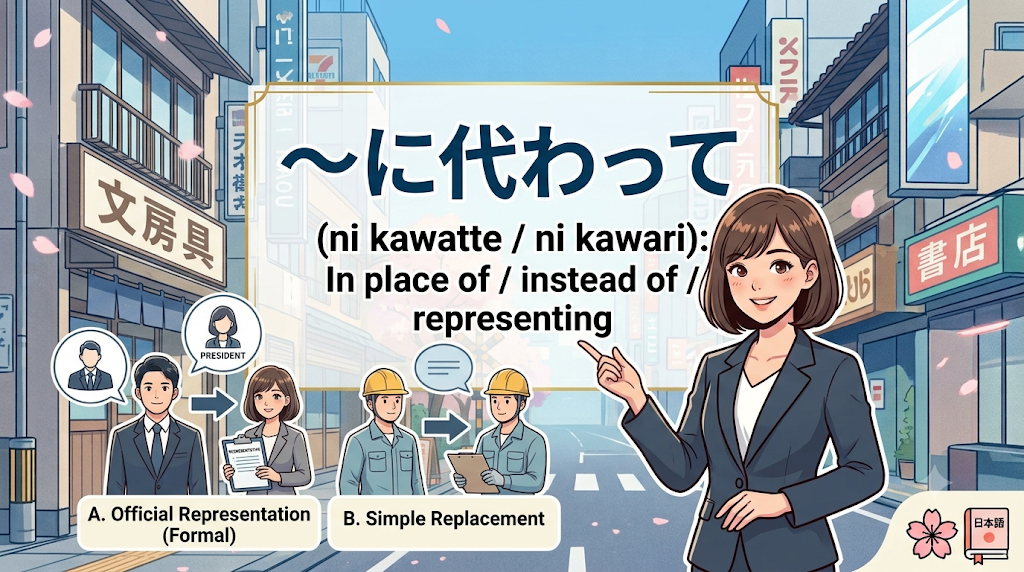
While this pattern is formally introduced at the JLPT N3 level, its practical application spans everyday conversations, business emails, broadcast journalism, and formal ceremonies. Mastering this pattern not only improves your Japanese reading comprehension and test scores, but it also gives you the exact tools needed to handle formal workplace interactions naturally.
In this deep dive, we will break down the structure, nuanced differences, real-world applications, common pitfalls, and JLPT test strategies for using ~に代わって / ~に代わり.
What Does ~に代わって / に代わり Mean?
At its core, ~に代わって / ~に代わり expresses that a person, group, or thing takes the position, role, or duty of another entity to perform an action.
- Primary English Translations:
- On behalf of…
- In place of…
- Representing…
- Replacing / Taking the place of…
Understanding the Kanji: 代
The kanji 代 (dai / ka-waru) carries core meanings such as generation, age, replace, substitute, or fee.
In this specific structure, it comes from the intransitive verb 代わる (kawaru), which means “to take the place of” or “to relieve someone.”
Basic Structure and Connection Rules
Connecting ~に代わって to other words in Japanese is straightforward because it almost exclusively attaches directly to Nouns.
1. Attachment Rule
| Formula | Example | Meaning |
| Noun + に代わって | 父に代わって | On behalf of my father |
| Noun + に代わり | 社長に代わり | On behalf of the company president |
| Noun + に代わる + Noun | 人間に代わる AI | AI replacing humans |
2. Difference Between ~に代わって and ~に代わり
You will frequently encounter both forms in written material, textbooks, and spoken conversation. While their fundamental meaning is identical, their registers and stylistic usages differ:
- ~に代わって (ni kawatte):Uses the standard て-form (te-form). It is versatile, widely used in both everyday spoken Japanese and standard written forms.
- ~に代わり (ni kawari):Uses the 連用形 (ren’yōkei – stem form) as a clause connector. This structure is more formal, literary, and typical of business correspondence, speeches, news broadcasts, and written reports.
Detailed Usage Scenarios with Example Sentences
Let’s explore the primary contexts where you will use or encounter this grammar pattern.
Scenario A: Representing Someone / Doing Something on Behalf of a Person
This is the most common real-world application. When someone is absent, busy, or incapacitated, another person steps up to fulfill their duty or message.
1. 病気の部長に代わって、私が本日の会議を進行いたします。
Romaji: Byōki no buchō ni kawatte, watashi ga honjitsu no kaigi o shinkō itashimasu.
English: On behalf of the department manager who is ill, I will be conducting today’s meeting.
2. 出張中の課長に代わり、メールでお返事申し上げます。
Romaji: Shucchō-chū no kachō ni kawari, mēru de o-henji mōshi-agemasu.
English: In place of the section manager who is away on a business trip, I am replying to your email.
3. 本日は、旅行中の母に代わって夕飯を作りました。
Romaji: Honjitsu wa, ryokō-chū no haha ni kawatte yūhan o tsukurimashita.
English: Today, I cooked dinner on behalf of my mother, who is away on a trip.
Scenario B: Modern Replacement of Roles, Systems, or Technology
Beyond personal representation, this pattern describes one system, tool, or entity taking over the domain or responsibilities of another.
4. 最近では、人間に代わってロボットが工場で作業することが増えた。
Romaji: Saikin de wa, ningen ni kawatte robotto ga kōjō de sakyō suru koto ga fueta.
English: Recently, instances of robots working in factories in place of human workers have increased.
5. 現金に代わって、キャッシュレス決済が急速に普及しています。
Romaji: Genkin ni kawatte, kyasshuresu kessai ga kyūsoku ni fukkyū shite imasu.
English: Cashless payment systems are rapidly spreading, replacing physical cash.
Scenario C: Modifying a Noun (~に代わる + Noun)
When you want to describe a noun using “a substitute for…” or “an alternative to…”, turn the verb into its dictionary form ~に代わる (ni kawaru).
6. 石油に代わる新しいエネルギー源を開発する必要がある。
Romaji: Sekiyu ni kawaru atarashii enerugī-gen o kaihatsu suru hitsuyō ga aru.
English: There is a need to develop new energy sources to replace petroleum.
7. 彼は私にとって、父に代わる存在でした。
Romaji: Kare wa watashi ni totte, chichi ni kawaru sonzai deshita.
English: To me, he was a figure who took the place of a father.
Business Japanese: Real-World Nuances & Modesty
In Japanese workplace etiquette (ビジネスマナー), knowing how to state that you are acting on someone else’s behalf is a daily necessity.
When sending business emails or answering phone calls for a colleague or supervisor, combining ~に代わり with humble language (謙譲語 – kenjōgo) forms standard professional courtesy.
Practical Business Email Template
Here is how you might frame an email response when handling a project on behalf of a manager:
Plaintext
件名:【お知らせ】本日の打合せについて

〇〇株式会社
営業部 佐藤様

いつもお世話になっております。
▲▲株式会社の田中です。

本日予定しております打合せにつきまして、
急用により辞退致しました担当の山田に代わり、
私、田中がご対応させていただきたく存じます。

ご不便をおかけして誠に恐縮ですが、
何卒よろしくお願い申し上げます。
Key takeaway: Notice how 山田に代わり (Yamada ni kawari) maintains a polite tone before transitioning into humble verbs like ご対応させていただきたく存じます.
If you are systematically studying business Japanese and preparing for official proficiency tests, you can consult the official exam framework details at the JLPT Official Website to see how business and daily language requirements are tested across levels.
Grammar Breakdown: How to Avoid Confusing Similar Patterns
A common challenge for Japanese learners is confusing ~に代わって with other grammar points that deal with substitutes, trades, or replacements. Let’s clarify these distinctions.
1. ~に代わって vs. ~のかわりに (no kawari ni)
While both mean “instead of” or “in place of,” their underlying nuances differ in subtle but critical ways:
| Feature | ~に代わって (ni kawatte) | ~のかわりに (no kawari ni) |
| Primary Focus | Replacing a specific person, role, or obligation. | Trade-offs, balancing actions, or alternative choices. |
| Accepts Verbs? | No. Takes Nouns only. | Yes. Can follow verbs (e.g., 勉強する代わりに). |
| Compensation Nuance | Pure substitution (doing a job for someone). | “In exchange for…” (I’ll help you, in exchange for lunch). |
Example Comparison:
- 山田さんに代わって、報告書を出した。I submitted the report on behalf of Mr. Yamada. (Pure substitution/role replacement)
- 英語を教える代わりに、日本語を教えてもらった。In exchange for teaching English, I had them teach me Japanese. (Trade-off / Mutual exchange)
2. ~に代わって vs. ~に代えて (ni kaete)
Another easily confused pair is ~に代わって and ~に代えて.
- ~に代わって (Intransitive origin – 代わる): Focuses on the entity taking over the role.
- ~に代えて (Transitive origin – 代える): Means “as a substitute for” or “in lieu of,” often used in fixed formal speech markers or greetings to convey a message when the full standard action isn’t possible.
Standard Expression with ~に代えて:
- 挨拶に代えて、お祝いの言葉とさせていただきます。In lieu of a formal speech, please allow me to offer my congratulations.
JLPT Test Strategies: Common Pitfalls & Mistakes
When taking the JLPT N3 or N2, sentence assembly (並べ替え) and reading comprehension questions often test whether you truly grasp who is performing the action.
Common Pitfall 1: Particle Confusion
- Incorrect: 先生~~を~~代わって、授業をします。
- Correct: 先生に代わって、授業をします。
- Why: The target being replaced takes the particle に, reflecting the intransitive verb 代わる.
Common Pitfall 2: Confusing the Subject of the Action
In reading comprehension passages, pay close attention to who is performing the main verb:
Sentence: 社長に代わって、副社長がスピーチを行った。
Question: Who made the speech?
Answer: The Vice President (副社長), NOT the President (社長). The noun directly preceding に代わって is the entity being replaced!
For comprehensive grammar indexes and practice lists across all levels, resources like Jisho.org provide helpful verb conjugation breakdowns and dictionary definitions for real-time practice.
Interactive Practice Exercises
Test your understanding by filling in the blanks or translating the sentences below.
Section 1: Fill in the Correct Particle / Form
- 欠席の田中さん( )代わって、鈴木さんが発表します。
- 機械に( )仕事をするAIが注目されている。
Section 2: Choose the Correct Grammar Point
- 日曜日に働いた( 代わりに / に代わって )、月曜日に休みを取った。
- 入院中の父( 代わりに / に代わって )、私が店を取り仕切っています。
Answer Key & Explanations
- に (田中さんに代わって = On behalf of Mr. Tanaka)
- 代わる (機械に代わる仕事 = Jobs replacing machines — noun modification form)
- 代わりに (Taking a day off in exchange for working Sunday represents a trade-off, making 代わりに appropriate here)
- に代わって (Taking over a father’s role/duty due to hospitalization represents pure role substitution)
Summary Checklist
To wrap up, keep these core principles in mind when using or analyzing ~に代わって / ~に代わり:
- Meaning: “On behalf of,” “in place of,” or “replacing.”
- Connection: Attaches directly to Nouns.
- Formality: Use ~に代わって for general context; use ~に代わり for formal speech and business writing.
- Noun Modification: Use ~に代わる + Noun to mean “an alternative/substitute for.”
- Distinction: Use ~に代わって for roles/people; use ~のかわりに for general trade-offs, alternative actions, or verb phrases.