.
JLPT for Immigration to Japan: Visa, PR & Work Permit Guide
Moving to Japan to build a career, establish a business, or permanently settle down is an exciting endeavor. However, navigating Japan’s Immigration Services Agency (Shutsunyukoku Zairu Kanricho) requires understanding how your language qualifications align with legal visa requirements.
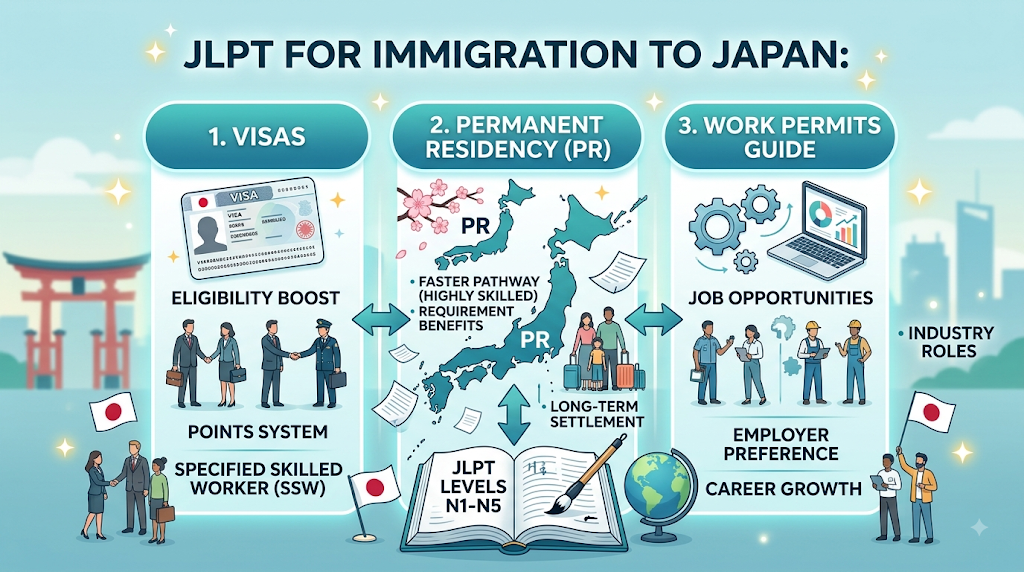
At the center of Japanese foreign policy and career assessment lies the Japanese-Language Proficiency Test (JLPT). Managed by Japan Educational Exchanges and Services (JEES) and the Japan Foundation, the JLPT assesses language ability across five distinct levels: N5 (basic) to N1 (advanced).
While many prospective residents ask whether a JLPT certificate is legally required to set foot in Tokyo or Osaka, the real answer involves strategic advantages. Language proficiency can mean the difference between a standard multi-year visa process and a fast-track Permanent Residency in as little as 12 months.
This comprehensive guide breaks down how the JLPT interacts with Japan’s visa landscape, work permits, points systems, and long-term residency options.
1. Do You Really Need the JLPT to Work or Live in Japan?
A common myth among foreign professionals is that you cannot obtain a Japanese visa without passing an official language exam. In reality, Japanese immigration law treats language requirements differently depending on your target visa category.
                         JAPANESE VISA PATHWAYS & JLPT CORRELATION
                                             │
      ┌──────────────────────────────────────┼──────────────────────────────────────┐
      │                                      │                                      │
▼ Highly Skilled Professional         ▼ Specified Skilled Worker              ▼ Standard Work Visas
   (Points System)                      (SSW i / i)                              (Engineering, Humanities)
   • N2 = +10 Points                    • N4 or JFT-Basic                       • No legal minimum
   • N1 = +15 Points                      is MANDATORY                             (Employer sets threshold)
   • 1–3 Year PR Fast Track                                                       • N2/N1 usually expected
For general work categories—such as the standard Engineer / Specialist in Humanities / International Services visa—the Ministry of Justice does not set a universal legal requirement for a JLPT certificate. If an employer sponsors your Certificate of Eligibility (COE) and confirms you can fulfill your job duties (even entirely in English), immigration will process your visa.
However, for specialized tracks like the Specified Skilled Worker (SSW) program or healthcare fields, passing a recognized language test (JLPT N4 or higher) is a non-negotiable legal prerequisite.
To understand the legal breakdown between mandatory testing and employer expectations, explore our detailed analysis on Japanese Visa Language Requirements: Do You Really Need JLPT?.
2. Breakdown of JLPT Levels for Visa & Work Categories
Each level of the JLPT corresponds to specific real-world abilities and immigration advantages:
+-----------+------------------------------------+-----------------------------------------------------+
| JLPT Level| Language Competency                | Immigration & Professional Application              |
+-----------+------------------------------------+-----------------------------------------------------+
| N5        | Basic everyday phrases & hiragana  | Student Visas (baseline proof of study)             |
| N4        | Basic conversations & vocabulary   | Specified Skilled Worker (SSW i) Minimum           |
| N3        | Everyday situations & bridge level | Technical Intern Training, Local Service Jobs       |
| N2        | Business fluency without assistance| Corporate Hiring Standard, +10 HSP Visa Points      |
| N1        | Full fluency, nuanced expressions  | Medical Licensing, Executive Roles, +15 HSP Points  |
+-----------+------------------------------------+-----------------------------------------------------+
JLPT N5 & N4: The Gateway Levels
- N5 Level: Demonstrates basic comprehension of hiragana, katakana, and elementary kanji. While it offers no work visa points, presenting an N5 certificate helps satisfy proof-of-study requirements when applying for a Student Visa at Japanese language schools.
- N4 Level: Serves as the mandatory legal baseline for the Specified Skilled Worker (SSW i) visa across industries like food service, caregiving, construction, and agriculture.
JLPT N3: The Transition Zone
- N3 Level: Bridges basic and advanced Japanese. While it rarely fulfills executive corporate requirements, N3 is highly valued for customer-facing service jobs, hotel hospitality, and technical roles where internal team communication is supervised.
JLPT N2 & N1: The Corporate & Immigration Gold Standards
- N2 Level: Represents comfortable business fluency. Most domestic Japanese corporations, tech firms, and multinationals set N2 as the minimum benchmark for hiring foreign professionals into regular positions (Seishain).
- N1 Level: Demonstrates near-native reading, writing, and analytical skills. N1 is mandatory for foreign-licensed medical professionals (doctors, dentists, nurses) seeking to sit for Japan’s national medical licensing exams.
For an in-depth look at how employers view these milestones during hiring, read JLPT Required for Japanese Work Visa (Explained Clearly).
3. The Highly Skilled Professional (HSP) Visa & Point System
Japan’s Point-Based Preferential Immigration Treatment System for Highly Skilled Foreign Professionals offers significant advantages for career-oriented expats. Applicants scoring 70 points or more across categories like age, academic degrees, annual income, and professional experience receive a 5-year multi-entry visa, faster PR eligibility, and priority processing.
Your JLPT certificate serves as a major driver for earning these points:
                     JLPT SCORE CONTRIBUTION TO HSP POINTS

     JLPT Level Passed                            Bonus Points Awarded
   ┌────────────────────┐                       ┌──────────────────────┐
   │      JLPT N2       │ ═════════════════════>│      +10 Points      │
   └────────────────────┘                       └──────────────────────┘
   ┌────────────────────┐                       ┌──────────────────────┐
   │      JLPT N1       │ ═════════════════════>│      +15 Points      │
   └────────────────────┘                       └──────────────────────┘
Point Allocation for Language Ability
- JLPT N1 Pass: Earns 15 bonus points toward your total.
- JLPT N2 Pass: Earns 10 bonus points toward your total.
- Degree from a Japanese University: Earns an additional 10 bonus points (which can stack alongside your language points).
Why These Points Matter
In many scoring profiles, an applicant sitting at 60 points (e.g., based on salary and age) can cross the 70-point threshold simply by passing the JLPT N2 or N1 exam. This eliminates years off the standard timeline required to secure permanent residence.
To calculate your exact breakdown and strategically stack your application, read our comprehensive guide on How JLPT Points Work for Japanese Immigration.
4. Fast-Tracking Permanent Residence (PR) via JLPT
Standard Permanent Residence (Eijuken) applications in Japan typically require 10 years of continuous physical residence, with at least 5 of those years spent under an active work visa.
However, leveraging the Point-Based System dramatically compresses this timeline:
                      PERMANENT RESIDENCE TIMELINE COMPARISON

Standard Path:
[ Year 1 ] ──► [ Year 3 ] ──► [ Year 5 ] ──► [ Year 8 ] ──► [ Year 10 ] ──► Apply for PR

70-Point Track (e.g., With JLPT N2):
[ Year 1 ] ──► [ Year 2 ] ──► [ Year 3 ] ──► Apply for PR (Fast-Tracked)

80-Point Track (e.g., With JLPT N1):
[ Year 1 ] ──► Apply for PR (1-Year Ultra Fast-Track)
Fast-Track Rules Explained
- The 3-Year Route (70 Points): If you maintain a score of 70 points or higher for 3 consecutive years, you are eligible to apply for Permanent Residence. Passing the JLPT N2 often secures the missing points needed to reach this bracket.
- The 1-Year Route (80 Points): If your profile hits 80 points or higher, you can apply for Permanent Residence after 1 year of residence in Japan. Holding a JLPT N1 certification provides 15 points, making the 80-point milestone far more achievable.
Beyond points, immigration officers evaluating standard PR applications review your overall integration into Japanese society. Demonstrating advanced language ability via N2 or N1 shows active participation in local communities, stable employment prospects, and minimal burden on public infrastructure.
To review complete documentation checklists and legal filing steps, check out JLPT for Permanent Residence in Japan: Full Guide.
5. JLPT vs. Alternative Language Tests for Visas
While the JLPT is the most famous assessment tool worldwide, it is not the only language exam recognized by the Immigration Services Agency of Japan. Depending on your visa category and career goals, alternative exams may better suit your schedule or skill set.
+------------------+-----------------------------+-----------------------------+-----------------------------+
| Feature          | JLPT                        | JFT-Basic                   | BJT (Business Japanese)     |
+------------------+-----------------------------+-----------------------------+-----------------------------+
| Primary Focus    | General comprehension & grammar| Daily practical conversation| Corporate communication     |
| Test Frequency   | Twice yearly (July & Dec)   | Multiple times per month    | Computer-based (frequent)   |
| Exam Format      | Paper-based multiple choice | Computer-Based Testing (CBT)| Computer-Based Testing (CBT)|
| Best Used For    | HSP Visa Points, Corporate  | Specified Skilled Worker    | HSP Visa Points, Mid-Career |
+------------------+-----------------------------+-----------------------------+-----------------------------+
Key Alternatives to Consider
- JFT-Basic (Japan Foundation Test for Basic Japanese): Designed specifically for the Specified Skilled Worker (SSW i) visa. Unlike the paper-based JLPT—which is administered only twice a year—the JFT-Basic uses Computer-Based Testing (CBT) and offers frequent testing windows throughout the year.
- BJT (Business Japanese Proficiency Test): Focuses on realistic corporate settings. Scoring 480+ points on the BJT awards points equivalent to JLPT N1 under the Highly Skilled Professional points system, while 400+ points aligns with JLPT N2.
If you are weighing test dates against tight visa deadlines, read our side-by-side comparative analysis: JLPT vs JFT: Which Test Is Better for Visa Applications?.
6. Strategic Advice for Your Language & Visa Roadmap
Navigating Japanese language studies while managing a visa transition requires clear planning. Here is a practical roadmap to maximize your time and career outcomes:
Step 1: Align Your Target Level with Your Visa Goal
- If your objective is manual or service industry employment via the Specified Skilled Worker pathway, focus on achieving JLPT N4 or passing the JFT-Basic quickly.
- If your objective is corporate employment, engineering, or fast-track PR, target JLPT N2 as your primary milestone.
Step 2: Mind the JLPT Exam Schedule
The JLPT is held only twice per year (the first Sunday of July and the first Sunday of December). Registration opens months in advance. Missing a registration window can delay your visa submission or point calculation by up to six months. Plan your study calendar around these fixed dates.
Step 3: Combine Language Certification with Professional Qualifications
While JLPT points are valuable, they work best when paired with relevant work experience, advanced degrees, and competitive salaries. Calculate your overall points profile holistically rather than relying solely on language credentials.
External Resources & Official Portals
To verify official immigration frameworks, review points calculation sheets, or register for upcoming language examinations, consult these primary sources:
- Access official immigration guidelines, visa categories, and point calculation forms via the Immigration Services Agency of Japan (ISA).
- Check official test dates, global testing centers, and scoring criteria directly on the Japanese-Language Proficiency Test (JLPT) Official Website.
- Review general visa issuance procedures, diplomatic mission contacts, and entry requirements at the Ministry of Foreign Affairs of Japan (MOFA).