Business Meeting Etiquette in Japan: Do’s & Don’ts
Stepping into a conference room in Tokyo, Osaka, or Nagoya can feel intimidating if you aren’t familiar with Japanese corporate culture (Shakaijin culture). Standard Western meeting conventions—like casual banter, immediate interruptions, or taking any open seat—do not translate directly to a Japanese corporate environment.
In Japan, meetings (Kaigi, 会議) are rarely held to debate aggressive strategy from scratch or settle disputes openly. Instead, they often serve to confirm decisions, build consensus (Nemawashi), align group priorities, and cultivate long-term mutual trust (Rapport).
Whether you are preparing for your first business trip to Japan, negotiating with Japanese suppliers, or managing a cross-border partnership, understanding Japanese business meeting etiquette is essential for success. This detailed guide breaks down every phase of a Japanese business meeting, from preparation to follow-up, along with practical language tips and actionable cultural insights.
1. The Core Philosophy Behind Japanese Meetings
To navigate a Japanese meeting effectively, you must understand three foundational cultural concepts:
- Wa (和 – Harmony): Maintaining a peaceful, conflict-free group dynamic is paramount. Open disagreements, public criticism, or aggressive confrontation destroy Wa and cause participants to lose face.
- Honne and Tatemae (本音と建前): Honne refers to a person’s true, inner feelings, while Tatemae refers to the public face or stance one adopts to keep harmony. In official meetings, you will predominantly hear Tatemae.
- Nemawashi (根回し – Informal Consensus Building): Literally translating to “binding the roots,” Nemawashi is the process of consulting key stakeholders privately before the actual meeting. By the time the formal meeting occurs, the decision is usually 90% finalized; the meeting itself acts as a formal confirmation ceremony.
Understanding these concepts clarifies why Japanese business meetings move at a measured, deliberate pace.
2. Pre-Meeting Phase: Punctuality and Preparation
Preparation sets the tone for your professionalism long before you exchange greetings.
The 10-Minute Rule (10-Fun Mae Agodu)
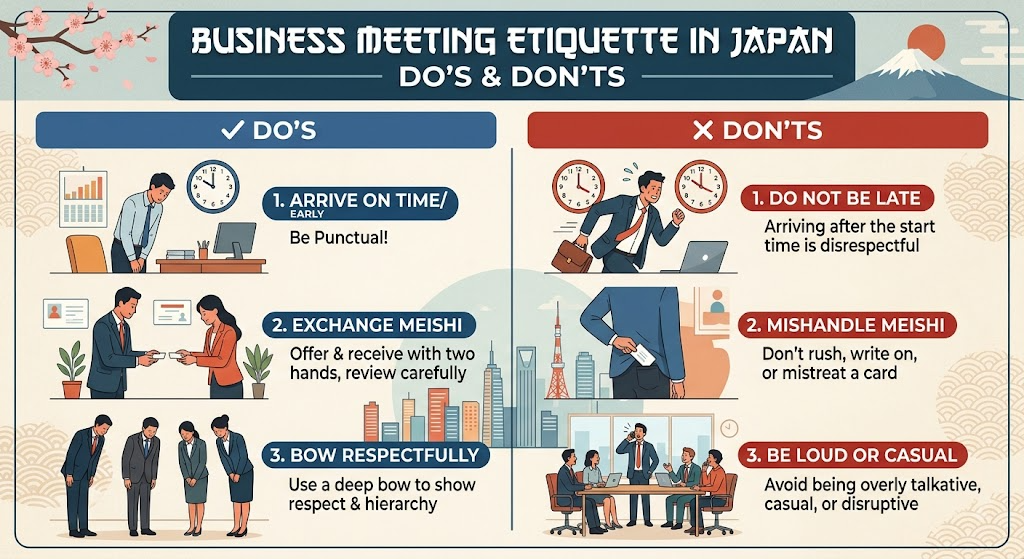
In Western business, arriving exactly on time is usually acceptable. In Japan, being “on time” means arriving 10 to 15 minutes before the scheduled start time.
- Arriving 10 minutes early: Shows respect, reliability, and readiness.
- Arriving exactly on time: Considered cutting it too close.
- Arriving late: A serious breach of protocol. If unforeseen transit delays occur, notify your host via phone or message immediately with your updated estimated arrival time.
Bring the Right Materials
Always bring physical printed copies of your presentation, agenda, and company backgrounders. Print enough copies for every participant plus 2–3 extra sets. Pass documents out using both hands with the text facing the recipient so they can read it immediately without turning the paper around.
3. The Room Dynamics: Kamiza vs. Shimoza (Seating Protocol)
Seating arrangements in Japan follow strict hierarchical rules based on age, rank, and guest status. The positions are divided into Kamiza (上座 – Upper/Honor Seat) and Shimoza (下座 – Lower Seat).
+-------------------------------------------------------+
|                    [ Back of Room ]                   |
|                                                       |
|   [Kamiza - Seat 1]        [Kamiza - Seat 2]          |
|   (Most Senior Guest)      (Next Senior Guest)        |
|                                                       |
|                     TABLE                             |
|                                                       |
|   [Shimoza - Seat 2]       [Shimoza - Seat 1]         |
|   (Next Host Member)       (Most Junior Host)         |
|                                                       |
|                 [ Entrance / Door ]                   |
+-------------------------------------------------------+
Seating Rules to Remember:
- Kamiza (Honor Seat): Located furthest from the entrance door, typically facing the door or positioned near a window or decorative feature. This seat is reserved for the most senior member of the visiting group or client.
- Shimoza (Lower Seat): Located closest to the entrance door. This area is reserved for the hosting team and the most junior personnel.
- Wait to be seated: Never sit down first. Wait outside or near the entrance until your hosts direct you to a specific seat by saying, “Dozo, ochakuseki kudasai” (Please take a seat).
4. The Business Card Exchange (Meishi Koukan)
Exchanging business cards (Meishi) is a solemn ritual that establishes identity and relative rank. Treat every business card you receive as an extension of the person who gave it to you.
                    HOW TO EXCHANGE MEISHI

     Giver                                    Receiver
 +-----------+                            +-----------+
 | Hold with |                            | Hold with |
 | BOTH hands| ========> CARD ========>   | BOTH hands|
 +-----------+                            +-----------+
       |                                        |
 Bow slightly &                           Acknowledge rank &
 state name/company                       place neatly on desk
Essential Rules for Cards:
- Use Both Hands: Present and receive business cards using both hands, holding the card by its top corners without covering company logos or names.
- Facing the Recipient: Turn the card so the text faces the recipient right-side up.
- Placement on the Table: Place received business cards neatly on top of your card case on the table, ordered according to where each person is sitting. This acts as a visual reference map throughout the meeting.
- Never write on a business card: Writing notes on a card in front of the owner is considered highly disrespectful.
For a complete breakdown of card layout, storage, and handling etiquette, read our dedicated guide on Japanese Business Card Etiquette: Meishi Rules Explained.
5. During the Meeting: Communication, Body Language, and Keigo
Navigating the meeting itself requires balancing clear communication with polite Japanese language conventions.
Master Key Business Japanese Phrases
Even if the primary language of the meeting is English, using appropriate honorific language (Keigo) demonstrates effort and cultural awareness.
Here are essential business phrases to know:
| Japanese (Kanji/Kana) | Romaji | Meaning | When to Use |
| はじめまして | Hajimemashite | Nice to meet you | First greeting during business card exchange |
| よろしくお願いします | Yoroshiku onegaishimasu | I look forward to working with you | At the end of introductions |
| お世話になっております | Osewa ni natte orimasu | Thank you for your continued support | Standard opening greeting for existing partners |
| 少々お待ちください | Shoushou omachi kudasai | Please wait a moment | When checking information or documents |
| かしこまりました | Kashikomarimashita | Understood / Certainly | Accepting a request or instruction politely |
| 承知いたしました | Shouchi itashimashita | Understood | Alternative polite acknowledgement |
For a deeper dive into polite language structures, check out our guide on Keigo for Business Emails: Polite Japanese Made Simple to see how these expressions adapt to written correspondence.
Active Listening and Aizuchi (Nodding)
In Japanese conversations, listeners continuously use small verbal responses and head nods called Aizuchi (相槌) to signal that they are paying attention.
Common aizuchi include:
- Hai (はい): Means “I am listening/understanding,” not necessarily “I agree with your proposal.”
- Sou desu ne (そうですね): “I see” or “That is true.”
- Naruhodo (なるほど): “I understand” (Note: Use primarily with peers or subordinates, stick to Hai or Sou desu ku with senior clients).
Do not mistake continuous nodding as an indicator that the deal is sealed—it simply means your counterparty understands your points.
Silence Is Not an Emergency
Western culture often views silence during meetings as awkward or negative. In Japan, long pauses (5–15 seconds) signal deep contemplation, respect, and careful consideration. Avoid rushing to fill silent gaps with extra pitching; give your counterparts space to process the information.
6. Comprehensive Summary: Do’s and Don’ts
To keep these principles clear during high-stakes negotiations, keep this cheat sheet in mind:
The Do’s
- DO bow slightly when greeting and exchanging cards (a 15 to 30-degree bow is standard for business encounters).
- DO keep your business cards clean, crisp, and housed in a dedicated leather card holder.
- DO accept offered drinks (green tea or water), but wait for the host or senior member to drink first before taking a sip.
- DO bring clear, structured agendas and follow up with detailed written minutes after the meeting concludes.
The Don’ts
- DON’T point directly at people with your finger; use an open palm facing upward to indicate a person or team member.
- DON’T put business cards away in your pocket or wallet immediately during the meeting.
- DON’T cross your arms or legs tightly, as this signals defensiveness or disinterest.
- DON’T put direct pressure on senior members to make immediate binding decisions on the spot.
7. Post-Meeting Protocol: Follow-up and Written Courtesy
A successful meeting doesn’t end when you leave the conference room. How you exit and follow up reinforces your professionalism.
Leaving the Room and Escalator Etiquette
When the meeting finishes:
- Pack up your documents cleanly and return your chair to its original position.
- Walk with your hosts to the elevator or main lobby.
- Bow deeply (around 30–45 degrees) as elevator doors close or as your hosts depart. Keep bowing until the elevator doors fully shut.
Sending the Follow-up Email
Send a detailed follow-up email within 24 hours summarizing key takeaways, agreed-upon next steps, and express gratitude for their time. Formatting this email correctly is vital to maintaining corporate relationships.
To structure your follow-up correctly using appropriate formal templates, refer to our complete guide on Japanese Business Email Format (With Real Examples).
Further Resources & Official Learning Pathways
Developing business fluency in Japanese requires a solid understanding of grammar, vocabulary, and cultural context. To build your skills systematically through standardized testing and official guidelines, consult these authoritative resources:
- Review official JLPT test formats and requirements directly through the Japanese-Language Proficiency Test (JLPT) Official Site.
- Explore comprehensive learning materials, grammar lists, and study guides at JLPT Sensei.
- Access official cultural exchange programs, language grants, and educational initiatives via the Japan Foundation.
Understanding Japanese business meeting etiquette takes practice, but approaching every interaction with humility, respect, and attention to detail will help you build strong, lasting professional relationships in Japan.
This article is part of our comprehensive series on professional Japanese communication. For an overview of overarching corporate cultural norms, read our pillar guide on Japanese Business Etiquette: Culture Rules You Must Know.