
If you have been studying Japanese for a while, you have likely encountered sentences where someone isn’t just acting a certain way—they are seeming like something or pretending to be something they are not.
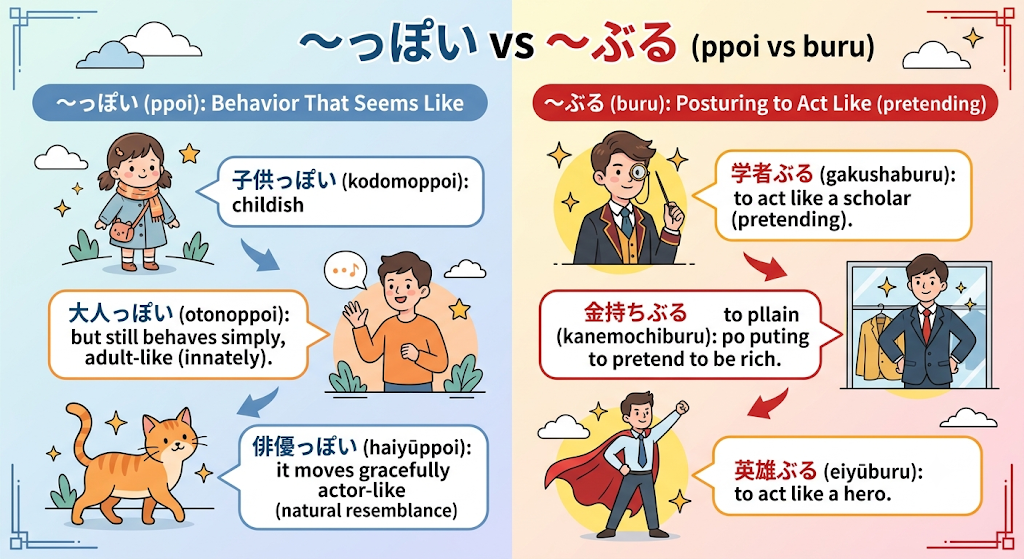
Two grammar points that frequently confuse intermediate Japanese learners (especially around the JLPT N3 and N2 levels) are 〜っぽい (ppoi) and 〜ぶる (buru).
At a quick glance, both can translate to English as “acting like,” “behaving like,” or “-ish.” However, using the wrong one in conversation can instantly change your sentence from an innocent observation to a sharp insult!
In this guide, we will break down the precise nuances, grammatical structures, psychological undertones, and real-life conversational contexts of 〜っぽい and 〜ぶる so you can sound natural and confident in your Japanese.
The Core Concept in 30 Seconds
Before diving into detailed grammar breakdowns, here is the golden rule to remember:
- 〜っぽい (ppoi): Focuses on perceived characteristics, qualities, or tendencies. It describes how something appears or feels to an observer. It can be natural, unintentional, or just a quality an object/person has.
- 〜ぶる (buru): Focuses on deliberate posturing or pretense. The speaker is highlighting that someone is consciously putting on an act to appear smarter, richer, cooler, or more innocent than they actually are.
Quick Example:
- 男っぽい (otokoppoi): “Manly” or “masculine” (describing genuine traits, behavior, or appearance).
- 男ぶる (otokoburu): “Trying to play the tough man” (acting big or tough to show off, usually in an exaggerated or fake way).
1. Deep Dive into 〜っぽい (ppoi)
What Does 〜っぽい Mean?
The suffix 〜っぽい functions very similarly to the English suffix “-ish,” “-like,” or “inclined to.” It attaches directly to nouns, adjective stems, or verb stems to show that something possesses a certain quality or appears to have that trait.
Importantly, 〜っぽい does NOT require intention. A person can be kodomoppoi (childish) without trying to act like a child.
How to Conjugate 〜っぽい
Because 〜っぽい ends in 〜い, it behaves grammatically just like a standard I-adjective (い-形容詞).
| Grammatical Base | Formation | Example | Meaning |
| Noun + っぽい | Noun + っぽい | 子供っぽい (kodomoppoi) | Childish / Kid-like |
| Adjective Stem + っぽい | Drop 〜い / 〜な + っぽい | 白っぽい (shiroppoi) | Whitish |
| Verb (Masu-stem) + っぽい | Verb stem + っぽい | 怒りっぽい (okorippoi) | Easily angered / Hot-tempered |
The Three Main Uses of 〜っぽい
A. Characteristic or Resemblance (Like / -ish)
Used when something or someone has the strong impression or appearance of a noun.
- 彼女は大人なのに、話す内容が子供っぽい。Kanojo wa otona nanoni, hanasu naiyou ga kodomoppoi.Even though she’s an adult, the things she talks about are childish.
- このお茶は少し薬っぽい味がする。Kono ocha wa sukoshi kusurippoi aji ga suru.This tea tastes a bit medicine-ish.
B. Tendency or Inclination (Prone to…)
When attached to the stem of dynamic verbs, it describes a personal trait or habit of doing something easily or frequently.
- 父は年を取ってから、忘れっぽくなった。Chichi wa toshi o totte kara, wasureppoku natta.Ever since my father got older, he’s become forgetful (prone to forgetting).
- 彼は怒りっぽい性格だから、言葉を選んだ方がいいよ。Kare wa okorippoi seikaku dakara, kotoba o eranda hou ga ii yo.He has a short temper (easily angered), so you’d better choose your words carefully.
C. Color and Texture Shades
Used with colors or states to mean “ish” or “slightly.”
- 白っぽいシャツ (shiroppoi shatsu) – A whitish shirt / off-white shirt.
- 水っぽいスープ (mizuppoi suupu) – A watery / runny soup.
2. Deep Dive into 〜ぶる (buru)
What Does 〜ぶる Mean?
The suffix 〜ぶる comes from the concept of “putting on an air” or “acting the part.” It translates to “to pretend to be,” “to pose as,” “to play the role of,” or “to put on airs.”
Key aspect: 〜ぶる involves conscious action and pretense. The speaker usually implies that the person’s behavior is ungenuine, affected, or snobbish. Because of this, 〜ぶる almost always carries a negative or critical nuance.
How to Conjugate 〜ぶる
Grammatically, 〜ぶる turns the word into a Group 1 Godan Verb (五段動詞). It conjugations just like regular verbs ending in 〜る (e.g., tsukuru).
| Grammatical Base | Formation | Example | Meaning |
| Noun + ぶる | Noun + ぶる | 学者ぶる (gakushaburu) | To act like a scholar / play the know-it-all |
| Na-Adjective Stem + ぶる | Stem + ぶる | 上品ぶる (jouhinburu) | To act refined / pretend to be classy |
| I-Adjective Stem + ぶる | Stem + ぶる | 偉ぶる (eraburu) | To act important / put on airs |
Common Conjugation Forms for 〜ぶる
- Present / Habitual: 偉ぶる (eraburu) – acts important
- Te-form (Continuous action): 善人ぶっている (zennin Butte iru) – is acting like a good person
- Past Form: かっこぶった (kakkobutta) – put on a cool act
- Negative Form: ぶらない (buranai) – doesn’t put on airs
Typical Scenarios for 〜ぶる
A. Pretending to possess a status or knowledge
- 彼は少し本を読んだだけで、すぐに学者ぶる。Kare wa sukoshi hon o yonda dake de, sugu ni gakushaburu.Just from reading a few books, he immediately plays the scholar.
- 知ったかぶりをするなよ。Shittakaburi o suru na yo.Don’t act like a know-it-all! (Shittakaburi is a very common fixed noun form).
B. Pretending to have a personality trait or social standing
- みんなの前でいい子ぶるのはやめなよ。Minna no mae de ii ko buru no wa yamenayo.Stop acting like a “good kid” in front of everyone.
- 彼女は貧しい育ちのくせに、いつも上品ぶっている。Kanojo wa mazushii sodachi no kuse ni, itsumo jouhinbutte iru.Despite growing up poor, she is always putting on refined airs.
Side-by-Side Nuance Comparison
To clearly understand how native Japanese speakers perceive these two forms, let’s contrast them directly across similar roots:
| Root Word | With 〜っぽい (Observer’s Impression) | With 〜ぶる (Intentional Posturing) |
| 大人 (Otona – Adult) | 大人っぽい (Otonappoi): Mature-looking, adult-like, sophisticated style. (Neutral/Positive) | 大人ぶる (Otonaburu): A teenager trying to act like a grown-up to impress people. (Critical) |
| 男 (Otoko – Man) | 男っぽい (Otokoppoi): Masculine traits, rugged, straightforward. | 男ぶる (Otokoburu): Trying to act like a tough guy or alpha male. |
| かわいこ (Kawaiko – Cute) | かわいっぽい (Kawaippoi): Has cute characteristics or a cute vibe. | かわいこぶる (Kawaikoburu): Playing coy, acting intentionally cute/innocent (often fake). |
| 偉い (Erai – Great/Important) | Not used in this form | 偉ぶる (Eraburu): Acting high-and-mighty, acting condescendingly. |
Real-World Nuances & Cultural Insights
1. The Social Judgment Factor
In Japanese culture, harmony (和 – wa) and authenticity (本音 – honne) play huge roles in communication.
When you accuse someone of 〜ぶる, you are calling out their tatemae (建前 – public facade) as fake. Calling someone ii-ko-buru (acting like a good child/person) or kawaikoburu (acting artificially cute) is a direct judgment of their insincerity.
Conversely, 〜っぽい is much safer. Saying someone’s outfit is kodomoppoi (childish) might be a critique of their fashion choice, but it doesn’t attack their underlying honesty or personality.
2. Conversational Slang: “Poi” on its Own
In casual spoken Japanese (especially among younger generations), っぽい (ppoi) can stand alone at the end of sentences to mean “It seems like it,” “Looks like it,” or “Probably!”
- A: 今日、田中さん来る? (Kyou, Tanaka-san kuru? – Is Tanaka coming today?)
- B: うーん、来ないっぽい。 (Uun, konai ppoi. – Hmm, seems like he’s not coming.)
You cannot do this with 〜ぶる!
Practice Quiz: Test Your Understanding
Try choosing the correct grammar pattern (〜っぽい or 〜ぶる) for each sentence below. Answers and explanations are right underneath!
- 彼は本当は何も知らないのに、いつも何でも知っている風に(知ったかぶりをする / 知りっぽい)。
- その服、春(っぽい / ぶる)デザインでとても素敵ですね!
- 彼女は人前で急に声を高くして(かわいこぶる / かわいいっぽい)癖がある。
- 彼は最近、とても(忘れっぽい / 忘れぶる)のでメモを取るようにしている。
Answers & Explanations
- 知ったかぶりをする (shittakaburi o suru)Reason: He is pretending to know everything when he doesn’t (intentional pretense).
- 春っぽい (haruppoi)Reason: Describing the seasonal appearance/vibe of the clothes (“spring-like”).
- かわいこぶる (kawaikoburu)Reason: She intentionally changes her voice to act coy or fake-cute in public.
- 忘れっぽい (wasureppoi)Reason: Describing a natural tendency or trait of being forgetful (verb stem + ppoi).
Recommended Learning Resources
To build a strong foundation in Japanese grammar and prepare thoroughly for JLPT exams, explore these helpful study guides:
- Master foundational patterns with the official JLPT N3 Grammar & Vocabulary Guide.
- Learn more about nuances and sentence structures on Tae Kim’s Guide to Learning Japanese.
- Deepen your understanding of native expressions with interactive lessons on NHK World’s Easy Japanese.
Conclusion
Understanding the subtle difference between 〜っぽい and 〜ぶる is a fantastic milestone in your Japanese learning journey.
- Use 〜っぽい when you want to describe how something looks, feels, or tends to be naturally.
- Use 〜ぶる when you notice someone putting on a performance or acting pretentiously.

